The math is straightforward. Iowa's chronic absenteeism rate peaked at 25.6% in 2021-22. The pre-COVID baseline was 12.7% in 2018-19. The current rate is 15.8%. That puts Iowa 75.9% of the way back, three-quarters recovered from the worst attendance crisis in the state's tracking history.
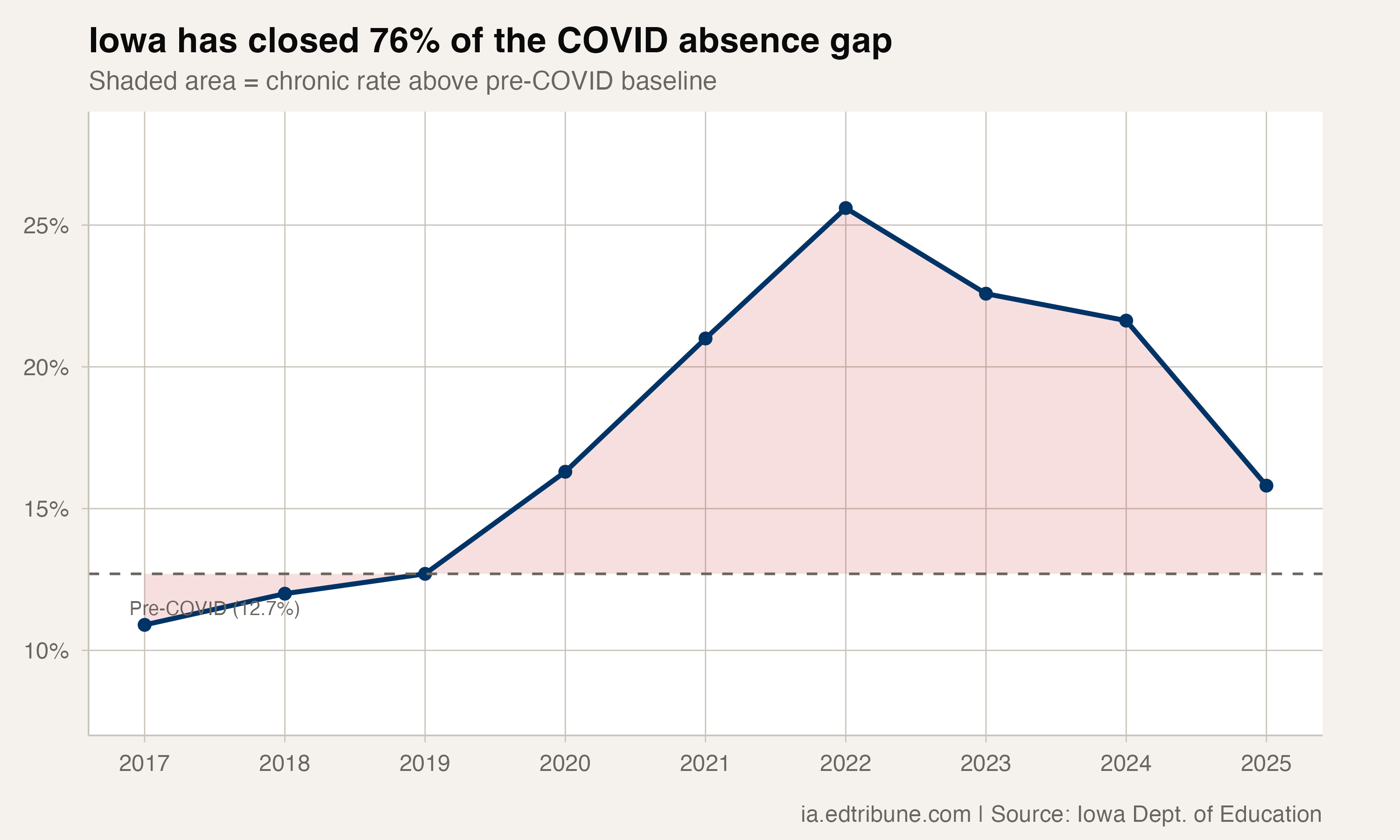
The remaining 3.1 percentage points translate to roughly 15,000 students who are chronically absent today who would not have been under 2019 patterns. At the current pace of improvement (the state has been dropping about 3.3 points per year since the peak), full recovery to pre-COVID levels could arrive as early as 2025-26.
Iowa is among 15 states that formally adopted a goal to cut chronic absenteeism in half within five years. At 15.8%, it has already surpassed that threshold relative to the 2022 peak of 25.6% (half would be 12.8%). But the state set its benchmark against its own pre-COVID rate, meaning the target is approximately 6.4%, a level Iowa has never achieved.
The district picture: two Iowas
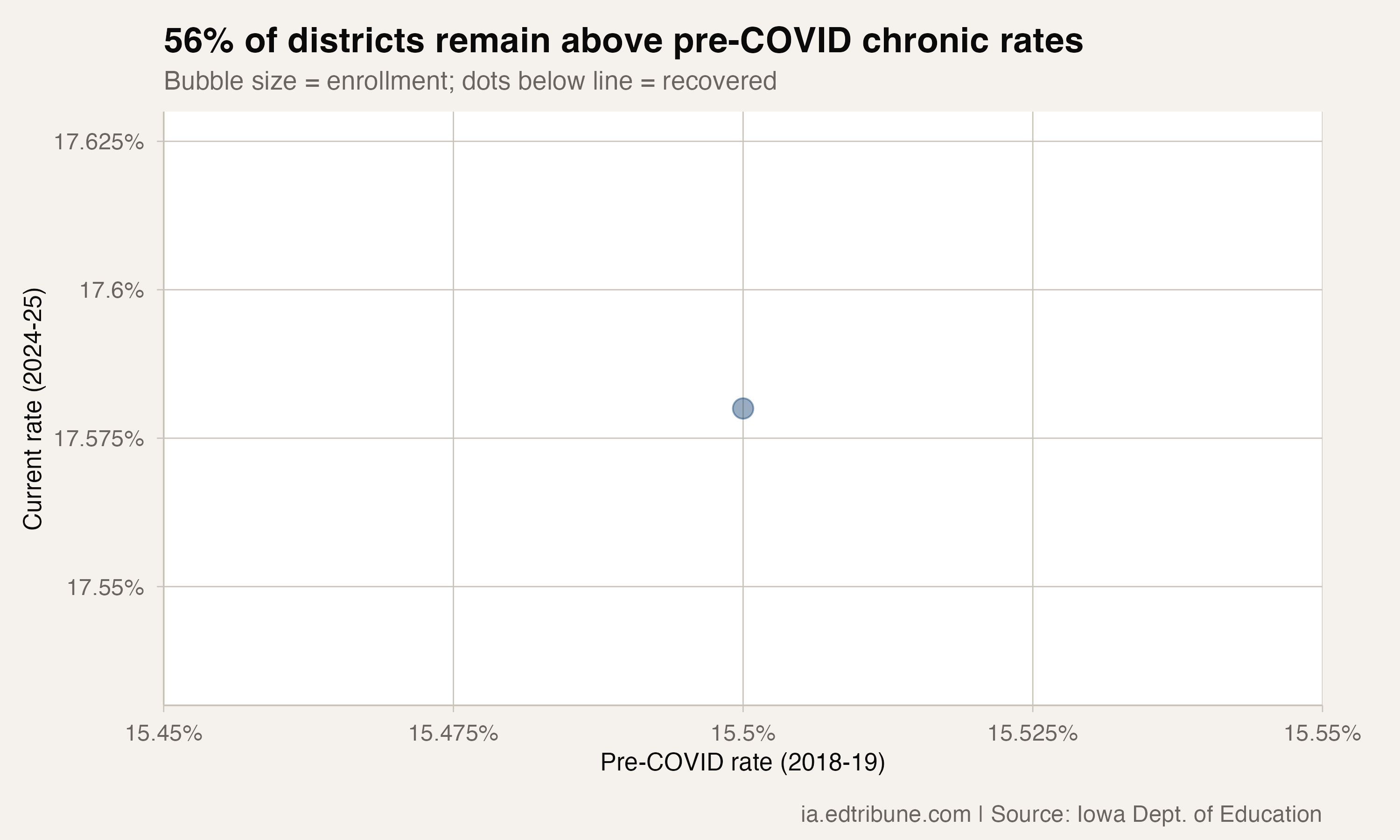
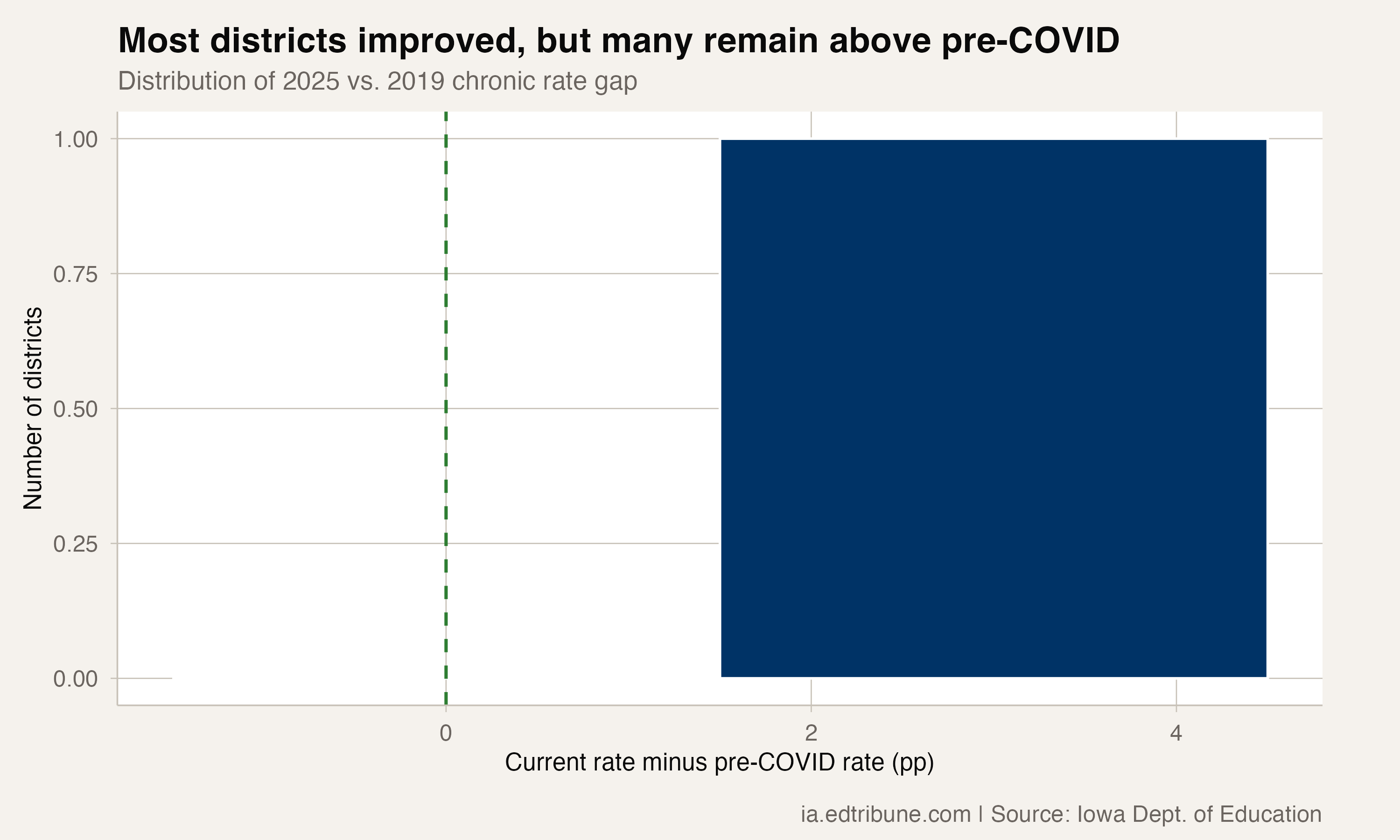
The statewide percentage masks a deeply uneven recovery. Of 325 districts with chronic absence data spanning both 2018-19 and 2024-25, just 142 (43.7%) have fully recovered to their pre-COVID rate or better.
The remaining 183 districts, 56.3% of the total, still have chronic rates above their baselines. Some by a point or two. Others by double digits.
Waterloo↗ET is the starkest example. At 33.5%, its chronic rate sits 9.2 points above the 2018-19 level of 24.3%, meaning the district has recovered roughly half of the way back from its 42.4% peak. At the other end, Iowa City↗ET has not just recovered but surpassed its baseline, dropping from a 28.0% peak to 10.3%, now 4.0 points below its 2019 level.
The denominator problem
Recovery percentages come with a caveat. Iowa's total enrollment declined from 494,333 in 2018-19 to 484,112 in 2024-25, a loss of 10,221 students. Some of the chronically absent students who "disappeared" from the data did not start attending; they left the public school system entirely. Homeschooling, private school enrollment, and families leaving the state all reduce the chronic absent count without improving any student's attendance.
Roughly 4% of the three-year reduction in chronically absent students (from 125,750 in 2022 to 76,535 in 2025) came from enrollment decline rather than attendance improvement. The remaining 96% represents genuine behavioral change: students who were missing school and are now showing up.
Why the last 24% may be the hardest
The students who returned to regular attendance first were likely the ones whose absences were most responsive to intervention: younger students whose parents could adjust schedules, families where the barrier was logistics rather than disengagement, and communities where the COVID-era disruption was temporary.
The students who remain chronically absent after three years of recovery may face more structural barriers: housing instability, work obligations in meatpacking towns, mental health challenges that the pandemic deepened rather than created. Iowa reports no demographic subgroups for chronic absenteeism, so the state cannot track whether its recovery is reaching its most vulnerable students.
Recovery from spikes tends to slow as rates approach their baseline. The last three points are harder than the first ten. Iowa has also never actually achieved the 6.4% rate that its "halve chronic absenteeism" pledge implies. The state may be converging on a rate it has never seen before, which is a different challenge than returning to one it remembers.
Iowa publishes district-level chronic absenteeism data through the Iowa Department of Education. The IAEdTribune is an independent publication and is not affiliated with the Iowa Department of Education.
Have a tip or feedback? Contact us at theedtribune@gmail.com.
Detailed code that reproduces the analysis and figures in this article is available exclusively to EdTribune subscribers.
Discussion
Sign in to join the discussion.
Loading comments...