If you look only at the overall K-12 chronic absenteeism rate, West Des Moines Community School District↗ET appears to have a manageable problem. At 24.3%, it is above the state average of 15.8% — concerning, but less unusual than its computed high school rate.
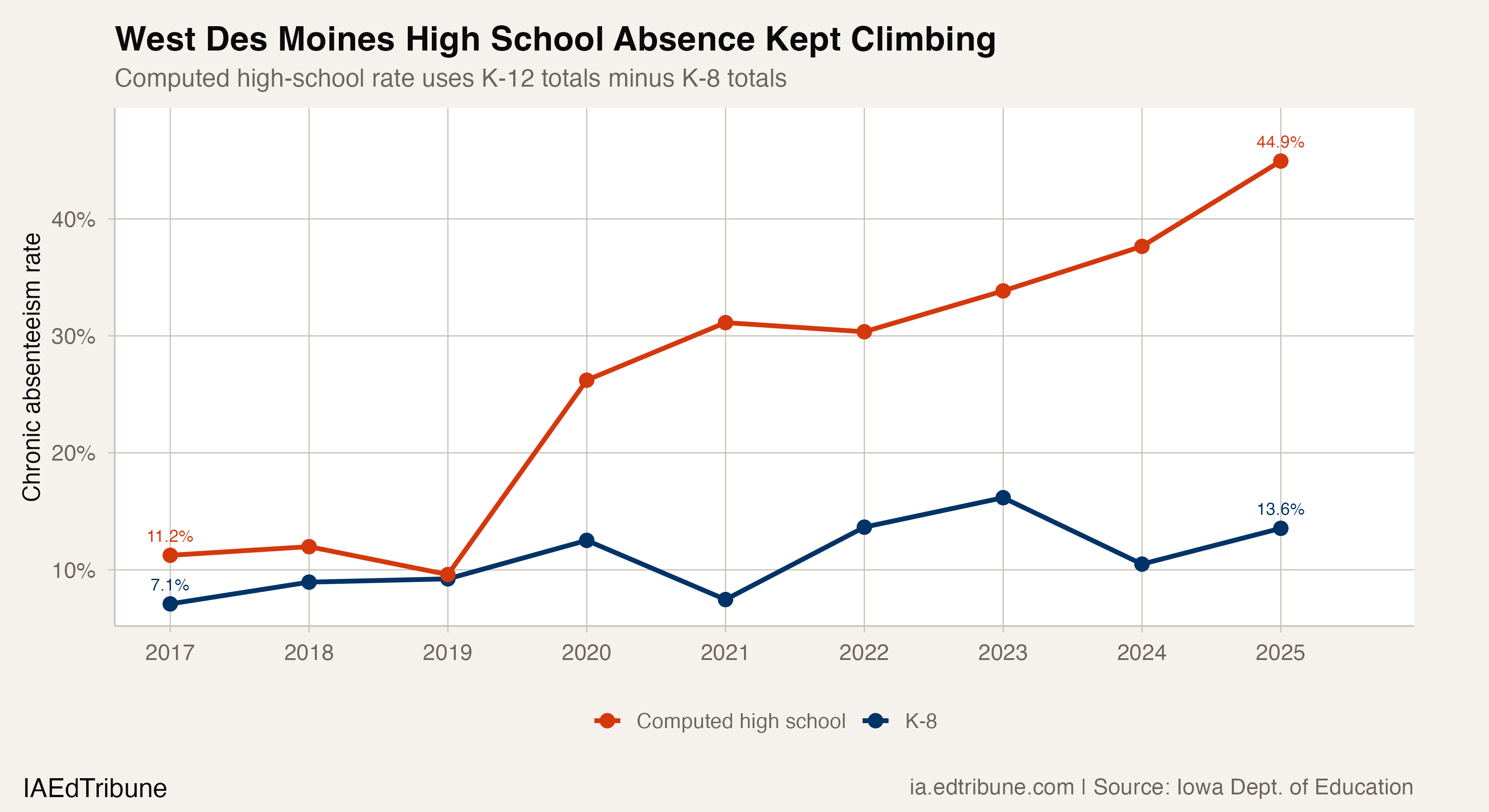
Decompose the number by grade band and the picture is different. West Des Moines' K-8 chronic rate is 13.6%. Its computed high school rate is 44.9%. Nearly half of the district's high school students are chronically absent. The 31.4-point gap between the two grade bands is the largest among 71 Iowa district records with 500 or more computed high school students.
An eight-year climb
The high school rate has not spiked and recovered. It rose from 11.2% in 2016-17 to 44.9% in 2024-25, a 33.7-point increase over eight years. The climb was not perfectly linear, but the recent pattern is stark: 30.4% in 2021-22, 33.8% in 2022-23, 37.7% in 2023-24 and 44.9% in 2024-25. The K-8 rate, by contrast, has followed the broader state pattern, rising during COVID and falling back.
The divergence predates the latest reading. In 2018-19, before COVID, West Des Moines' K-8 and HS rates were within a point of each other (9.2% vs. 9.6%). By 2020-21, the gap was 23.7 points. By 2024-25, it was 31.4. The state file shows the widening but does not identify its cause.
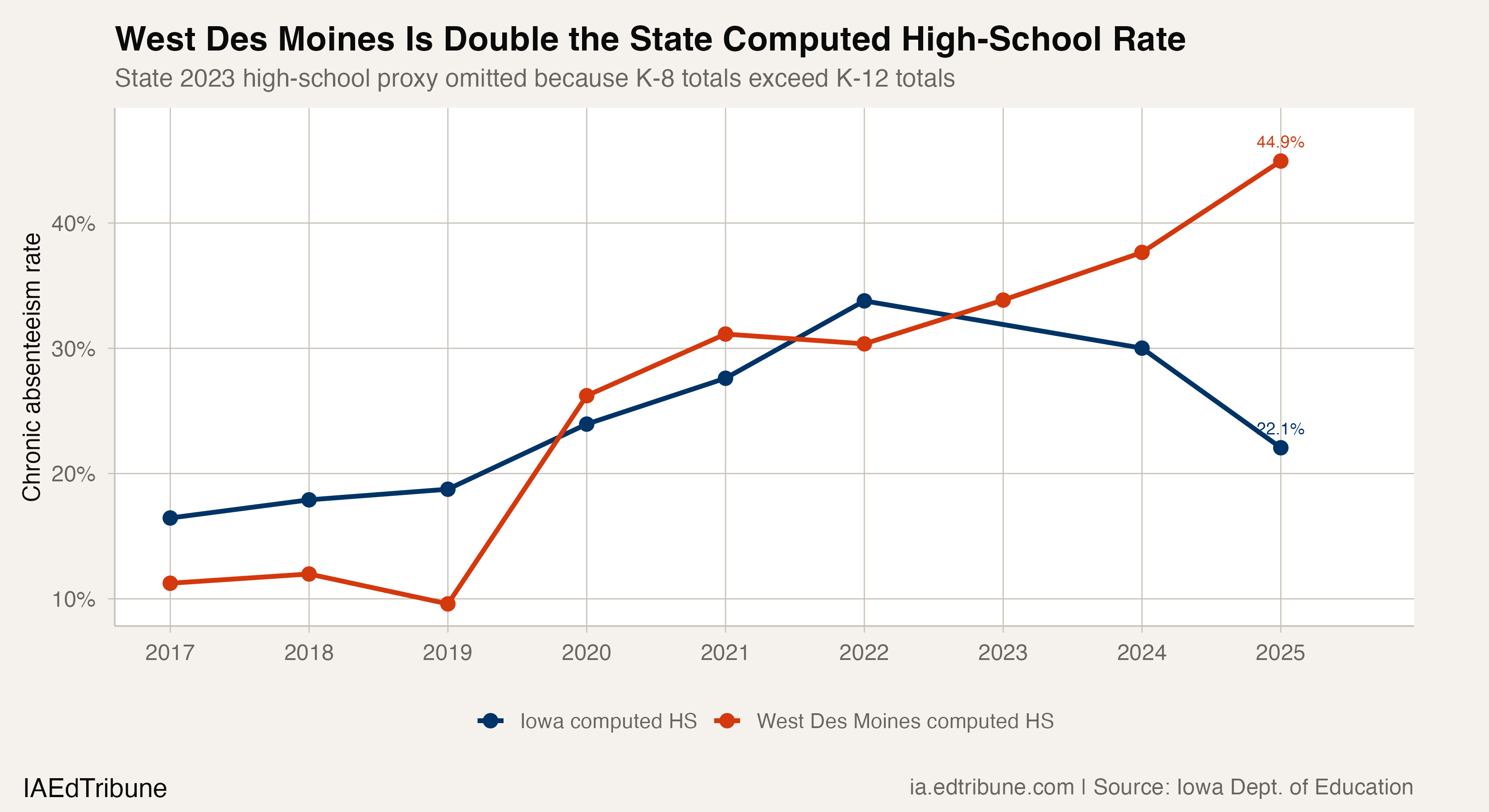
The statewide computed high school rate is 22.1%, while West Des Moines sits at roughly double that. West Des Moines' rate continued climbing in the latest four observations: 30.4% (2022), 33.8% (2023), 37.7% (2024), 44.9% (2025).
An all-time high while the state improves
West Des Moines is one of 10 Iowa district records to post its all-time worst K-12 chronic absenteeism rate in 2024-25, a year when 285 of 324 comparable district records improved. Its overall K-12 rate of 24.3% is the highest in the district's nine-year data history. The K-8 improvement is real, but it cannot offset a high school rate that keeps climbing.
The district enrolls 9,137 students, making it the 10th-largest in Iowa. With a computed 3,117 high school students and a 44.9% chronic rate, about 1,400 high schoolers are chronically absent.
The suburban paradox
West Des Moines does not look like an absence outlier at every level. Its K-8 rate is lower than the state K-12 average. The outlier is the computed high-school rate.
That pattern points to a high-school-specific problem, not a districtwide attendance collapse. The state file does not identify why the grade-band rates differ.
Iowa's published state file does not include enough granularity to determine whether the 44.9% high school rate is concentrated in specific grades, schools or student populations. That limitation applies to this analysis; it does not establish what student-level information the district itself holds.
What the trend line makes clear is that the reported rate has not resolved on its own. The computed high-school rate increased 33.7 points from 2017 to 2025 while most comparable district K-12 records improved in the latest year. The state file does not identify the appropriate response.
Iowa publishes district-level chronic absenteeism data through the Iowa Department of Education. The IAEdTribune is an independent publication and is not affiliated with the Iowa Department of Education.
Have a tip or feedback? Contact us at theedtribune@gmail.com.
Detailed code that reproduces the analysis and figures in this article is available exclusively to EdTribune subscribers.
Discussion
Sign in to join the discussion.
Loading comments...