Correction (2026-05-09): An earlier version of this article reported the 2021-22 gap between Waterloo and the state average as 12.2 points. The correct value is 12.9 points.
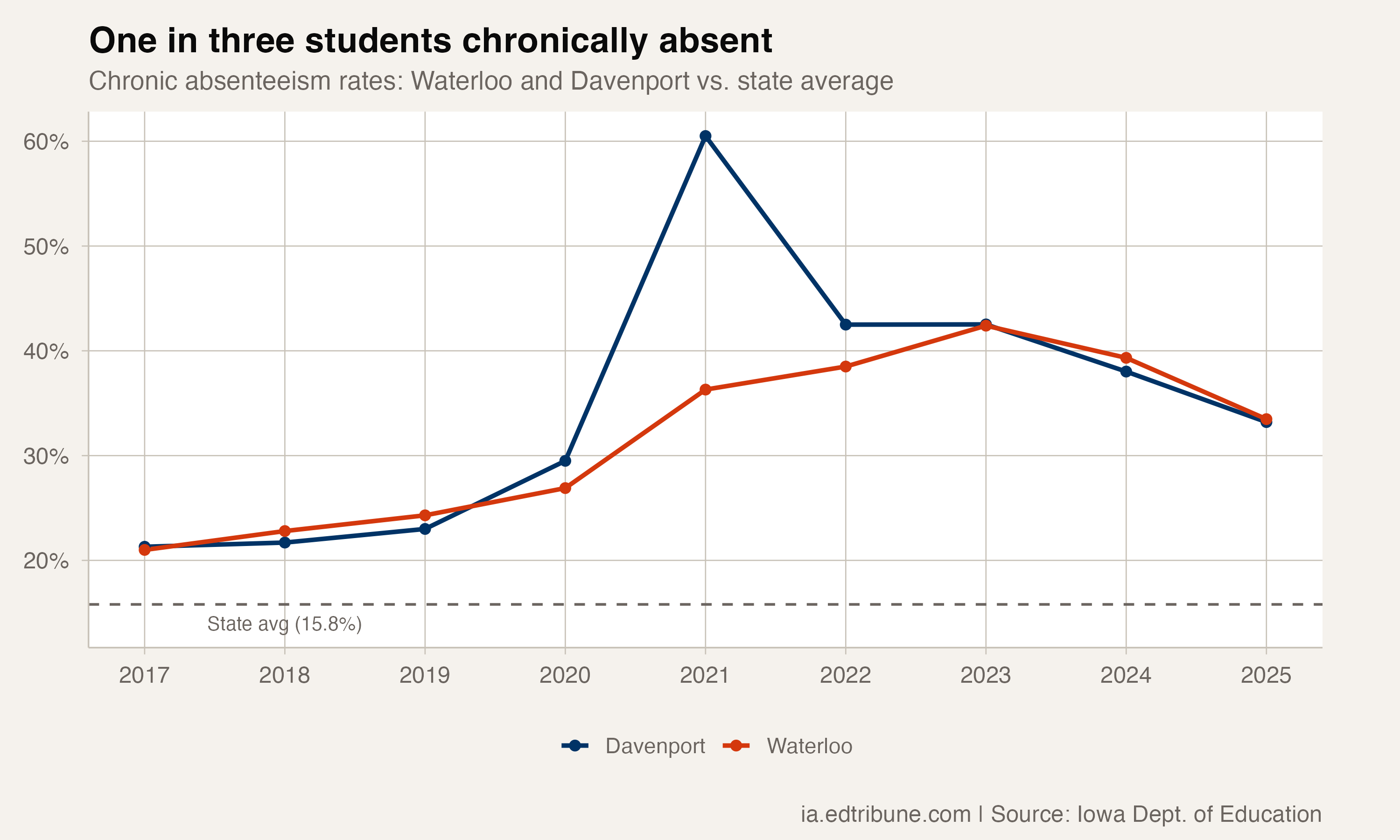
In 2020-21, three out of every five students in the Davenport Community School District were chronically absent. The 60.5% rate that year was the highest ever recorded by a major Iowa district, a number so large it suggests not a spike in absenteeism but a fundamental breakdown in the relationship between families and school buildings during the pandemic's darkest months.
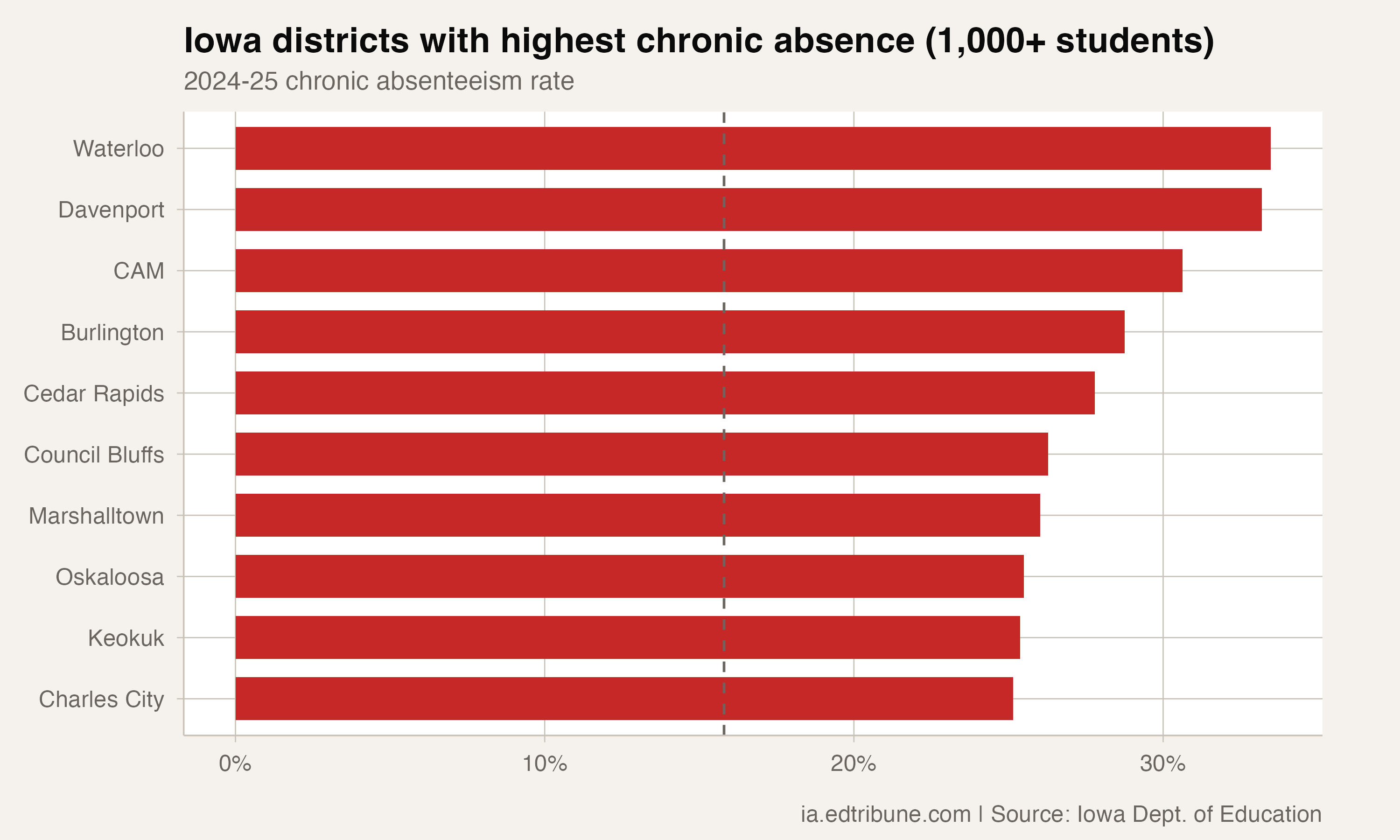
Four years later, Davenport↗ET has cut that rate nearly in half, to 33.2%. Waterloo↗ET is at 33.5%. Both have improved. Neither is close to acceptable. Together, these two industrial cities account for 7,846 chronically absent students, 10.2% of Iowa's total chronically absent population, from districts that hold just 4.9% of the state's enrollment.
Different paths to the same place
Waterloo's trajectory is a slow grind upward punctuated by a refusal to recover. The district's rate climbed from 21.0% in 2016-17 to 24.3% in 2018-19. It was already worsening before COVID. The pandemic pushed it to 38.5% by 2021-22, but the more alarming number came in 2022-23: 42.4%, the district's actual peak, a year when nearly every other Iowa district was already improving. Waterloo endured the longest consecutive worsening streak in the state, six years, from 2017-18 through 2022-23, before finally reversing direction.
Davenport's story is more volatile. The 60.5% spike in 2020-21 was followed by a sharp decline to 42.5% the next year, then a plateau at 42.5% again in 2022-23, and steady improvement since. The 33.2% current rate is still 10.2 points above Davenport's pre-COVID rate of 23.0%.
Both cities share industrial economies, higher poverty rates than the state average, and aging infrastructure. Both sit on rivers (Waterloo on the Cedar, Davenport on the Mississippi) in regions where the manufacturing base has been contracting for decades.
The numbers behind the numbers
Waterloo's 3,562 chronically absent students represent a population larger than many Iowa school districts. At 33.5%, the district is more than double the state average of 15.8%. The gap between Waterloo and the state average has persisted for all nine years of tracking data: 10.1 points in 2017, 12.9 in 2022, and 17.7 points today. The gap is widening over time, because the state has improved faster than Waterloo since the pandemic peak.
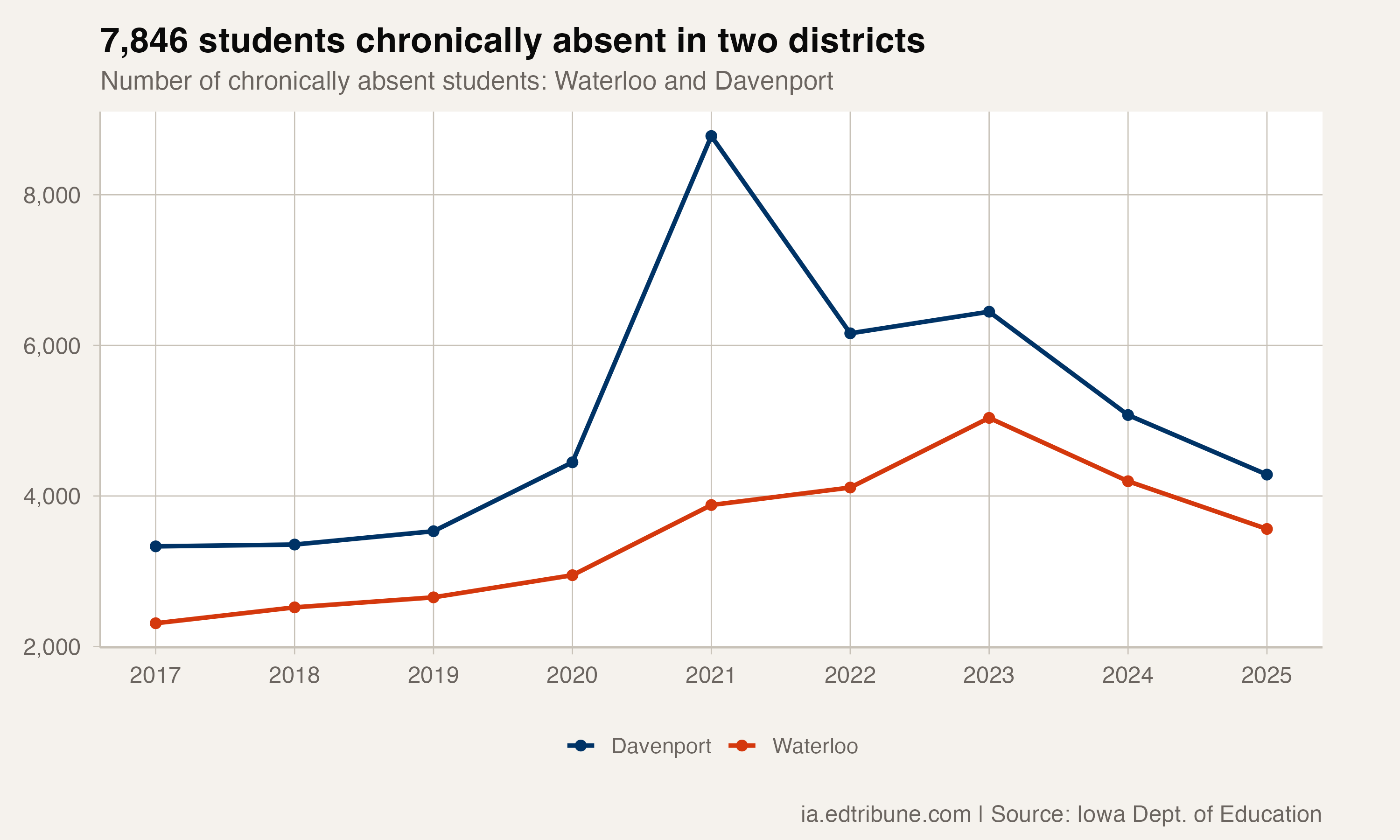
Davenport's 4,284 chronically absent students come from a shrinking enrollment base. The district enrolled 15,626 students in 2016-17 and 12,903 in 2024-25, a loss of 2,723 students, or 17.4%. Some families who left may have been the ones most likely to attend regularly, concentrating chronic absence among those who remained.
The long road back
At the current pace, Waterloo needs roughly four more years to return to its pre-COVID rate. Davenport needs three. Both timelines assume the improvement continues at its current speed, which it probably will not. The last few points of recovery are always the hardest.
Iowa reports no demographic breakdowns for chronic absenteeism, so neither district can determine whether the one-in-three rate falls disproportionately on Black students, English learners, or students whose families are economically disadvantaged. Both Waterloo and Davenport are among the few Iowa districts where white students are not the clear majority. Without that data, the interventions are necessarily generic: certified letters that go to every family the same way, regardless of whether the barrier is shift-work scheduling, transportation, or adolescent disengagement.
Iowa publishes district-level chronic absenteeism data through the Iowa Department of Education. The IAEdTribune is an independent publication and is not affiliated with the Iowa Department of Education.
Have a tip or feedback? Contact us at theedtribune@gmail.com.
Detailed code that reproduces the analysis and figures in this article is available exclusively to EdTribune subscribers.
Discussion
Sign in to join the discussion.
Loading comments...