Correction (July 20, 2026): An earlier version said 327 districts reported data, described a nine-year concentration trend when district K-12 records are available for four years, and understated both the top-ten and top-twenty shares. The package reports 329 districts in 2025. The top ten account for 40.8% of chronically absent students and the top twenty for 55.5%. Reducing the top five to the rounded statewide rate would mean approximately 7,710 fewer chronically absent students, not 7,600.
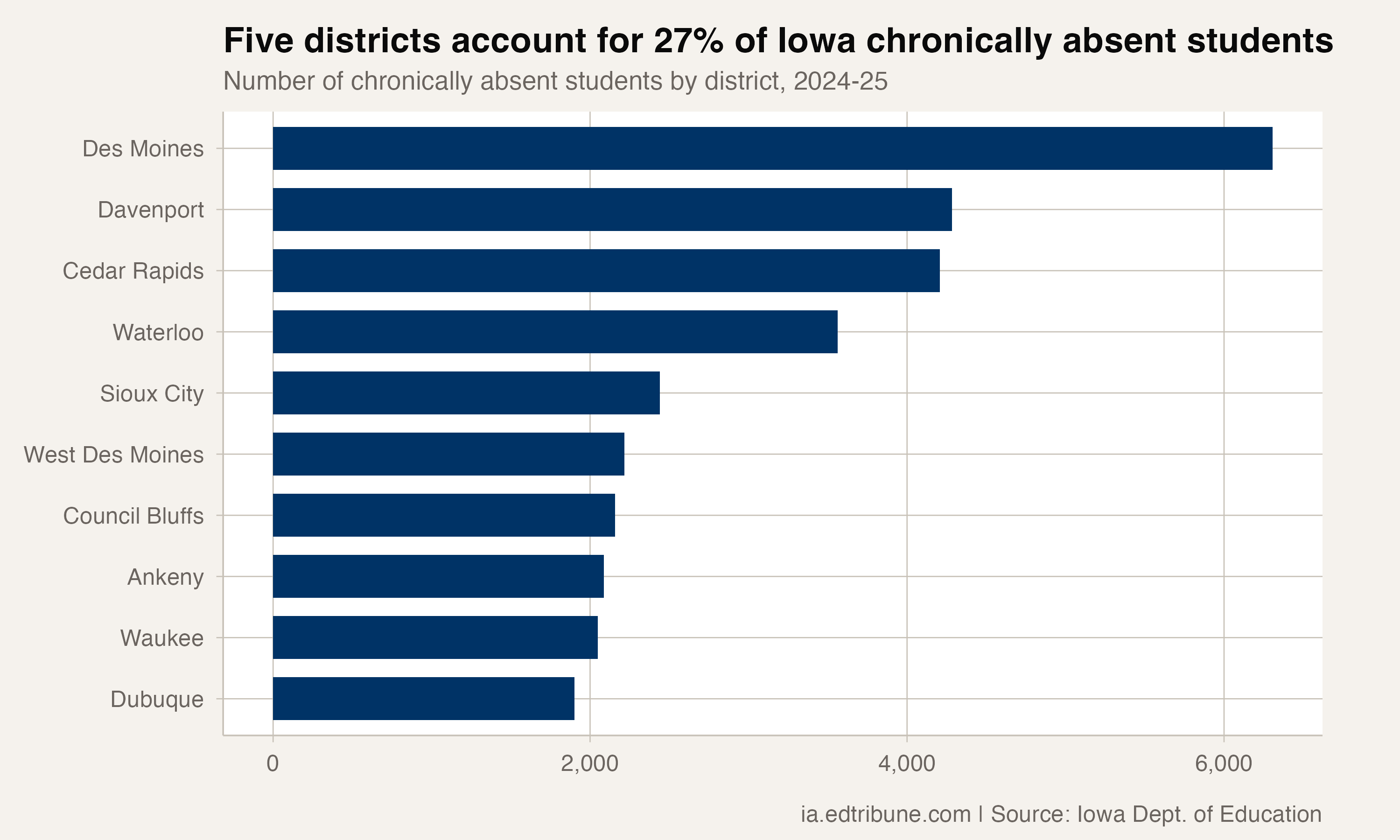
Iowa has 329 school districts reporting K-12 chronic absenteeism data for 2024-25. Five of them account for more than a quarter of every chronically absent student in the state.
Des Moines Independent↗ET (6,306 chronically absent), Davenport↗ET (4,284), Cedar Rapids↗ET (4,208), Waterloo↗ET (3,562), and Sioux City↗ET (2,441) combine for 20,801 chronically absent students — 27.2% of the state's total of 76,535. These five districts enroll 17.1% of Iowa's students but produce 27.2% of its chronic absence. They punch 1.6 times above their enrollment weight.
The math of targeted intervention
If Iowa reduced chronic absenteeism in just these five districts to the rounded statewide average of 15.8%, the state's total chronically absent population would drop by approximately 7,710 students—a 10.1% reduction in the state total from interventions in 1.5% of districts.
This is the concentration advantage: in a state with hundreds of districts, a small number of locally tailored strategies could affect a large share of the statewide total.
The challenge is that each of these five districts has a different version of the problem. Des Moines' 21.2% rate fell from 38.7% one year earlier. Waterloo's 33.5% and Davenport's 33.2% remain more than twice the state average, even after year-over-year declines. Cedar Rapids sits at 27.8%, and Sioux City at 16.9%—barely above the state average.
Sioux City: the exception in the top five
Sioux City's inclusion in the top five is a function of size, not rate. At 16.9%, its chronic rate is only 1.1 points above the state average. The district makes the list because it enrolls 14,470 students — enough that even a near-average rate produces 2,441 chronically absent students.
This illustrates a tension in attendance policy. Should intervention resources flow to the districts with the highest rates (Waterloo at 33.5%) or the highest counts (Des Moines at 6,306)? The rate-focused approach targets the worst-performing systems. The count-focused approach maximizes the number of students reached.
Concentration has moved around
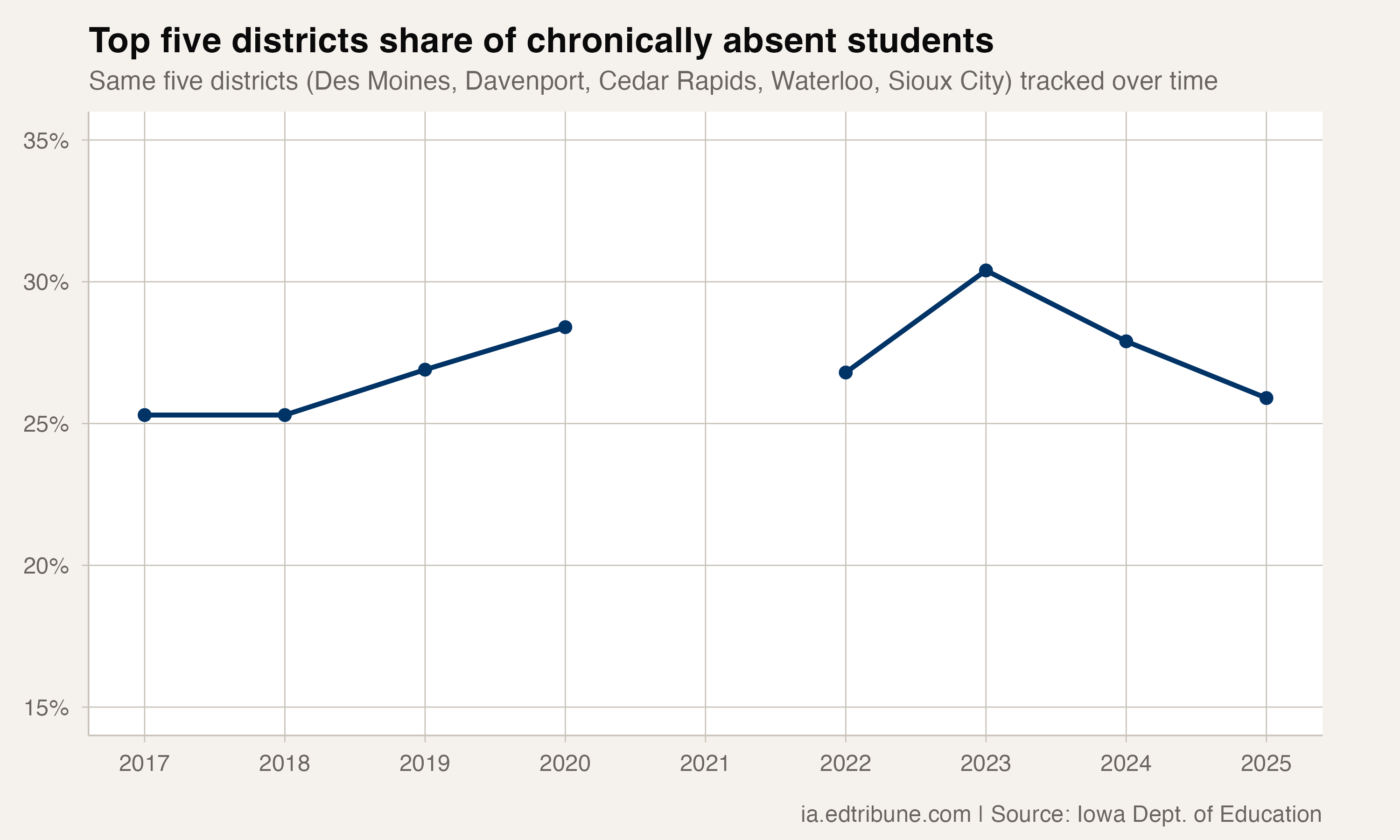
For the four years with published district K-12 records, these same five districts accounted for 27.8% of the statewide chronic-absence count in 2022, 33.2% in 2023, 29.1% in 2024, and 27.2% in 2025. The concentration peaked in 2023 and has fallen for two consecutive years.
Des Moines alone accounts for 8.2% of all chronically absent students in Iowa — one in twelve — from a district that enrolls 6.1% of the state. If Des Moines' rate were at the state average, the district would have 4,693 chronically absent students instead of 6,306, and the state total would drop by 1,613.
Beyond the top five
The concentration extends beyond the top five. The top ten districts account for 40.8% of all chronically absent students. The top twenty account for 55.5%. Iowa's 309 remaining reporting districts enroll 295,810 students.
This distribution has implications for state policy. Senate File 2435 established certified-mail notices, engagement meetings, and truancy provisions. Des Moines Public Schools set aside $70,000 for mail warnings, illustrating how the operational burden scales with district size.
The arithmetic shows that a lower statewide rate runs through a small number of large district systems. The political and operational barriers to that approach are another matter.
Iowa publishes district-level chronic absenteeism data through the Iowa Department of Education. The IAEdTribune is an independent publication and is not affiliated with the Iowa Department of Education.
Have a tip or feedback? Contact us at theedtribune@gmail.com.
Detailed code that reproduces the analysis and figures in this article is available exclusively to EdTribune subscribers.
Discussion
Sign in to join the discussion.
Loading comments...