This is part of the Iowa Graduation Rate series, examining trends in the Class of 2019-2024.
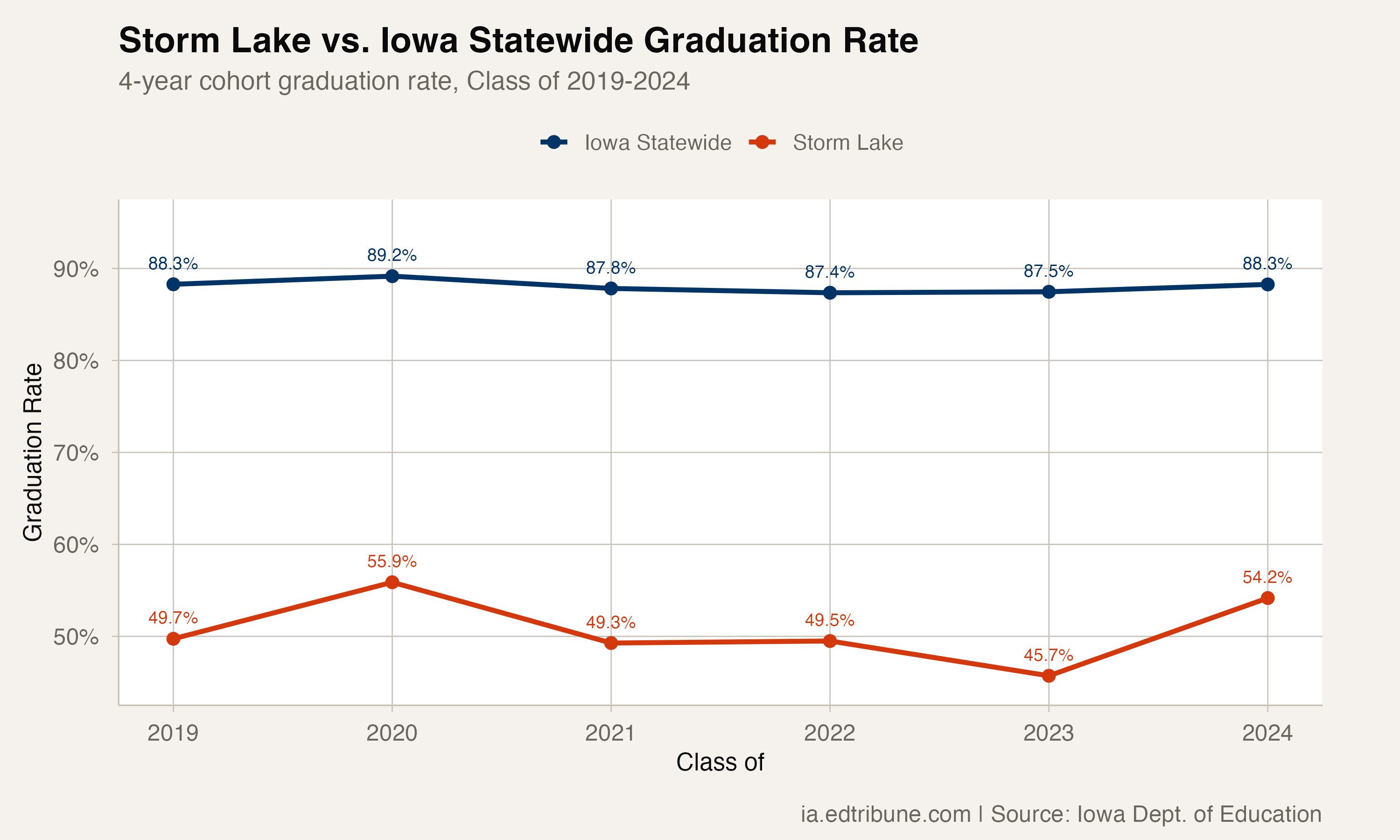
In Iowa, 88% of high school students earn their diplomas on time. In Storm Lake↗ET, just 54% do.
The 34-point gap between Storm Lake and the statewide average is not new, and it is not shrinking. Over the six years of available graduation data, the meatpacking town in northwest Iowa has never cracked 56%. In 2023, the rate fell to 46% before ticking back up to 54% for the Class of 2024.
What makes Storm Lake different from Iowa's other struggling districts is scale and demographics. This is not a tiny rural school with a handful of seniors producing a volatile rate. Storm Lake graduated a cohort of 192 students in 2024 — a mid-size class where the numbers are stable enough to mean something.
Where the language barrier shows up
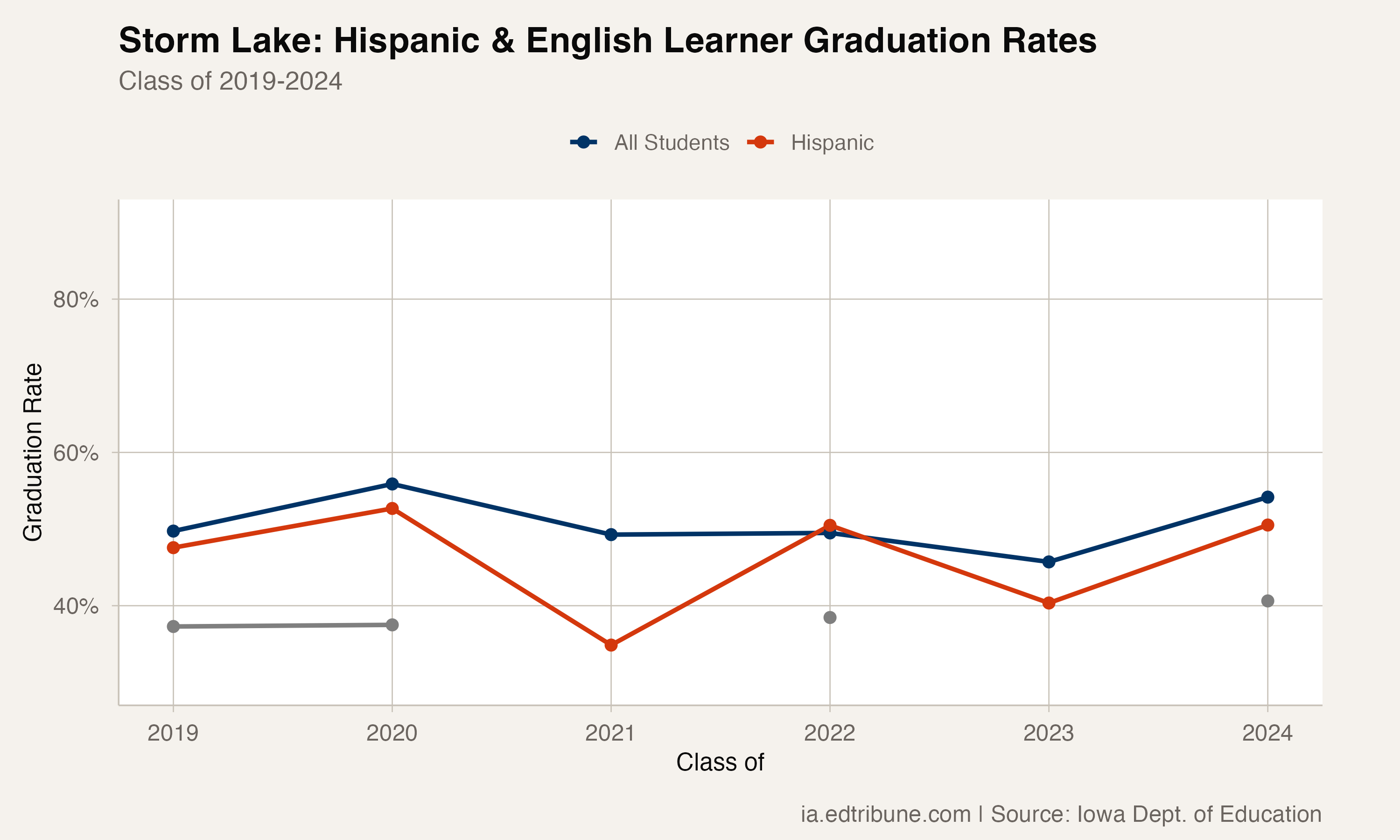
Storm Lake's English learner graduation rate tells the clearest part of the story. Just 41% of LEP students graduated on time in 2024, compared to 73% statewide. Hispanic students, who make up roughly half the cohort, graduated at 51%.
The pattern is consistent across years. English learners in Storm Lake have not exceeded 39% in four of the last six years. For a district where the majority of students come from immigrant families working in the Tyson Foods and other meatpacking plants, the four-year graduation timeline measures something specific: whether students who arrived in the United States as teenagers can acquire academic English and complete all coursework before turning 18.
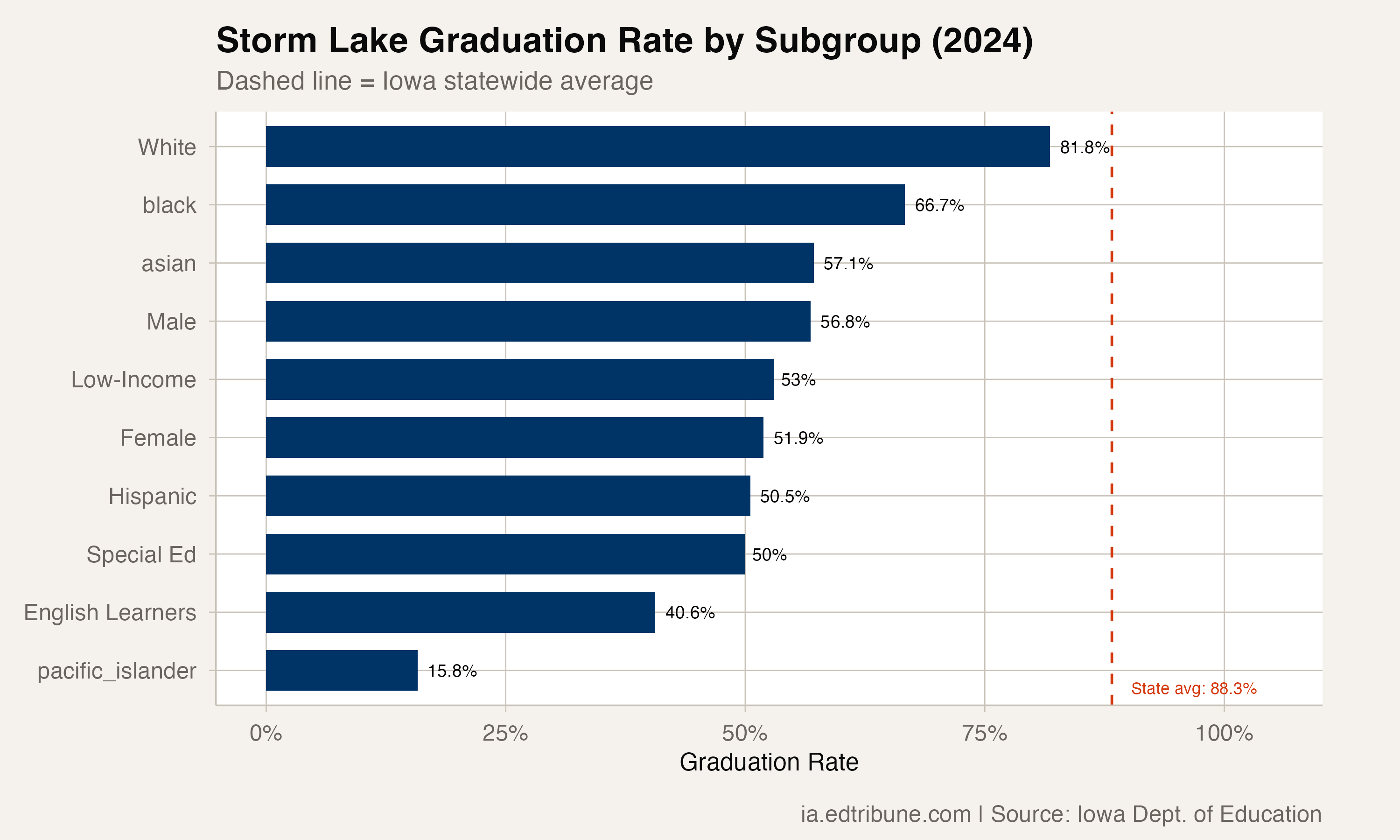
White students in Storm Lake graduated at 82% in 2024 — below the state average of 91% but far above their non-white classmates. The 31-point gap between white and Hispanic students within the same district dwarfs the statewide white-Hispanic gap of 10 points.
A town transformed
Storm Lake's demographic transformation is well-documented. What was once a predominantly white farming community became one of Iowa's most diverse cities after meatpacking plants began recruiting immigrant labor in the 1990s. The school district's graduating class now reflects that shift.
Pacific Islander students — a small but growing group in Storm Lake, many from the Marshall Islands — graduated at 16% in 2024, though the cohort of 19 makes the rate volatile. The Black graduation rate was 67%, based on a cohort of 12.
Students who are economically disadvantaged, who make up most of the cohort, graduated at 53% — essentially the same as the overall rate, confirming that poverty and language acquisition are deeply entangled in Storm Lake's graduation numbers.
Not alone, but the most extreme
Storm Lake is Iowa's lowest-graduating traditional district, but it is not the only one struggling. Burlington↗ET graduated 67% of students in 2024. Fort Dodge↗ET graduated 70%. Des Moines↗ET, the state's largest district, graduated 71%.
What separates Storm Lake is the persistence. Burlington and Fort Dodge have fluctuated above and below 70% over the data period. Storm Lake has been stuck in the low 50s for years, with a dip to 46% in 2023 marking its worst showing.
The two entities below Storm Lake on the state list — Choice Charter Schools at 32% and the catch-all "Accountable to State" category at 39% — serve specialized populations and are not traditional community school districts.
What the four-year rate misses
Iowa's graduation data tracks the four-year cohort rate: students who entered ninth grade and received a diploma four years later. For districts like Storm Lake, this metric may systematically undercount eventual graduation.
Students acquiring English often need a fifth or sixth year to complete requirements. Iowa does not publish extended-year graduation rates in its standard reporting, so it is impossible to say from this data how many Storm Lake students eventually graduate. The 54% rate is real, but it measures a specific thing — on-time completion — in a community where "on time" may be structurally misaligned with student needs.
Detailed code that reproduces the analysis and figures in this article is available exclusively to EdTribune subscribers.
Discussion
Sign in to join the discussion.
Loading comments...