This is part of the Iowa Graduation Rate series, examining trends in the Class of 2019-2024.
Iowa's statewide graduation rate returned to 88% in 2024, matching its pre-pandemic level for the first time since 2019. By the most visible metric, the state has recovered.
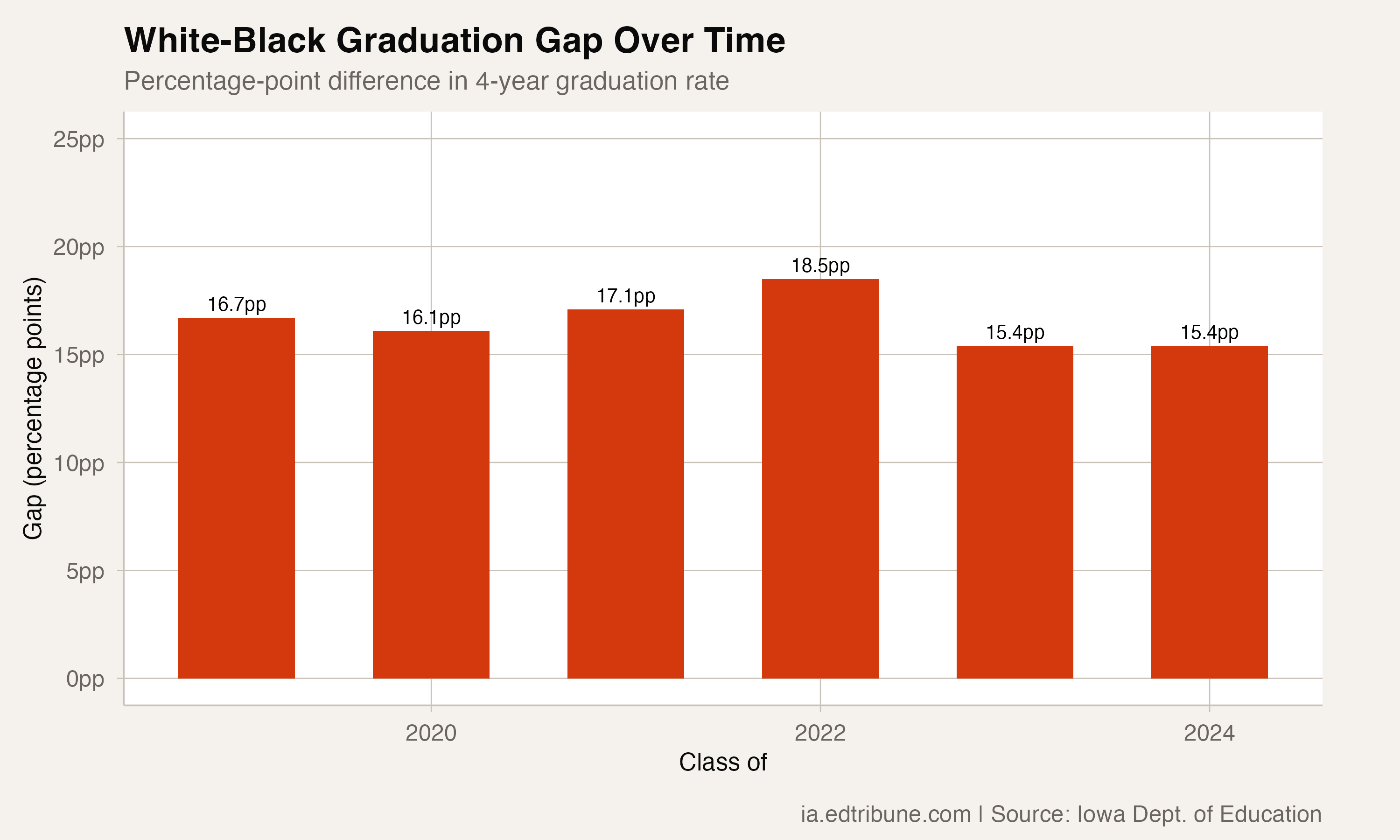
But the white-Black graduation gap tells a different story. At 15 points, the gap between white students (91%) and Black students (76%) is almost exactly where it was six years ago. It has bounced between 15 and 19 points every year since 2019, with no discernible trend toward closing.
The persistence is the point. Iowa's overall recovery was real but narrow -- driven by the white majority, which makes up 74% of the graduating cohort. Black students, who represent 6% of graduates, saw their rate climb from 74% to 76% over six years. That 2-point gain was real but too small to close a gap that was already in the mid-teens.
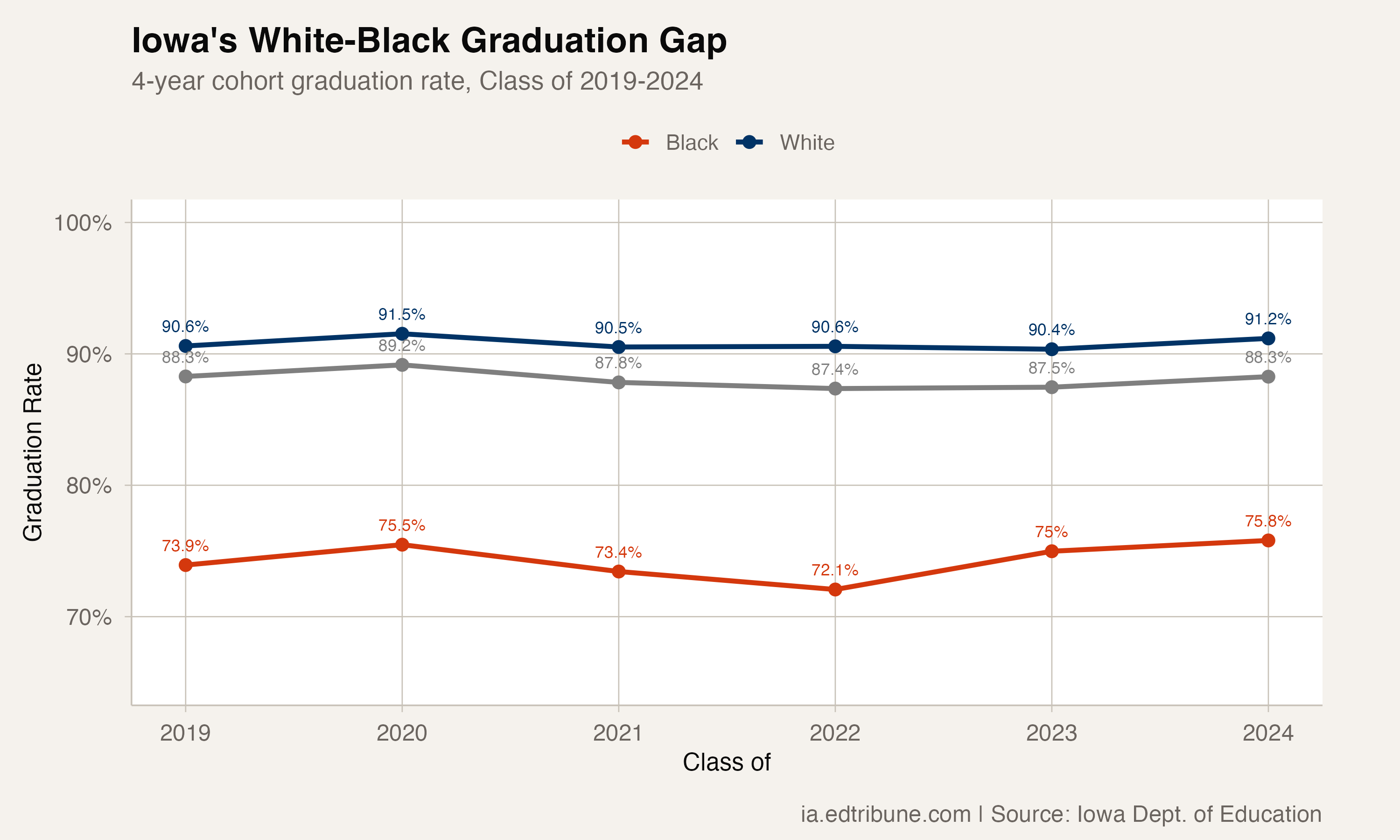
Six years of stasis
| Class of | White | Black | Gap |
|---|---|---|---|
| 2019 | 90.6% | 73.9% | 16.7pp |
| 2020 | 91.5% | 75.5% | 16.1pp |
| 2021 | 90.5% | 73.4% | 17.1pp |
| 2022 | 90.6% | 72.1% | 18.5pp |
| 2023 | 90.4% | 75.0% | 15.4pp |
| 2024 | 91.2% | 75.8% | 15.4pp |
The gap peaked at 19 points for the Class of 2022 -- the cohort most affected by pandemic-era disruption in their sophomore and junior years. It narrowed to 15 points by 2023 and held there in 2024. But "narrowing from the pandemic peak" is not the same as progress. The 2024 gap of 15 points is only slightly better than the 2019 gap of 17 points.
Not the widest gap, but the most stubborn
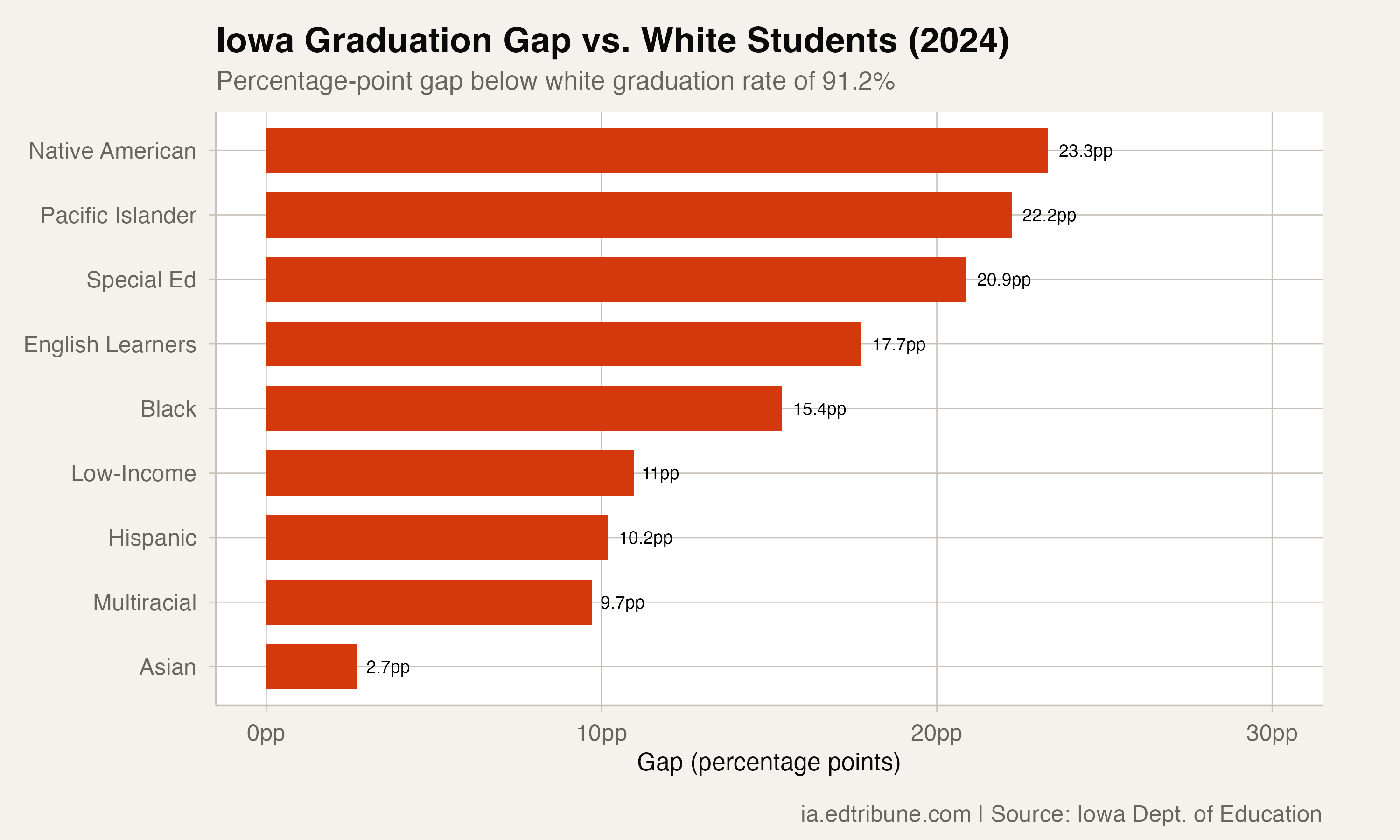
The white-Black gap is Iowa's third-widest equity divide after Native American students (23 points below white) and special education students (21 points below white). But those other gaps have moved, for better or worse. The Native American gap widened sharply. The special education gap has fluctuated.
The white-Black gap is distinct in its consistency. A 15-to-19-point range, year after year, suggests a set of conditions that are deeply embedded and resistant to the interventions Iowa has tried.
Where it plays out
Iowa's Black student population is concentrated in a handful of districts. The graduation data for Black students in 2024 reveals sharp differences by community:
In Waukee↗ET, Black students graduated at 98% -- essentially matching the district's overall rate. In Johnston↗ET, 94%. These suburban districts serve relatively small Black cohorts (58 and 66 students, respectively) in communities with high overall graduation rates.
The picture reverses in urban cores. In Des Moines↗ET, the largest Black cohort in the state at 463 students, the rate was 67%. In Waterloo↗ET, 68%. In Burlington↗ET, 59%. In Dubuque↗ET, 63%.
The district-level data suggests that the statewide gap is driven primarily by urban districts where Black students are concentrated and where graduation challenges affect all demographic groups. In Des Moines, white students graduate at 77% -- well below the state white average of 91%.
The gender dimension
Statewide, female students graduated at 90% and males at 87% -- a 3-point gap. Among Black students, the gender pattern likely amplifies the racial gap, as Black males nationally graduate at lower rates than Black females. Iowa's data does not publish a Black-male or Black-female cross-tabulation at the state level, but the gender gap within Des Moines (75% female vs. 68% male) hints at the compounding effect.
What 15 points means in practice
Iowa graduated 1,823 Black students in 2024, out of a cohort of 2,405. At 76%, roughly 582 Black students in Iowa did not graduate on time.
If Black students graduated at the white rate of 91%, approximately 365 fewer Black students would have failed to earn their diplomas. That is an additional 365 students per year -- enough to fill a small high school -- whose outcomes are shaped by a gap that has barely moved in six years.
Detailed code that reproduces the analysis and figures in this article is available exclusively to EdTribune subscribers.
Discussion
Sign in to join the discussion.
Loading comments...