This is part of the Iowa Graduation Rate series, examining trends in the Class of 2019-2024.
Among the standard subgroups in Iowa's graduation data sits a line item that few states report: non-binary students.
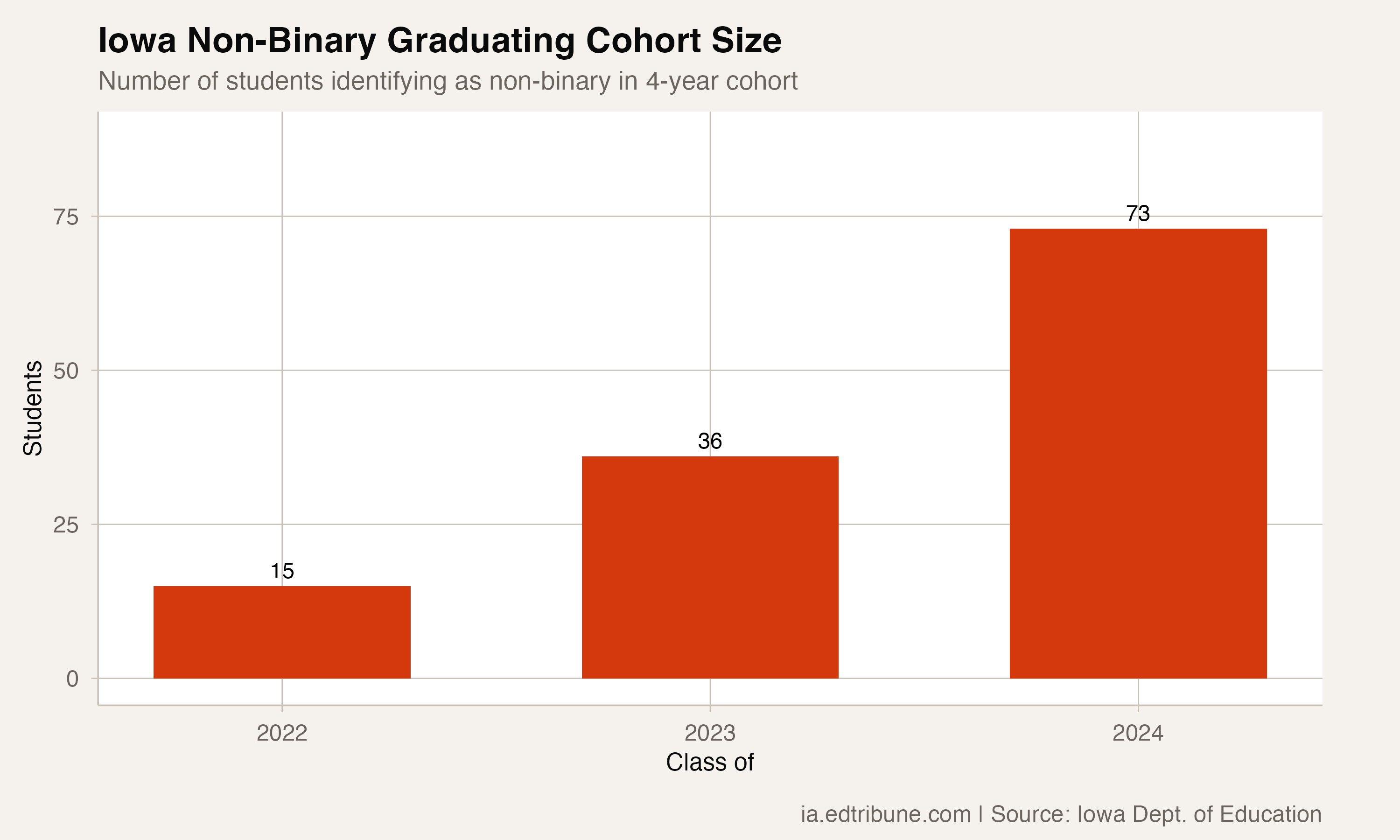
Iowa began tracking graduation rates for students who identify as non-binary with the Class of 2022. The cohort was 15 students. By 2024, it had grown to 73. Their graduation rate was 84%.
The data point is small and volatile. It also reflects a reporting choice few states have made: breaking out graduation outcomes for students who do not fit the male or female categories.
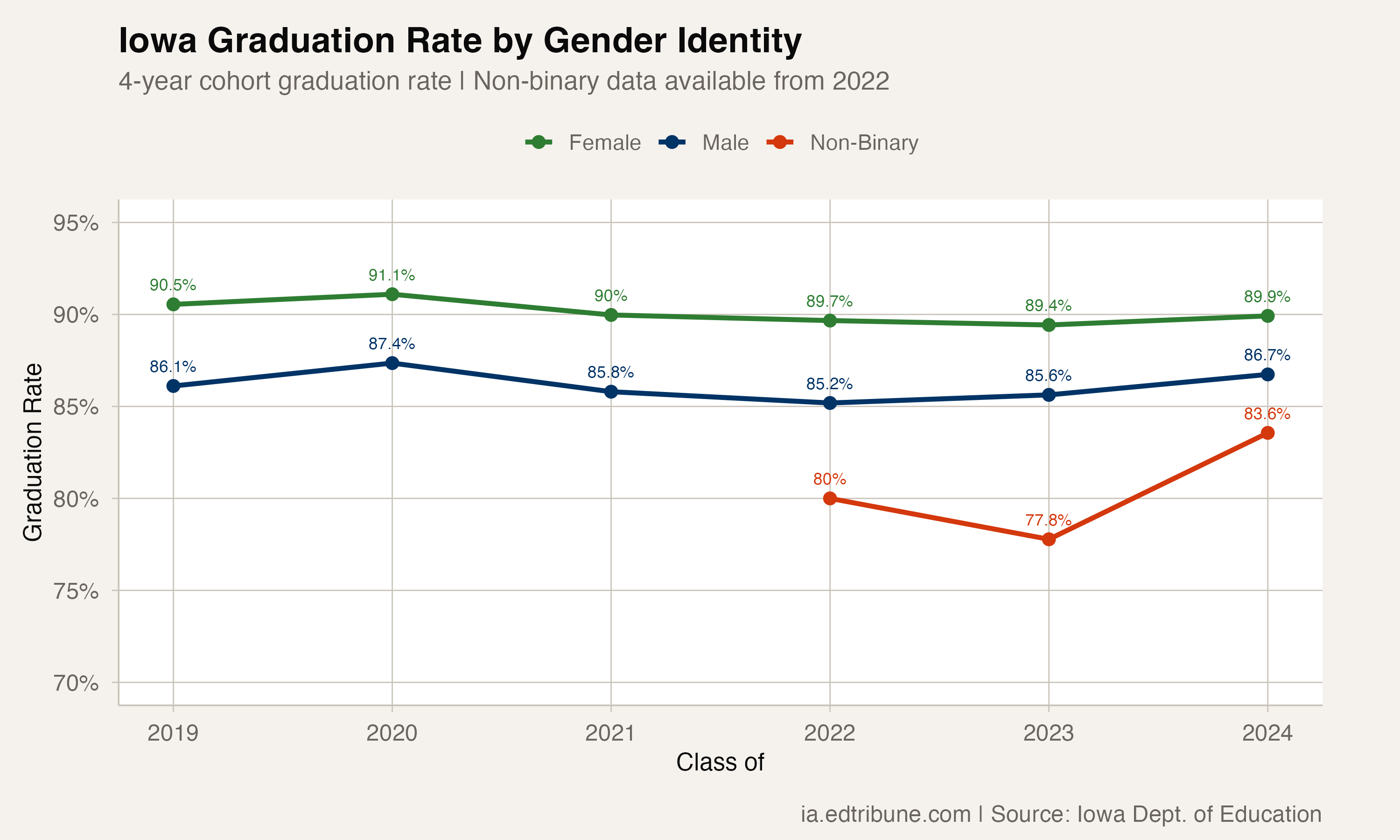
What the numbers show
| Class of | Graduation Rate | Cohort Size |
|---|---|---|
| 2022 | 80.0% | 15 |
| 2023 | 77.8% | 36 |
| 2024 | 83.6% | 73 |
Three years of data is not enough to identify a trend. The cohort is growing rapidly, from 15 to 73 in two years, which could reflect more students identifying as non-binary, better data collection, or both.
At 84%, non-binary students graduated above Black students (76%), English learners (73%), special education students (70%), Native American students (68%), and Pacific Islander students (69%). They graduated below the state average of 88%, females at 90%, and males at 87%.
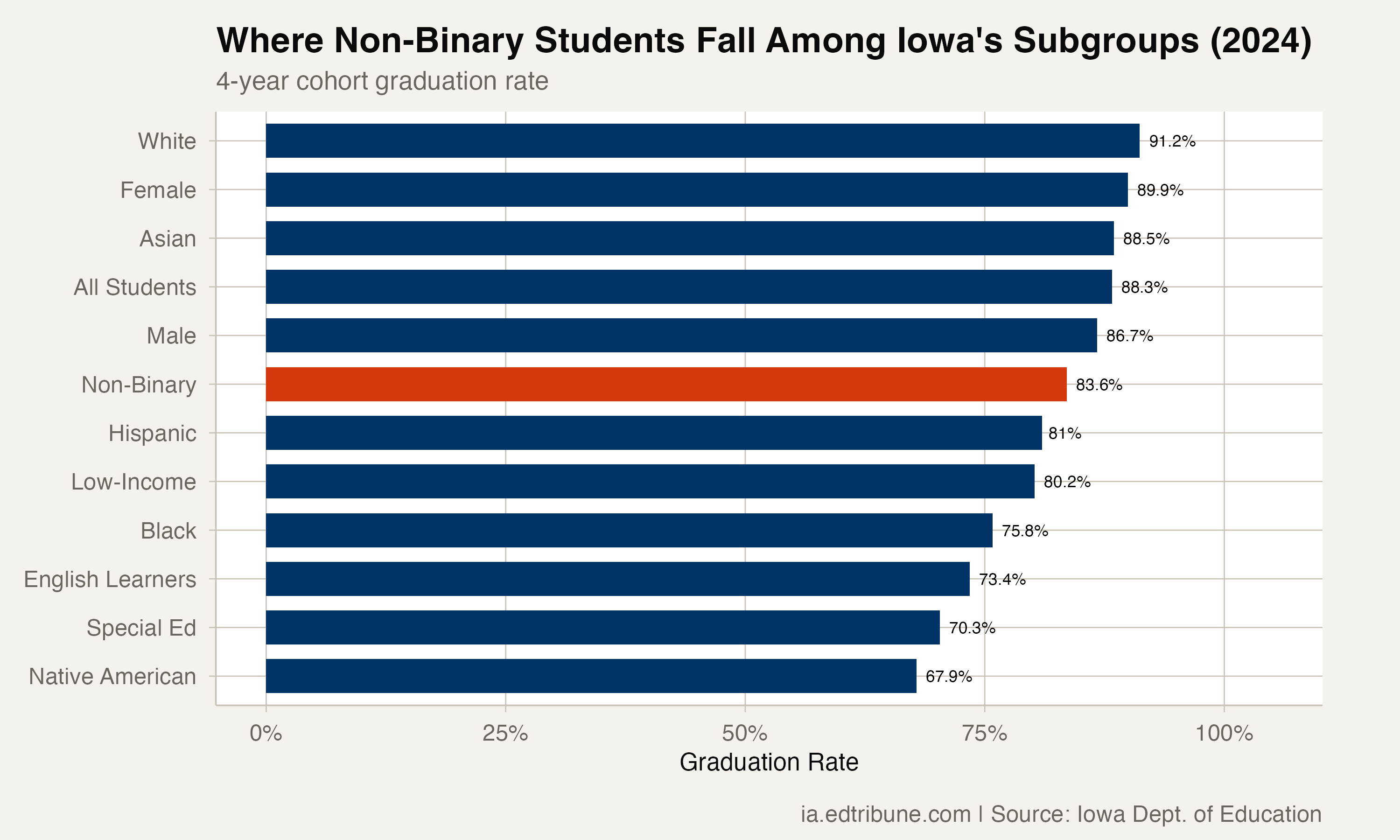
A growing cohort
The most notable pattern is the cohort's growth. At 73 students in 2024, non-binary students represent 0.2% of Iowa's graduating class. That is still a small fraction, but the count has climbed each year, from 15 to 36 to 73.
Iowa City↗ET is the only individual district that reported a non-binary graduation cohort large enough to appear in the data: 11 students at a 91% graduation rate. In all other districts, the cohort was too small to report without privacy suppression.
Why this matters
Many state education agencies report graduation by male and female only. Iowa's decision to add a non-binary category reflects both a policy choice about data collection and a practical reality: some students do not fit the binary gender categories, and schools increasingly have systems to record that.
The existence of the data does not mean much by itself. Three years and 73 students do not support generalizations about non-binary students' educational outcomes in Iowa. The rate could change substantially as the cohort grows and becomes less skewed toward school districts with the earliest and most robust gender-identity data systems.
What the data does provide is a baseline. As the cohort grows, Iowa will build up a run of years that few states report at all. The 84% rate for 2024 becomes a reference point: not because it tells us everything about non-binary students in Iowa schools, but because it tells us something where many states report nothing.
Much of the national research on LGBTQ+ youth educational outcomes has relied on surveys rather than administrative records. Iowa's approach of including non-binary as a standard reporting category in official graduation data adds a measured outcome to a field that has leaned on self-reported data.
Context and caveats
The non-binary cohort of 73 students statewide means that a few individual students' outcomes can shift the rate by more than a percentage point. Applied to the 73-student cohort, the jump from 78% in 2023 to 84% in 2024 works out to roughly four additional graduates, meaningful for those individuals but too small a sample for confident trend analysis.
It is also unclear how Iowa defines "non-binary" in its data collection, whether it is self-reported by students, parent-designated, or recorded through some other mechanism. The growth of the cohort over three years could reflect changing norms around self-identification as much as any demographic shift.
Detailed code that reproduces the analysis and figures in this article is available exclusively to EdTribune subscribers.
Discussion
Sign in to join the discussion.
Loading comments...