In this series: Iowa 2025-26 Enrollment.
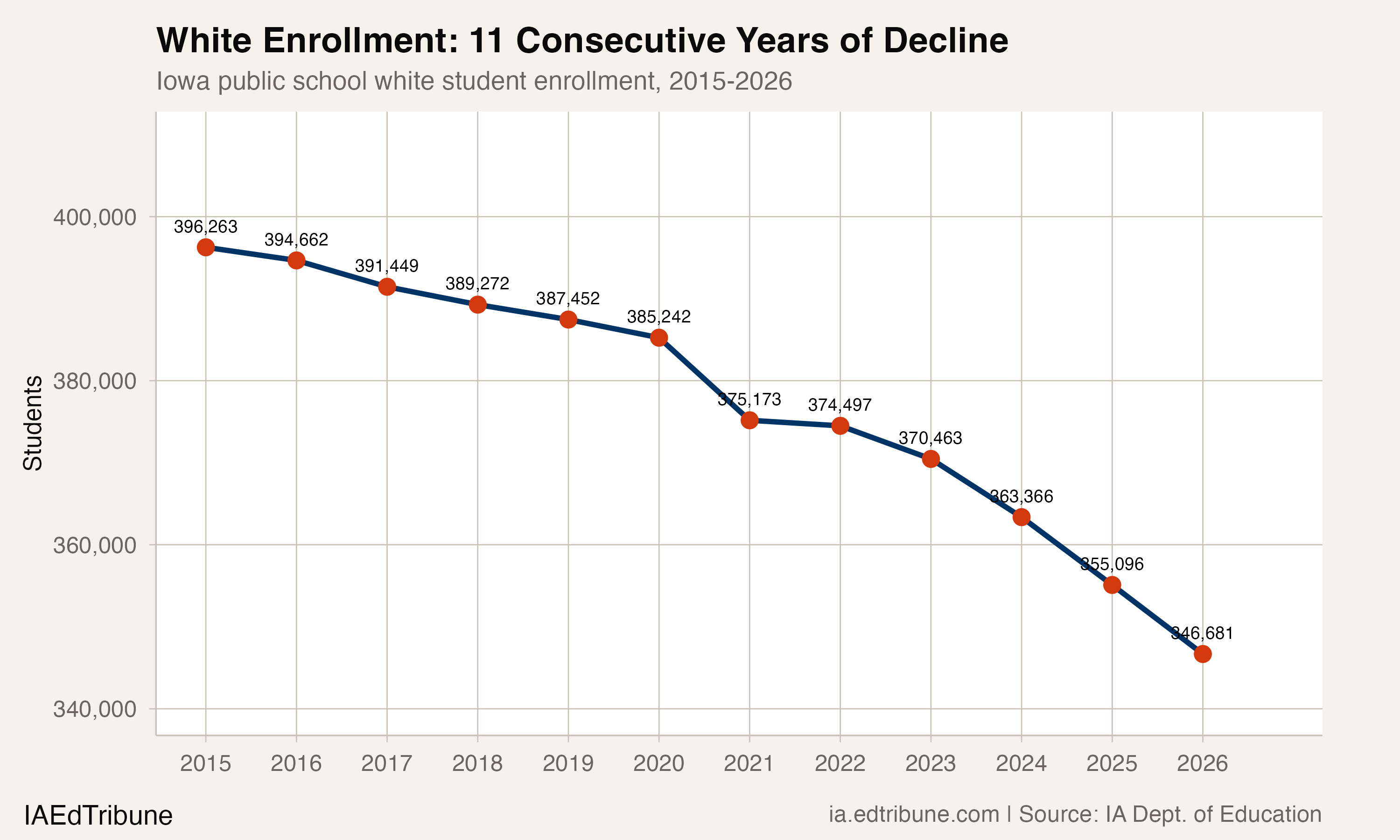
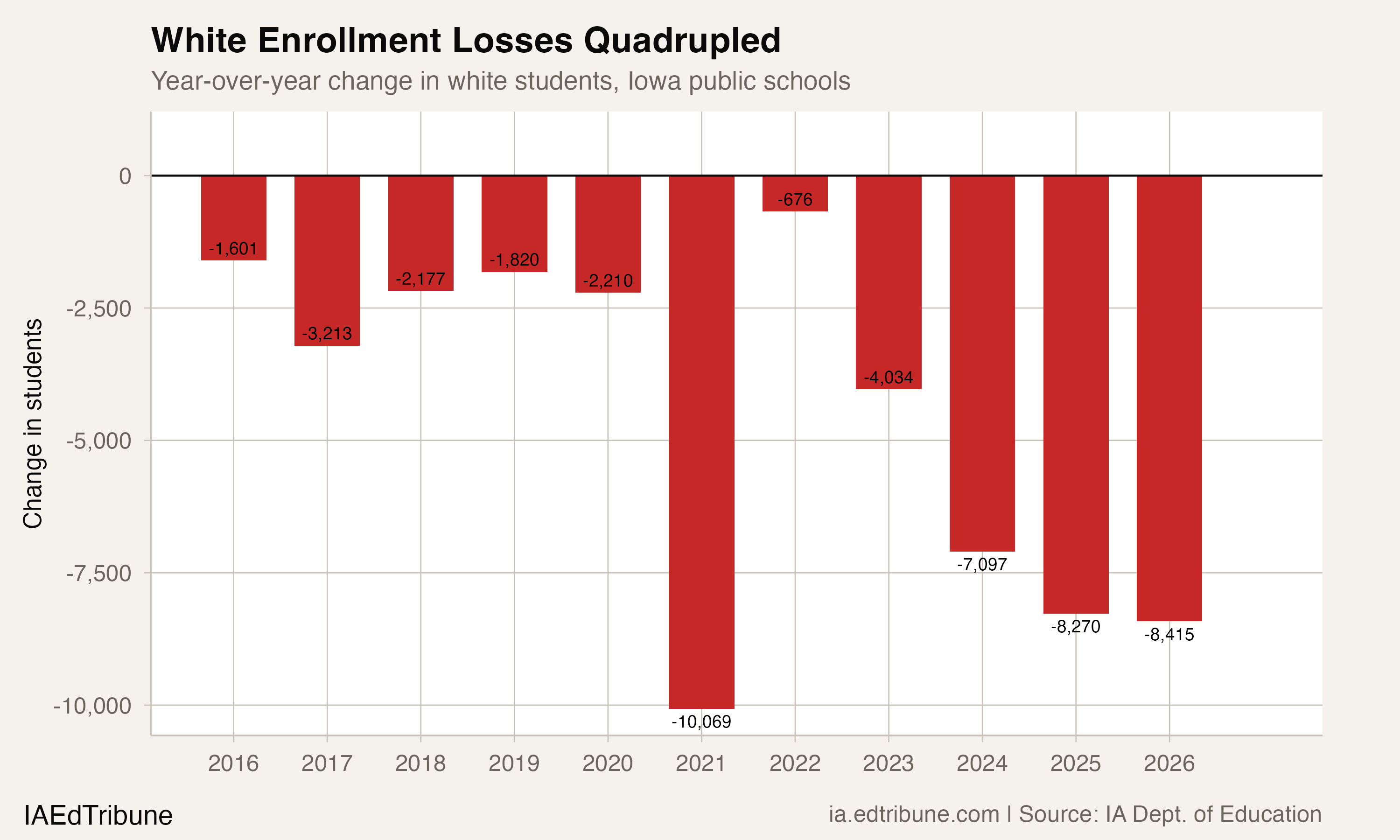
Every year since 2015, Iowa's public schools have enrolled fewer white students than the year before. Not one year of recovery. Not one pause. Eleven consecutive annual losses, every year in the available data, that started as a trickle of 1,601 students in 2016 and swelled to 8,415 in 2026.
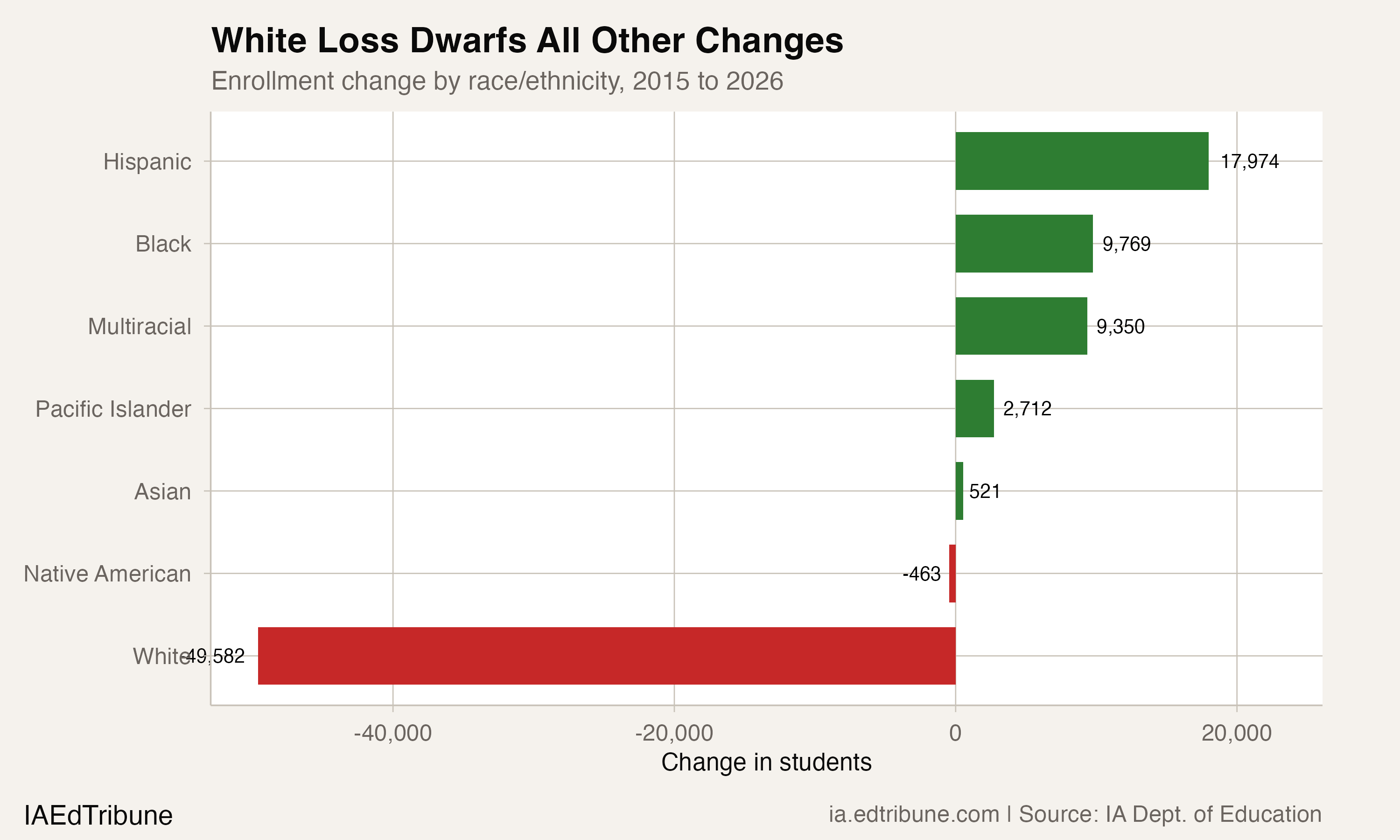
The cumulative toll: 49,582 white students, a 12.5% decline that accounts for five times the state's total enrollment loss over the same period. Iowa's overall enrollment fell by 9,719 students since 2015. White enrollment alone fell by nearly 50,000. The difference was filled by growing Hispanic, Black, and multiracial populations, without which Iowa's enrollment picture would be far worse.
The acceleration
The pace of white enrollment loss is not constant. It is getting worse.
From 2016 through 2020, Iowa lost an average of 2,204 white students per year. From 2024 through 2026, the average annual loss was 7,927, a 3.6-fold acceleration. The 2021 COVID year stands out as an anomaly, when 10,069 white students left in a single year. But unlike total enrollment, which partially recovered after COVID, white enrollment never bounced back. The 676-student loss in 2022 looked like a reprieve. It was not. Losses jumped to 4,034 in 2023, then 7,097, then 8,270, then 8,415.
The post-COVID pattern suggests that the pandemic accelerated a structural shift already underway, pulling forward years of decline into a compressed window.
Where the students of color are
White enrollment's decline is not happening in isolation. Iowa's student body is becoming substantially more diverse, and the growth in students of color has partially offset the white decline.
Hispanic students grew from 50,539 to 68,513 (+17,974, or 35.6%) since 2015. Black students grew from 27,665 to 37,434 (+9,769, or 35.3%). Multiracial students grew from 17,121 to 26,471 (+9,350, or 54.6%). Pacific Islander students nearly quadrupled from 983 to 3,695. Asian enrollment grew modestly (+521), while Native American enrollment declined 23.2%.
Combined, students of color grew from 110,073 to 149,936, a gain of 39,863. That gain offset 80% of the 49,582 white student loss, leaving the overall enrollment decline at 9,719. Without the growth in nonwhite enrollment, Iowa would have lost closer to 50,000 students total.
The 70% threshold
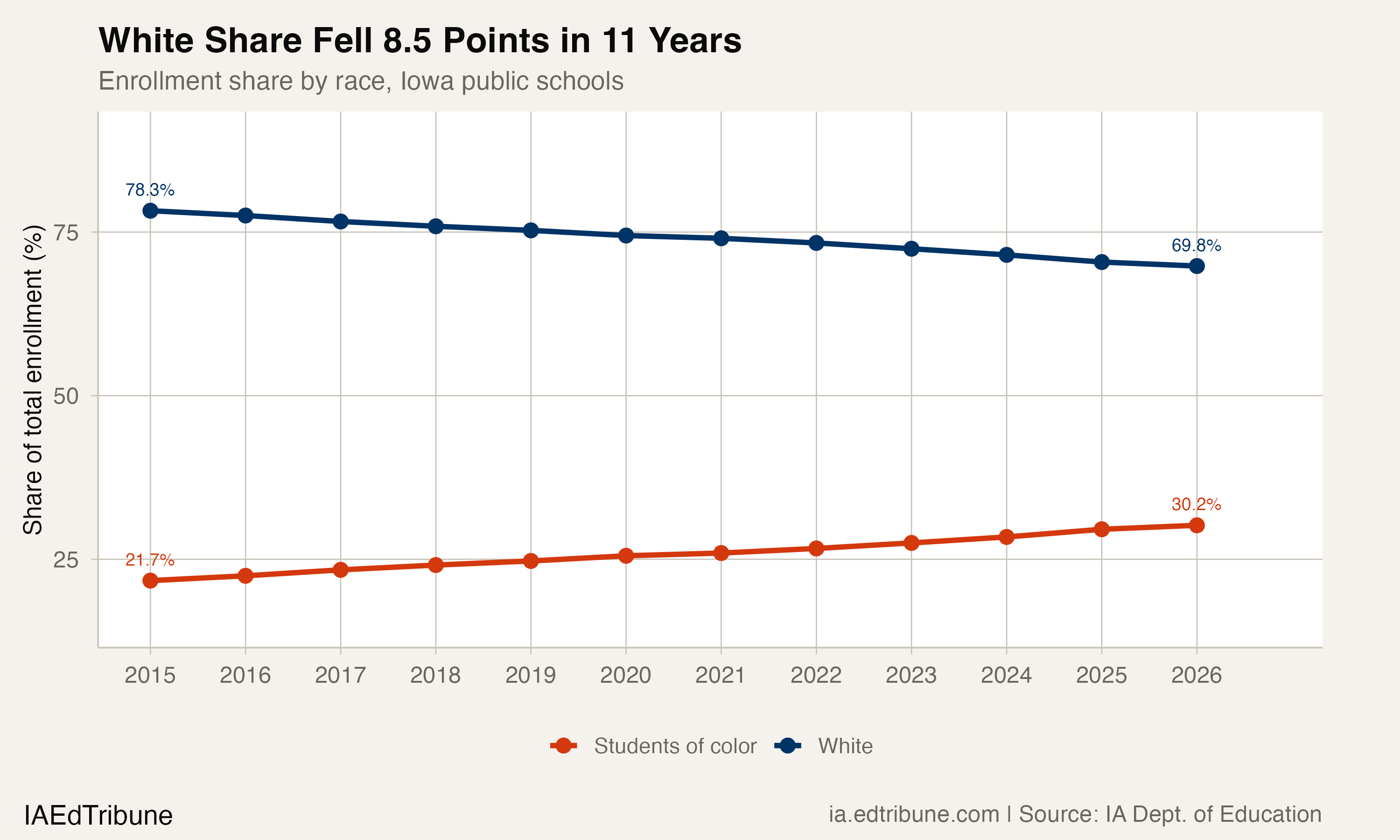
White students now make up 69.8% of Iowa's public school enrollment, down from 78.3% in 2015. That 8.5 percentage-point decline moved Iowa's schools from more than three-quarters white to just under 70%. Students of color crossed from 21.7% to 30.2% of enrollment, meaning nearly one in three Iowa public school students is now nonwhite.
At the current pace of 0.76 percentage points per year, a linear projection would put Iowa's schools below 50% white around 2052. That projection is crude and would require several assumptions about birth rates, migration, and policy to hold steady for 26 years. But the direction is unambiguous.
Why the decline is disproportionately white
The racial skew has a demographic explanation. The national total fertility rate fell to 1.62 in 2023, but that average hides variation: 75.6% of Iowa births are to white mothers, according to March of Dimes perinatal data for 2021-2023. When the birth rate falls, white enrollment absorbs most of the hit.
Rural depopulation compounds it. Two-thirds of Iowa's 99 counties lost population between 2010 and 2020. Rural Iowa is 89.9% white. When young families leave for Des Moines suburbs or leave the state, the students who vanish from rural rolls are predominantly white.
Iowa's ESA program introduces a third channel. Private school enrollment grew 6.5% in one year. No demographic breakdown of ESA users is published, but Iowa's private schools are 84% white compared to 70% in public schools. Each white student shifting from public to private appears in this data as a loss.
These forces cannot be separated cleanly. Birth rates are structural. Rural migration is decades old. ESAs are new. The combined result: white enrollment losses jumped from 2,000 per year to 8,000.
Seven districts crossed the line
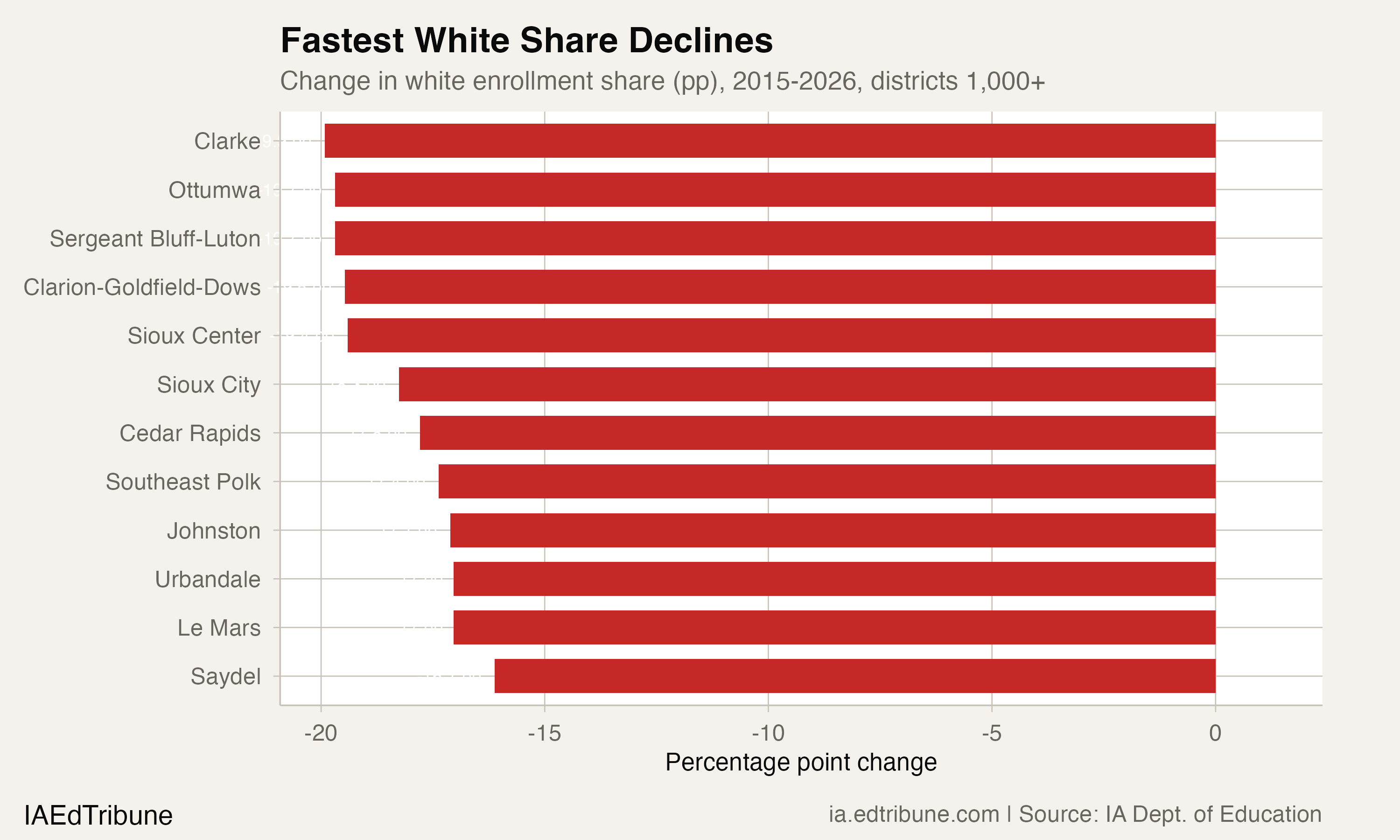
Seven Iowa districts that were majority-white in 2015 are now majority students of color: Davenport (56.9% to 46.8%), Iowa City (60.4% to 49.4%), Ottumwa (68.0% to 48.4%), Sioux Center (68.4% to 49.0%), Sioux City (53.1% to 34.9%), South Tama (53.9% to 43.9%), and Waterloo (52.5% to 37.5%). The total number of majority-minority districts in Iowa grew from eight to 20.
Sioux City's transformation is the most pronounced. In 2015, 7,803 of its 14,684 students were white, a 53.1% share. By 2026, white enrollment dropped to 4,927 of 14,124, just 34.9%. The district lost 2,876 white students while its total enrollment fell by only 560, meaning Hispanic, Black, and other nonwhite students filled much of the gap.
Des Moines was already minority-white in 2015 at 43.2%. It dropped to 30.3% by 2026, losing 5,727 white students. Des Moines is now more than two-thirds students of color.
What reporting suggests
The Iowa Department of Education's December 2025 enrollment release attributed enrollment declines broadly to "lower birth rates and fewer students progressing from grade to grade," without addressing the racial dimension directly.
"The vast majority of Iowa families chose to send their child to their high-quality neighborhood public school in 2025." — Iowa Department of Education, December 2025
That framing, while accurate on the surface, understates what is happening underneath. One in six Iowa students now uses an alternative to their neighborhood school, including open enrollment, charters, and ESA-funded private schools. The ESA program's expansion to universal eligibility in 2025-26 moved the number of participants from 27,866 to 41,044, and private school enrollment grew 6.5% in a single year.
An Iowa State University Extension report on Iowa's rural-urban population shift documented the structural context: Iowa's rural population fell by more than 278,000 between 1940 and 2020, with 82 of 99 counties experiencing rural population decreases. The number of completely rural counties increased from 21 in 2010 to 37 in 2020. Since rural Iowa is overwhelmingly white, rural depopulation feeds directly into the white enrollment pipeline.
What the data cannot resolve
The enrollment data tracks who is in public schools. It cannot distinguish between a white student who was never born, one who moved to Nebraska, one who transferred to a private school with an ESA, and one who was homeschooled. All four appear identically as a missing enrollment record.
The ESA effect is particularly difficult to isolate. The program's rapid expansion could be pulling white students out of public schools, or it could be subsidizing families who were already paying private tuition. Both reduce public school white enrollment on paper, but only the first represents an actual departure. The Iowa Department of Education reported that 1,905 students statewide switched from public to private using ESAs in 2024-25, a small fraction of the white enrollment loss. The rest is births, migration, and demographic change.
The multiracial category also introduces measurement ambiguity. Multiracial students grew by 9,350, or 54.6%, since 2015. Some of these students have one white parent. The growth in multiracial identification may partially reflect students who would have been counted as white in earlier reporting frameworks, which would overstate the "loss" of white students. Iowa changed its race/ethnicity reporting framework in 2009-10, and the effects of that reclassification may still be rippling through the data as cohorts turn over.
The 50,000th student
Iowa's white enrollment is on pace to cross below 340,000 by 2027 if the current trajectory holds. The school finance implications follow students regardless of race: Iowa funds districts primarily through per-pupil allocations, and 157 districts are already on budget guarantee, a state backstop that prevents funding from falling below the prior year.
The more consequential question is whether the state's institutions are designed for the students who are actually showing up. Iowa's teaching workforce was 97.3% white as of 2019-20, serving a student body that is now 30% students of color. If white enrollment continues to decline at the current rate while nonwhite enrollment grows, Iowa will add roughly one percentage point of diversity per year. The students are changing faster than the schools.
Detailed code that reproduces the analysis and figures in this article is available exclusively to EdTribune subscribers.
Discussion
Sign in to join the discussion.
Loading comments...