In this series: Iowa 2025-26 Enrollment.
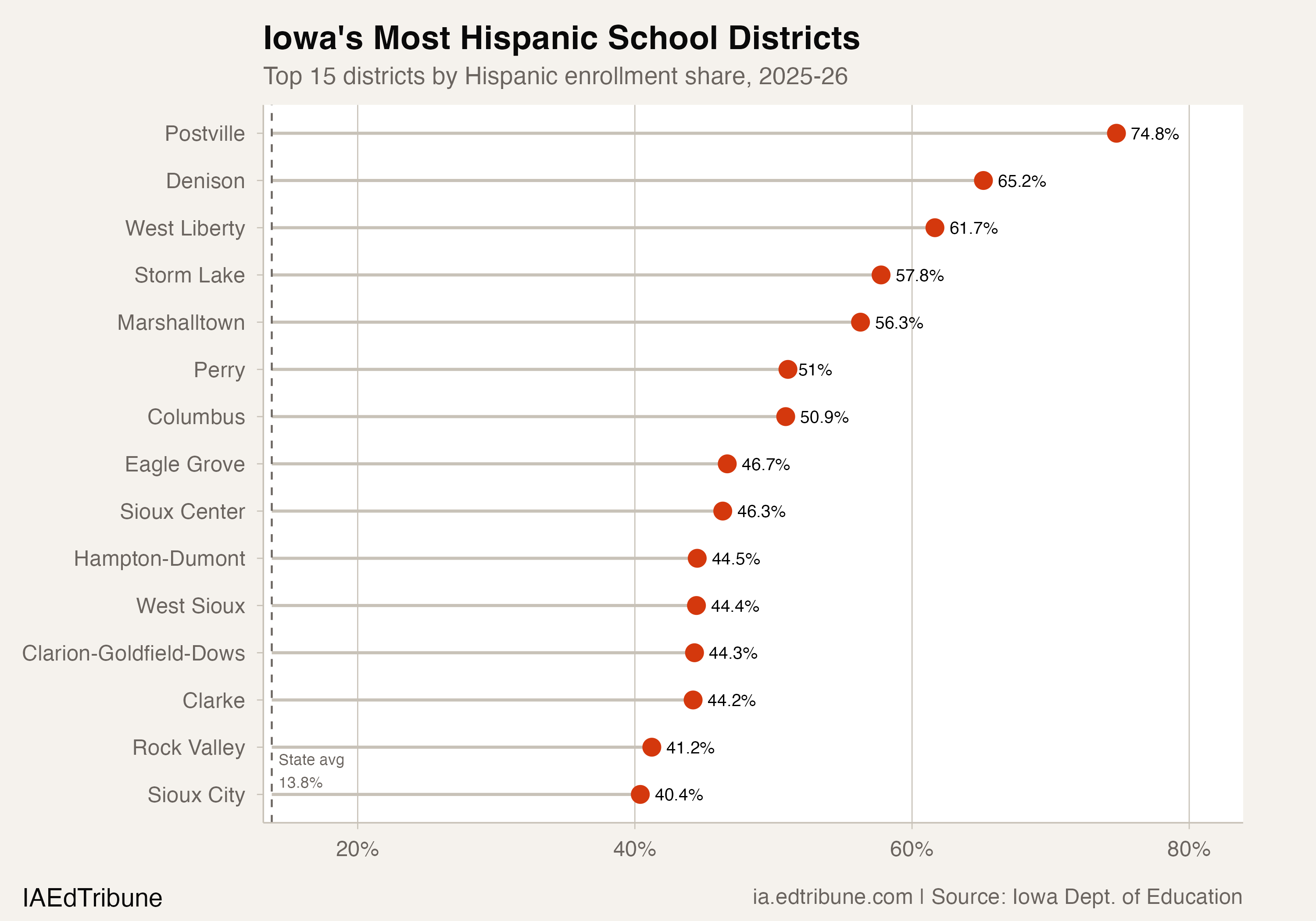
In a state that is 69.8% white in its public schools, Postville's enrollment is three-quarters Hispanic. Seven Iowa school districts now have majority-Hispanic student bodies, up from four in 2015. Another eight districts are between 40% and 50% and closing fast. Iowa is 13.8% Hispanic statewide. These towns are three to five times that.
The concentration maps precisely onto meatpacking and food processing geography. JBS in Marshalltown. Tyson in Storm Lake, Columbus Junction, and Perry. Smithfield in Denison. Agri Star in Postville. West Liberty Foods in West Liberty. The plants recruit immigrant labor. The families settle. The schools absorb the children.
The seven districts
Seven Iowa districts enrolled more Hispanic than non-Hispanic students in 2025-26:
| District | Hispanic share (2026) | Hispanic share (2015) | Change |
|---|---|---|---|
| Postville | 74.8% | 48.5% | +26.3pp |
| Denison | 65.2% | 61.1% | +4.1pp |
| West Liberty | 61.7% | 55.2% | +6.5pp |
| Storm Lake | 57.8% | 52.5% | +5.3pp |
| Marshalltown | 56.3% | 49.7% | +6.6pp |
| Perry | 51.0% | 49.2% | +1.8pp |
| Columbus | 50.9% | 60.8% | -9.9pp |
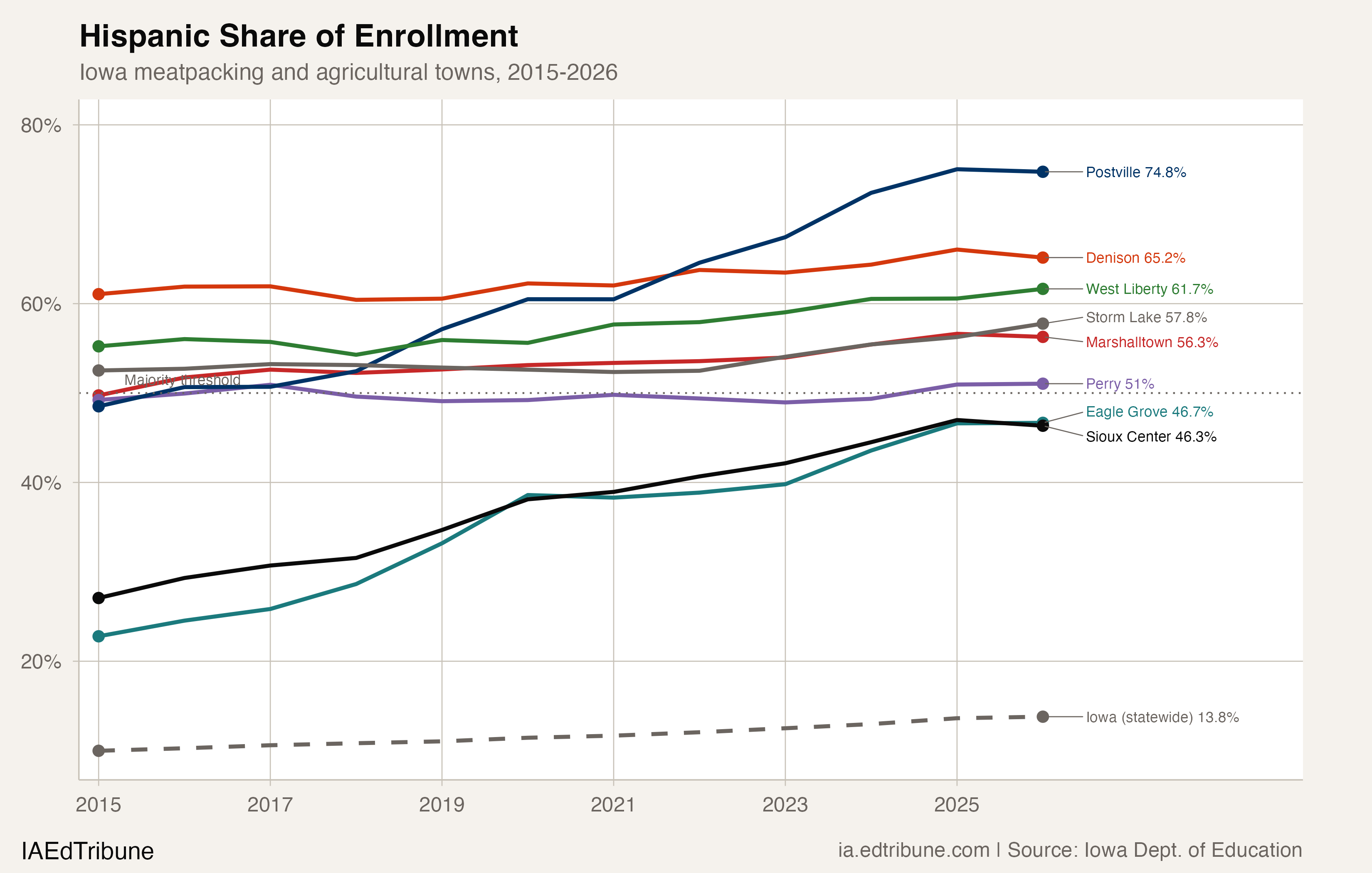
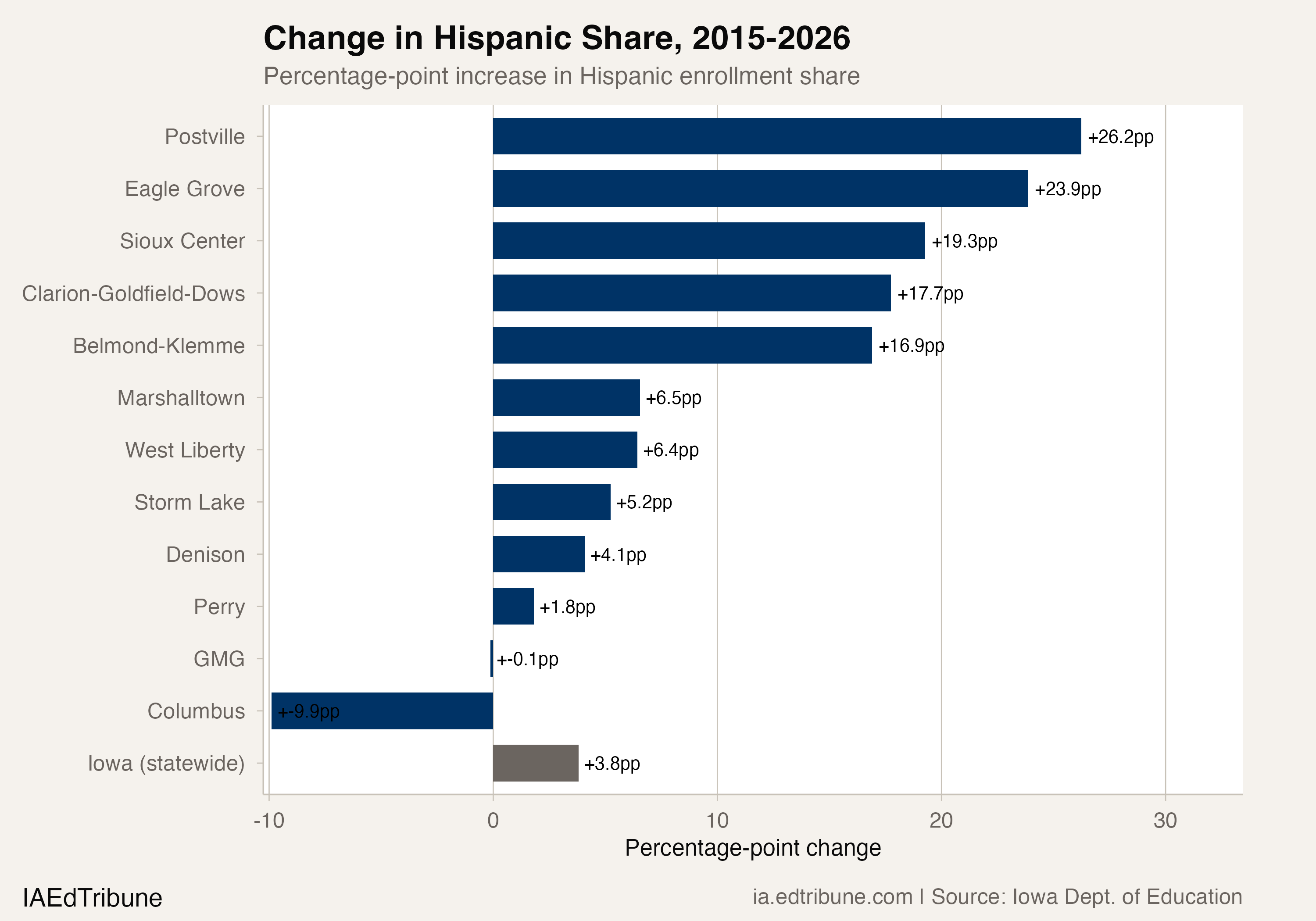
Two patterns stand out. The first is acceleration: Postville gained 26.3 percentage points of Hispanic share in 11 years, the fastest shift of any Iowa district with more than 100 students. The second is that Columbus is the lone counter-trend, its Hispanic share falling from 60.8% to 50.9% as the district lost 115 students overall.
Three of the seven crossed the 50% threshold during this period. Marshalltown and Perry were both hovering just under 50% in 2015; Postville was at 48.5%. Denison, West Liberty, Storm Lake, and Columbus were already majority-Hispanic a decade ago.
The next wave
The more striking story may be the districts that are not yet majority-Hispanic but are heading there fast. Eagle Grove went from 22.8% to 46.7% Hispanic in 11 years, a gain of 23.9 percentage points. Sioux Center went from 27.1% to 46.3%, a 19.2 percentage-point shift. Both are within a few years of crossing 50%.
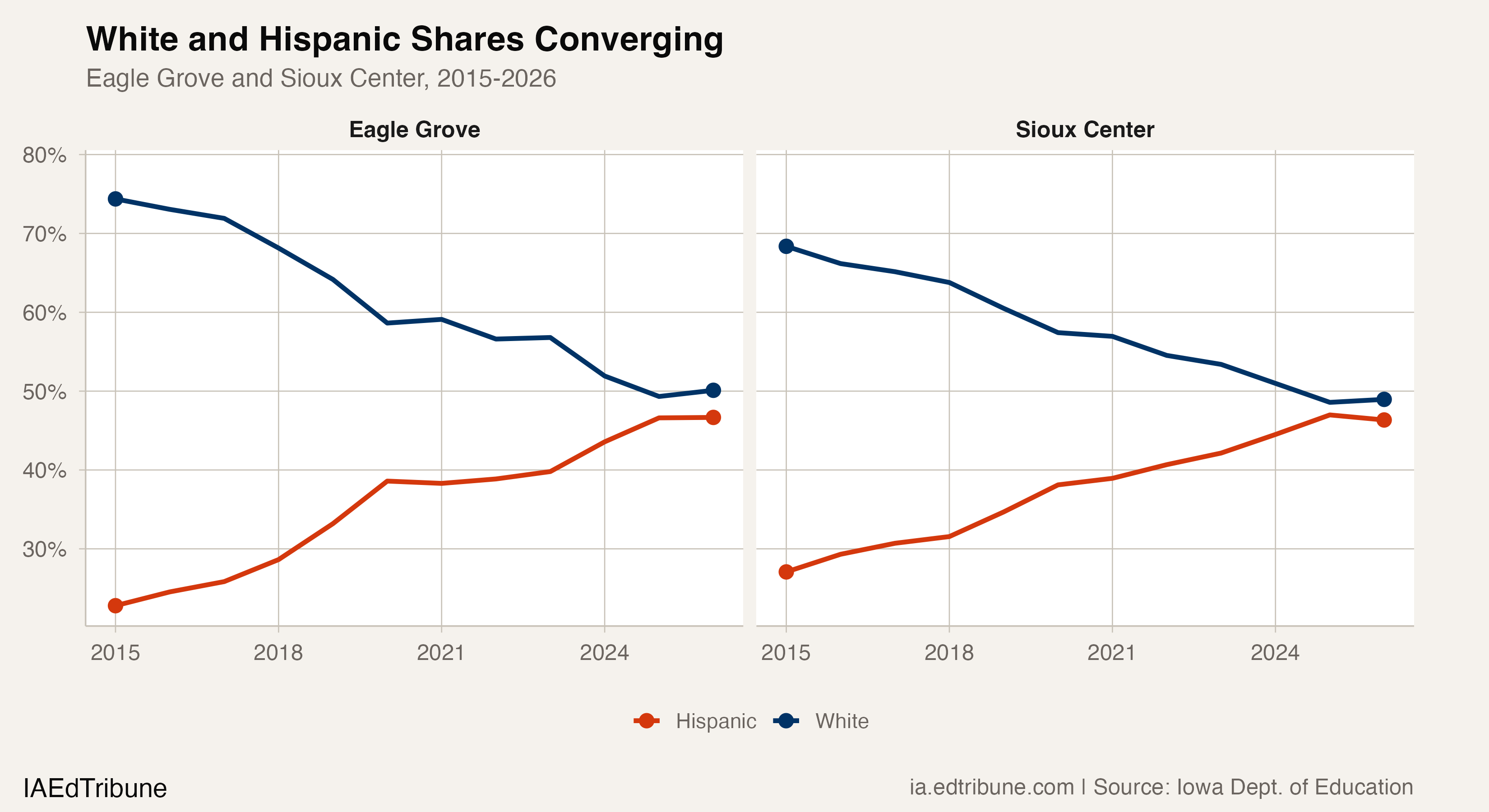
In Eagle Grove, Prestage Foods opened a $320 million pork processing plant in March 2019, employing roughly 900 workers. The school district's total enrollment jumped from 882 to 1,008 in five years, entirely on the strength of Hispanic enrollment growth, which nearly doubled from 201 to 389 students over the same period. White enrollment barely moved.
Clarion-Goldfield-Dows gained 17.7 percentage points of Hispanic share, reaching 44.3%. Belmond-Klemme gained 17.0 points to reach 38.0%. Clarke gained 17.4 points to 44.2%. Eight districts total sit between 40% and 50% Hispanic.
Postville's trajectory
Postville is the most concentrated example in the state. In 2008, ICE conducted what was then the largest workplace immigration raid in U.S. history at the Agriprocessors meatpacking plant, arresting 389 workers. The town of 2,200 lost nearly 20% of its population in a single afternoon. The school district went into emergency lockdown; a third of elementary and middle school students were absent the following days.
"Common noises, such as lawn mowers or helicopters, made students jumpy or have an emotional reaction." -- Colorin Colorado, "Lessons from Postville"
The plant was bought and reopened as Agri Star in 2009, recruiting workers through visa programs. The Hispanic community rebuilt, and by 2016 Postville had crossed 50% Hispanic enrollment. By 2026, nearly three out of four students are Hispanic. White enrollment fell from 278 to 142 over the same period, a 49% decline.
The enrollment data cannot distinguish between families who arrived as new immigrants and children already present who were counted differently across years. But the sustained, monotonic growth from 48.5% to 74.8% across 11 years suggests genuine arrival and settlement rather than a one-time reclassification event.
What the plants mean for schools
Meatpacking plants do not just reshape school demographics. They reshape school budgets. Districts with high proportions of English learners receive supplemental state and federal funding, but the instructional programs those students receive carry higher per-pupil costs. Denison's school district has over 700 English language learners in a district of roughly 2,200 students, and 23 languages are spoken in its hallways.
The operational challenge is staffing. Denison runs a dual language program where students alternate between English and Spanish instruction weekly, and roughly a dozen of its current ELL teachers are themselves former students in the district.
"When your teaching staff can mirror your student population, connections are more automatic." -- Kim Buryanek, Superintendent, Denison Community Schools, Iowa Public Radio, Sept. 2024
Storm Lake's school district is 87% non-white, with 23 languages spoken across fewer than 3,000 students. In a district that small, finding certified bilingual teachers for every language group is structurally impossible. These districts improvise with paraprofessionals, community liaisons, and grow-your-own pipelines.
Growing while Iowa shrinks
Iowa's total enrollment fell from 506,336 to 496,617 between 2015 and 2026, a loss of 9,719 students. Several meatpacking towns moved in the opposite direction. Sioux Center grew 31.0%, from 1,315 to 1,722 students. Storm Lake grew 19.6%, from 2,477 to 2,962. Eagle Grove grew 8.8%. These are among the fastest-growing districts in the state, and all of that growth came from Hispanic enrollment.
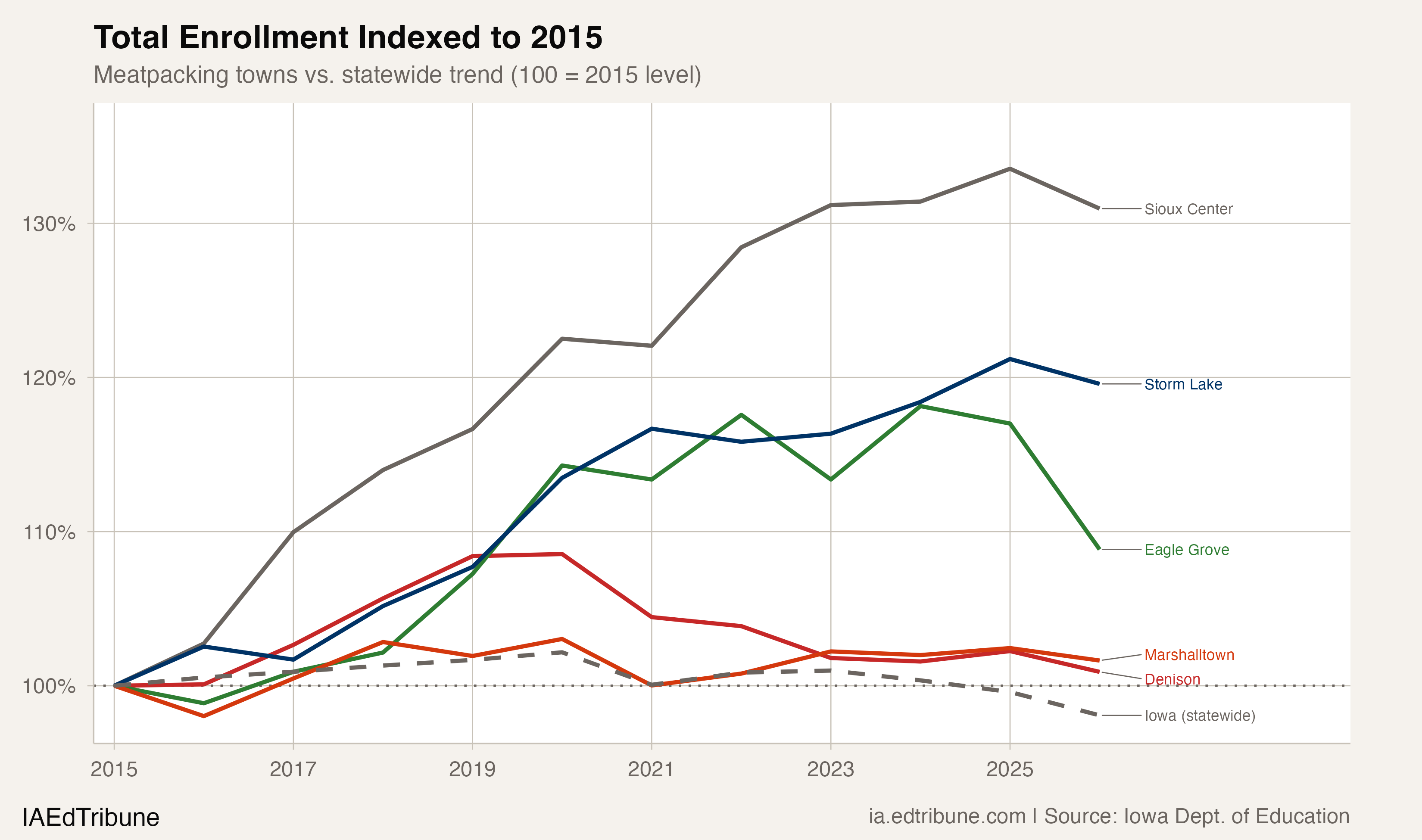
Not every meatpacking town is growing. Perry lost 136 students after Tyson Foods closed its pork processing plant in June 2024, eliminating 1,300 jobs in a town of 8,000. The school district dropped from 1,858 to 1,722 students in two years, a 7.3% decline. An estimated 300 students had a household connection to a Tyson employee.
Perry illustrates the dependency: when the plant closes, families leave and enrollment collapses. The district's Hispanic share actually ticked up from 49.4% to 51.0% after the closure, suggesting that non-Hispanic families may have left at higher rates, or that the remaining Hispanic population has deeper community roots.
The fragility of the model
The meatpacking employment model that sustains these towns is under direct policy pressure. In July 2025, JBS notified more than 200 workers at its Ottumwa plant that their work visas had been revoked under the termination of the CHNV parole program. Workers from Haiti, Cuba, Nicaragua, and Venezuela received termination letters with immediate effect.
"Workers did everything right. They followed the procedure." -- Brian Ulin, union representative, NBC News, July 2025
The Ottumwa plant is the city's largest employer, with roughly 2,500 workers. Statewide, approximately 42% of meatpacking workers are immigrants. If visa revocations expand beyond the CHNV program, the enrollment pipeline feeding these districts could slow or reverse. The data cannot yet show whether the 2025-26 enrollment figures reflect any ICE-related withdrawals; those effects would appear in 2026-27 counts at the earliest.
Iowa's statewide Hispanic enrollment dipped by 197 students in 2026, only the second decline in the dataset (the other was a negligible 45-student dip during COVID in 2021). Whether that inflection reflects immigration enforcement, demographic maturation, or statistical noise is not yet clear. If it reflects enforcement, the towns with the highest Hispanic concentration face the sharpest exposure.
Detailed code that reproduces the analysis and figures in this article is available exclusively to EdTribune subscribers.
Discussion
Sign in to join the discussion.
Loading comments...