In this series: Iowa 2025-26 Enrollment.
In 2015, Mason City enrolled seven Pacific Islander students. By 2026, that number was 228. Ottumwa went from 29 to 475. Sioux City from 30 to 454. These are not rounding errors in large urban districts. They are small Iowa cities where a single demographic group grew by 1,000% or more in 11 years, and where one in 10 students now belongs to a community most Iowans have never encountered.
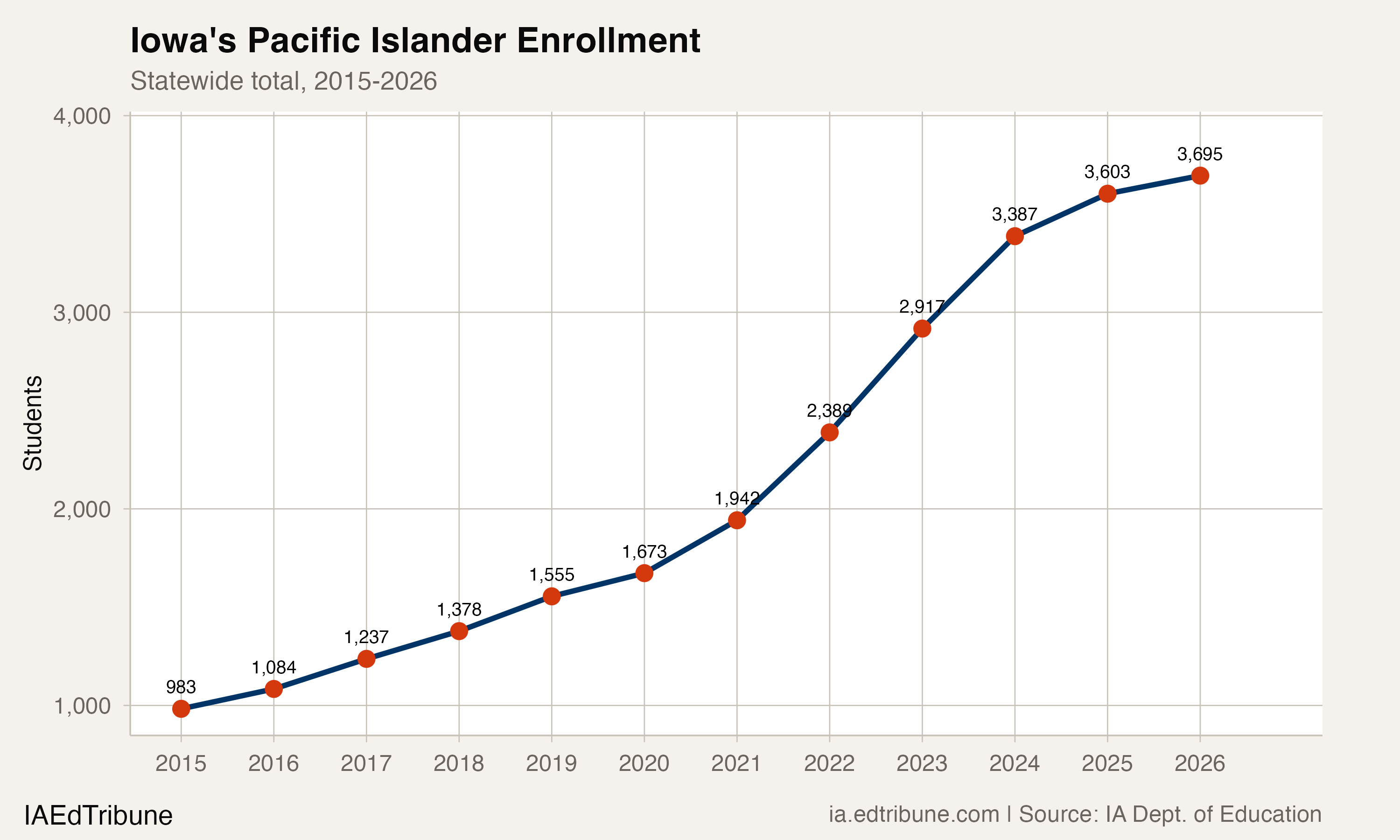
Iowa's Pacific Islander student population rose from 983 to 3,695 between 2015 and 2026, a 275.9% increase that makes it the fastest-growing racial or ethnic group in the state's public schools by a wide margin. The next-closest, multiracial students, grew 54.6%. The growth is overwhelmingly concentrated in six meatpacking and industrial towns: Ottumwa, Sioux City, Waterloo, Storm Lake, Mason City, and Dubuque. Together, those six districts account for 69.1% of the statewide increase.
A community rooted in nuclear history
The numbers trace to a specific population: Marshallese families, citizens of the Republic of the Marshall Islands who can live and work in the United States under the Compact of Free Association. The compact, signed in 1986, was part of the U.S. government's response to decades of nuclear weapons testing in the Marshall Islands during the 1940s and 1950s. Over 50% of all Marshallese now reside in the United States, according to the Migration Policy Institute.
The largest mainland Marshallese community is in northwest Arkansas, drawn there by poultry processing jobs at Tyson Foods. Iowa's communities appear to follow the same pattern: meatpacking employment at JBS, Tyson, and other plants in towns where jobs are plentiful and housing is affordable. Dubuque's Marshallese community is the oldest in the state, dating to the early 1990s, and now numbers approximately 1,400 residents, making it the largest Marshallese population in the Midwest.
The settlement pattern is not random. Every one of the top six districts for Pacific Islander growth hosts a major meatpacking or food processing operation. Storm Lake has Tyson's pork and poultry complexes. Ottumwa has JBS. Waterloo has Tyson and John Deere. The communities grow through chain migration: one family finds work, settles, and tells relatives.
Six towns, one pattern
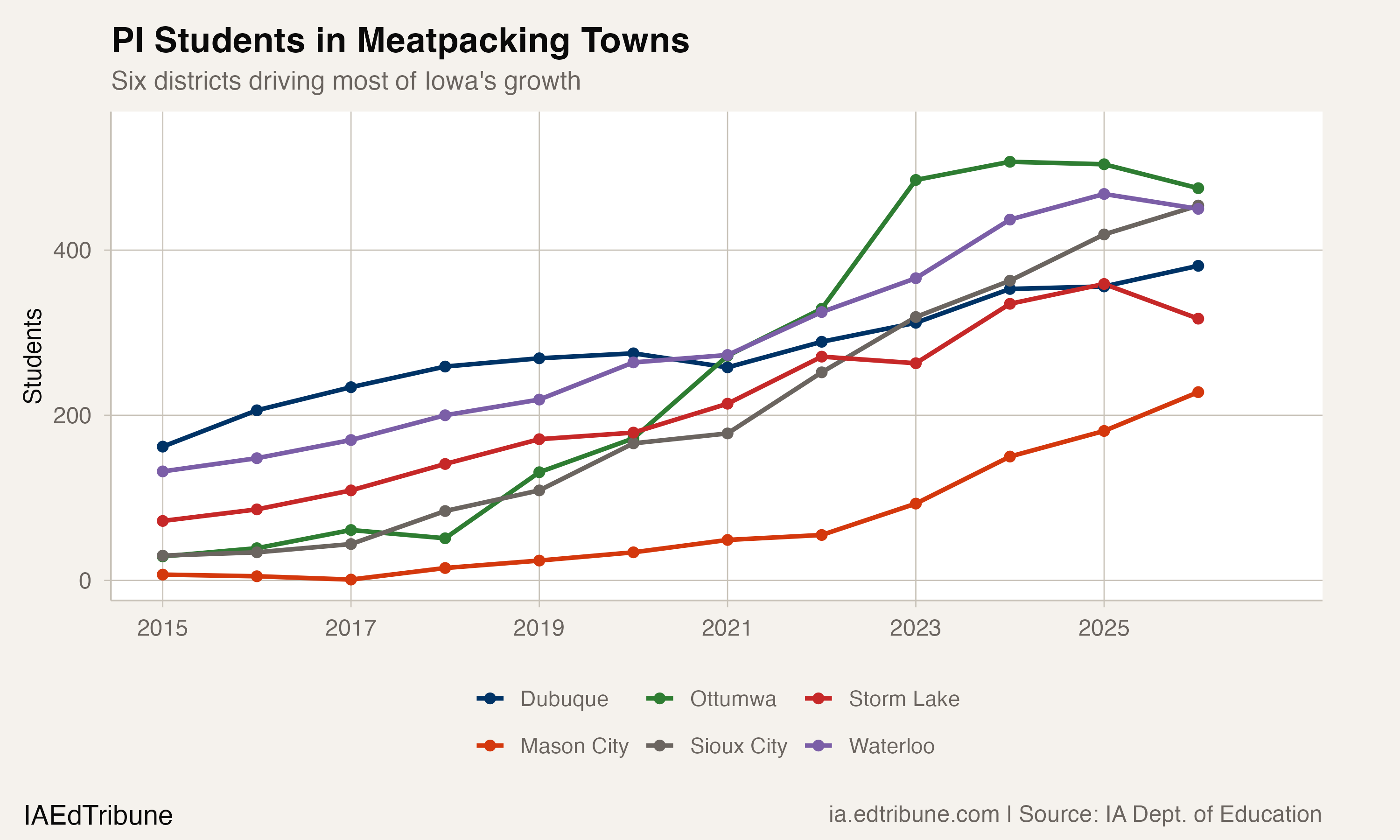
The six districts tell distinct stories within the same broad pattern.
Ottumwa has the largest Pacific Islander student population in the state at 475, representing 9.9% of district enrollment. Growth was explosive from 2019 to 2023, when the count jumped from 131 to 485. But Ottumwa peaked at 507 students in 2024 and has since declined, possibly reflecting the visa revocations at JBS in 2025 that displaced roughly 200 workers. Whether those were Marshallese workers or other nationalities is not clear from available reporting.
Storm Lake has the highest concentration: 10.7% of its 2,962 students are Pacific Islander. In a district where Tyson employs over 3,000 people and the student body is already majority non-white, the Marshallese represent the latest wave in a decades-long pattern of immigrant labor filling meatpacking jobs.
Mason City shows the steepest trajectory. From seven students in 2015 to 228 in 2026, a 3,157% increase, the Pacific Islander share of district enrollment went from 0.2% to 6.7%.
Sioux City, the largest of the six districts at 14,124 students, added 424 Pacific Islander students. The absolute numbers are large, but at 3.2% of enrollment, the concentration is lower than in smaller towns.
Waterloo and Dubuque round out the top six. Waterloo's 450 Pacific Islander students make up 4.3% of enrollment. Dubuque's 381 students represent 3.8%, but the community's roots go back three decades.
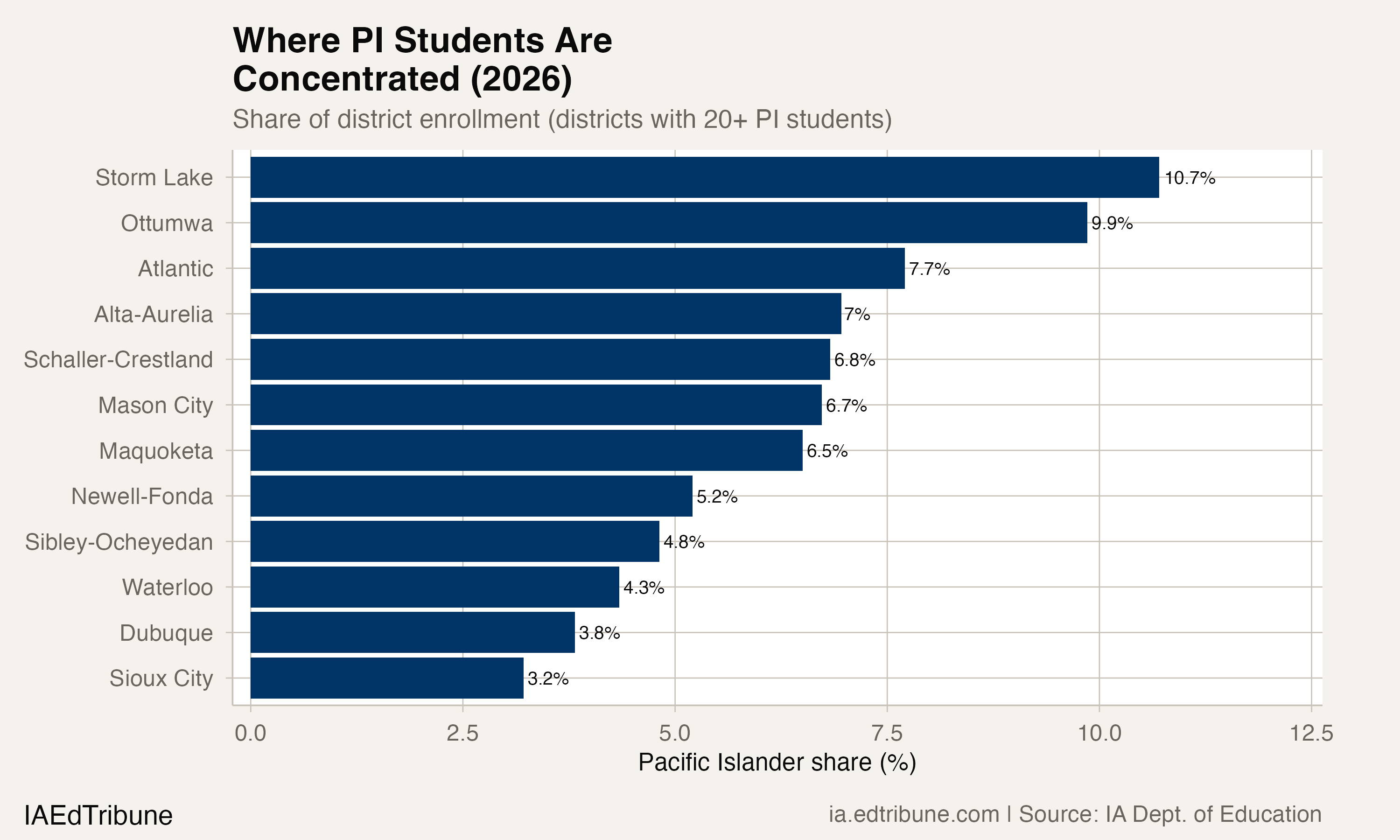
The concentration beyond the top six
The share chart reveals something the absolute numbers obscure. Atlantic, a district of 1,544 students in western Iowa, is 7.7% Pacific Islander. Alta-Aurelia, with 862 students, is 7.0%. Schaller-Crestland, population 293, is 6.8%. Maquoketa, at 1,215 students, is 6.5%. These are small towns where 20 to 120 Pacific Islander students constitute a significant share of the school community.
A crossover five years in the making
In 2021, Pacific Islander enrollment surpassed Native American enrollment statewide for the first time. By 2026 the gap had widened to 3,695 versus 1,529. The two trajectories are mirror images: Pacific Islanders grew 275.9% while Native Americans declined 23.2%.
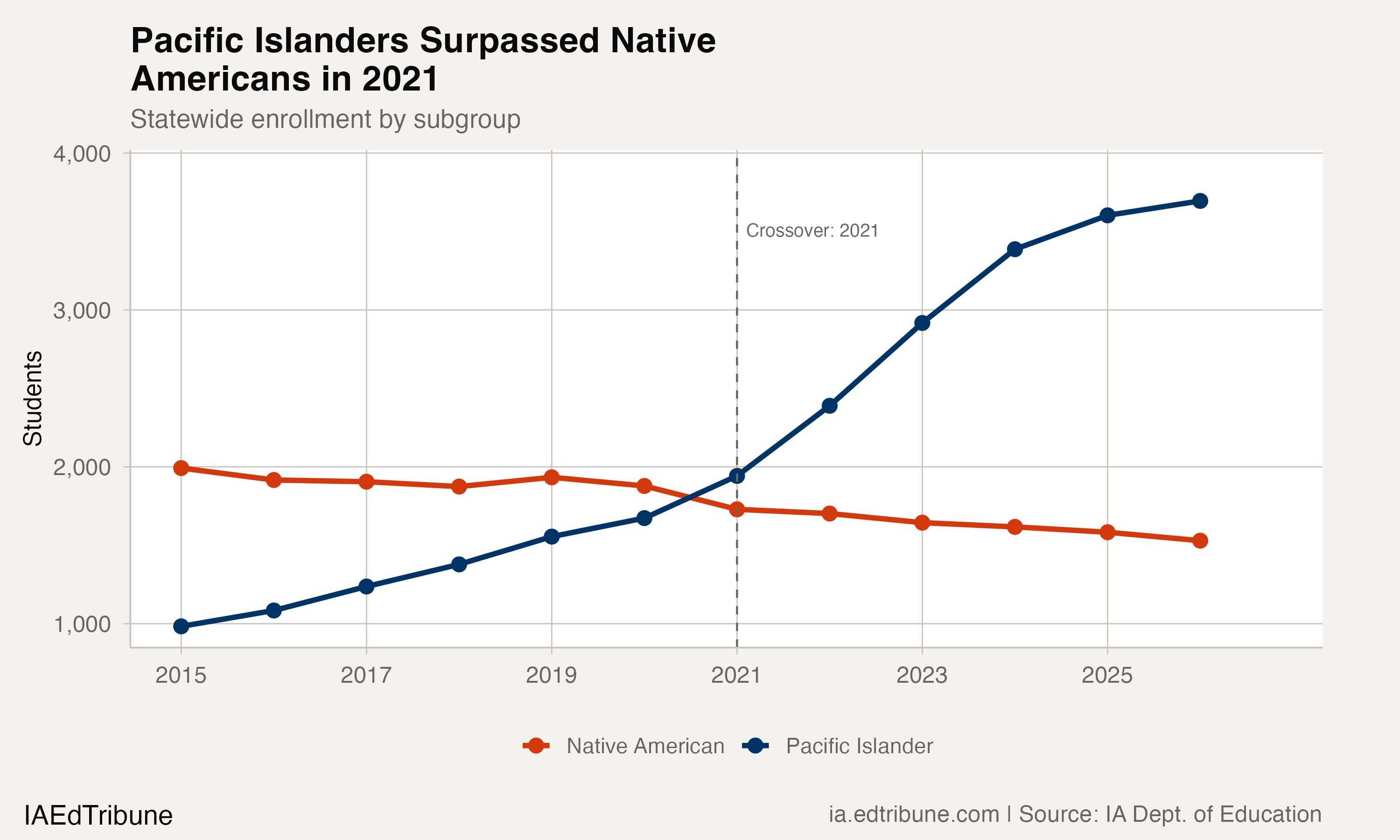
The crossover is notable because Native American students have been part of Iowa's enrollment reporting for decades. Pacific Islanders were a rounding error as recently as 2015, less than 0.2% of statewide enrollment. They now represent 0.74%, and in the communities where they are concentrated, they are a core constituency the school system must serve.
Schools scrambling for capacity
The growth has outpaced institutional preparation. The Iowa Department of Education designated Ottumwa High School a "Priority" school in November 2024, the lowest performance rating in its system. The department specifically identified Hawaiian and Pacific Islander students as a group struggling academically.
"It can be challenging with languages like Marshallese and Tonga where we don't have a lot of expertise locally." -- David Cassels Johnson, University of Iowa, via KYOU-TV, Nov. 2024
The language gap is structural. Marshallese is spoken by roughly 44,000 people worldwide. Finding certified bilingual educators or even interpreters in rural Iowa is not a staffing challenge that scales the way Spanish-language support does.
In Dubuque, a University of Iowa research project found that chronic absenteeism among Pacific Islander students runs at approximately 78%, compared to a general K-12 rate above 30%. The researchers identified a lack of belonging as the primary driver, with bullying and insufficient cultural competency training for staff cited as contributing factors.
"A key factor behind students' absenteeism is tied to a lack of belonging." -- University of Iowa, Iowa Initiative for Sustainable Communities, April 2024
The 78% figure, if accurate across districts, means that in a town like Storm Lake, where Pacific Islanders are one in 10 students, chronic absenteeism in this group alone could drag district-wide metrics.
The deceleration question
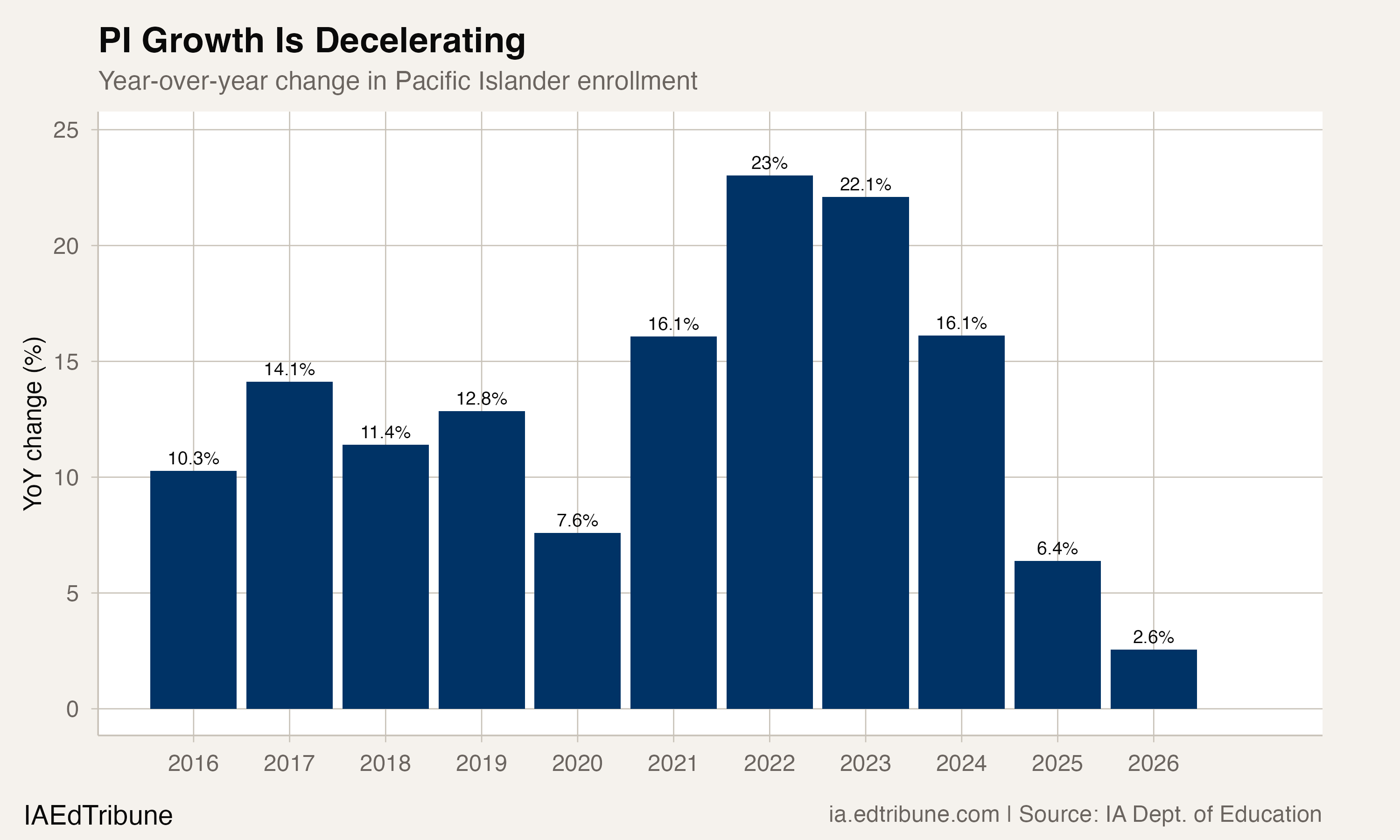
After a decade of double-digit annual growth, Pacific Islander enrollment growth slowed sharply. The year-over-year increase fell from 23.0% in 2022 to 6.4% in 2025 and just 2.6% in 2026. Ottumwa and Waterloo both posted slight declines from their 2024 peaks.
Multiple factors could explain the slowdown. The most direct is immigration enforcement: in July 2025, JBS notified roughly 200 Ottumwa workers that their legal status had changed under new federal policy. While the affected workers were primarily from Haiti and Central America, the enforcement climate may have discouraged secondary migration by Marshallese families who, despite having legal status under COFA, face deportation risk if travel documents lapse.
An alternative explanation is simply that the initial migration wave has plateaued. Chain migration networks are not infinite. If the original draw was a handful of meatpacking plants, the labor demand at those plants sets a ceiling on community size. The enrollment data cannot distinguish between families who stopped arriving and families who arrived but chose not to stay.
What the enrollment data does not show
This analysis relies exclusively on enrollment counts by race, which means it cannot confirm that these students are Marshallese rather than Tongan, Samoan, or from other Pacific Island nations. The "Pacific Islander" category in Iowa's data encompasses all Native Hawaiian and Pacific Islander students. The geographic concentration in meatpacking towns and the alignment with known Marshallese settlement patterns in Dubuque make the Marshallese hypothesis the most likely explanation, but the data does not prove it.
The data also cannot measure what happens to students after they enroll. The 78% chronic absenteeism figure from Dubuque suggests that enrollment counts may overstate actual participation in schooling. Whether similar patterns hold in Ottumwa, Storm Lake, or Mason City is unknown from enrollment data alone.
A question of capacity
Iowa added 2,712 Pacific Islander students in 11 years. That is a rounding error in a state of 496,617 students. It is not a rounding error in Ottumwa, where one in 10 students speaks a language almost no Iowa teacher was trained to support, or in Storm Lake, where district staff must now serve Marshallese families alongside Lao, Somali, and Mexican communities that arrived in earlier immigration waves.
The growth rate has slowed, but the students are here. The question facing these districts is not whether the numbers will keep climbing. It is whether the schools built for a different student body can adapt to the one they have.
Detailed code that reproduces the analysis and figures in this article is available exclusively to EdTribune subscribers.
Discussion
Sign in to join the discussion.
Loading comments...