In this series: Iowa 2025-26 Enrollment.
Eighteen years after 900 federal agents descended on this northeast Iowa town and arrested 389 meatpacking workers in the largest workplace immigration raid in U.S. history, Postville's schools are three-quarters Hispanic. The share has not declined. It has nearly doubled.
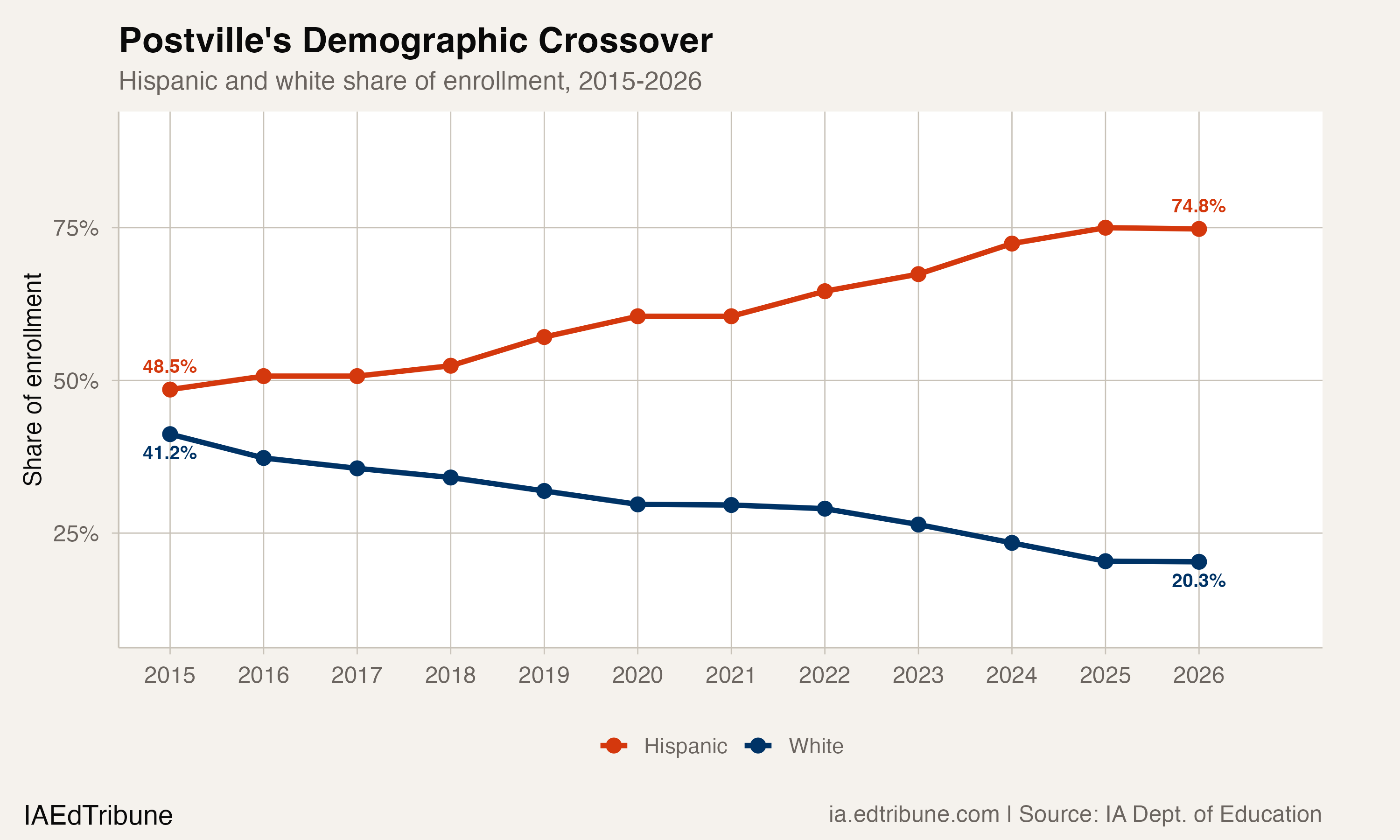
In 2014-15, Hispanic students made up 48.5% of Postville's enrollment. By 2025-26, that figure reached 74.8%, the highest of any district in Iowa and 5.4 times the statewide rate of 13.8%. The next-closest district, Denison, is at 65.2%. Postville is not just an outlier among Iowa's meatpacking towns. It is in a category by itself.
From raid to rebuild
On May 12, 2008, ICE agents raided the Agriprocessors kosher meatpacking plant and detained roughly 20% of the town's population. The plant went bankrupt. Businesses closed. Half the town's residents left.
"When the raid happened, the town was desolate, I mean there was nobody around." -- Bob Schroeder, Postville resident, via KCRG, Jan. 2025
The plant reopened under new ownership as Agri Star Meat and Poultry, which a 2024 investigation described as processing roughly 50,000 chickens daily and employing about 325 people. The workforce that rebuilt the plant was predominantly Hispanic, and the families that followed rebuilt the town. Postville's school enrollment grew from 674 in 2015 to a peak of 767 in 2020, a 13.8% increase driven almost entirely by Hispanic families.
The enrollment data tells the story of that rebuild in annual increments. Hispanic enrollment rose from 327 to 553 between 2015 and 2025, adding 226 students while white enrollment fell by 128 and Black enrollment dropped by 23. The district grew because Hispanic families arrived faster than other families left.
The 26-point shift
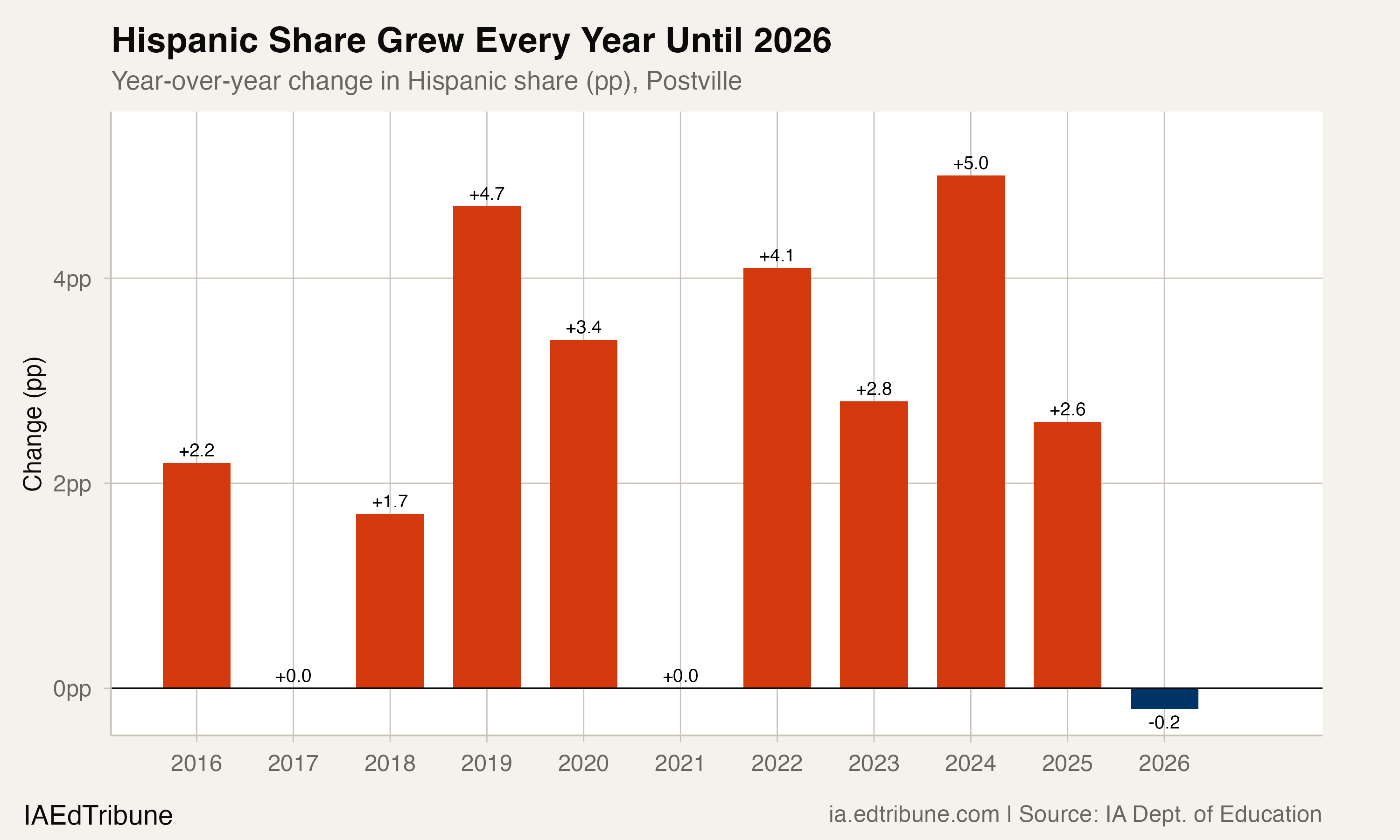
The speed of Postville's demographic change has no parallel in Iowa. Hispanic share rose 26.3 percentage points in 11 years, averaging 2.4 points per year. The steepest single-year jumps came in 2019 (+4.7pp), 2024 (+5.0pp), and 2022 (+4.1pp). White share fell from 41.2% to 20.3% over the same period, a 20.9-point decline.
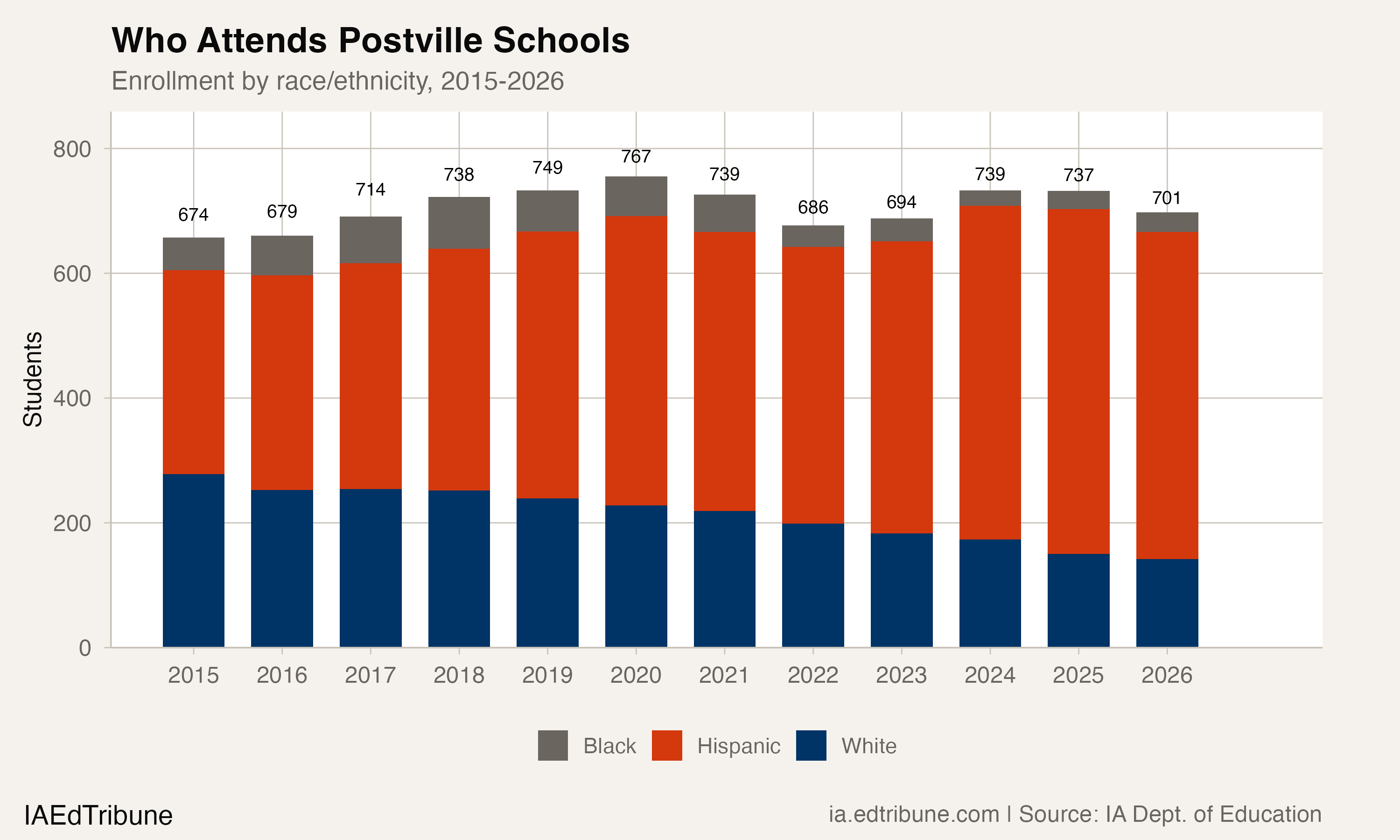
The stacked bars reveal something the share lines obscure: total enrollment is volatile. Postville peaked at 767 students in 2020, dropped 81 students over the next two years, recovered to 739 by 2024, then fell again to 701 in 2026. These are not small fluctuations in a large district. In a school of 701 students, a single classroom of families moving in or out shifts the share chart.
The Black student population followed its own trajectory. It peaked at 83 students (11.2% of enrollment) in 2018, then collapsed to 32 (4.6%) by 2026, a 61.4% decline. The enrollment data cannot explain why. One possibility is that Black workers who came to Agri Star in the plant's early years under new ownership have since moved on. Another is that the Black population was partially composed of refugee families whose resettlement patterns shifted.
Where Postville fits among Iowa's meatpacking towns
Postville is the extreme case, but it is not unique. Seven Iowa districts now have majority-Hispanic enrollment, up from four in 2015. All seven are meatpacking or food-processing communities.
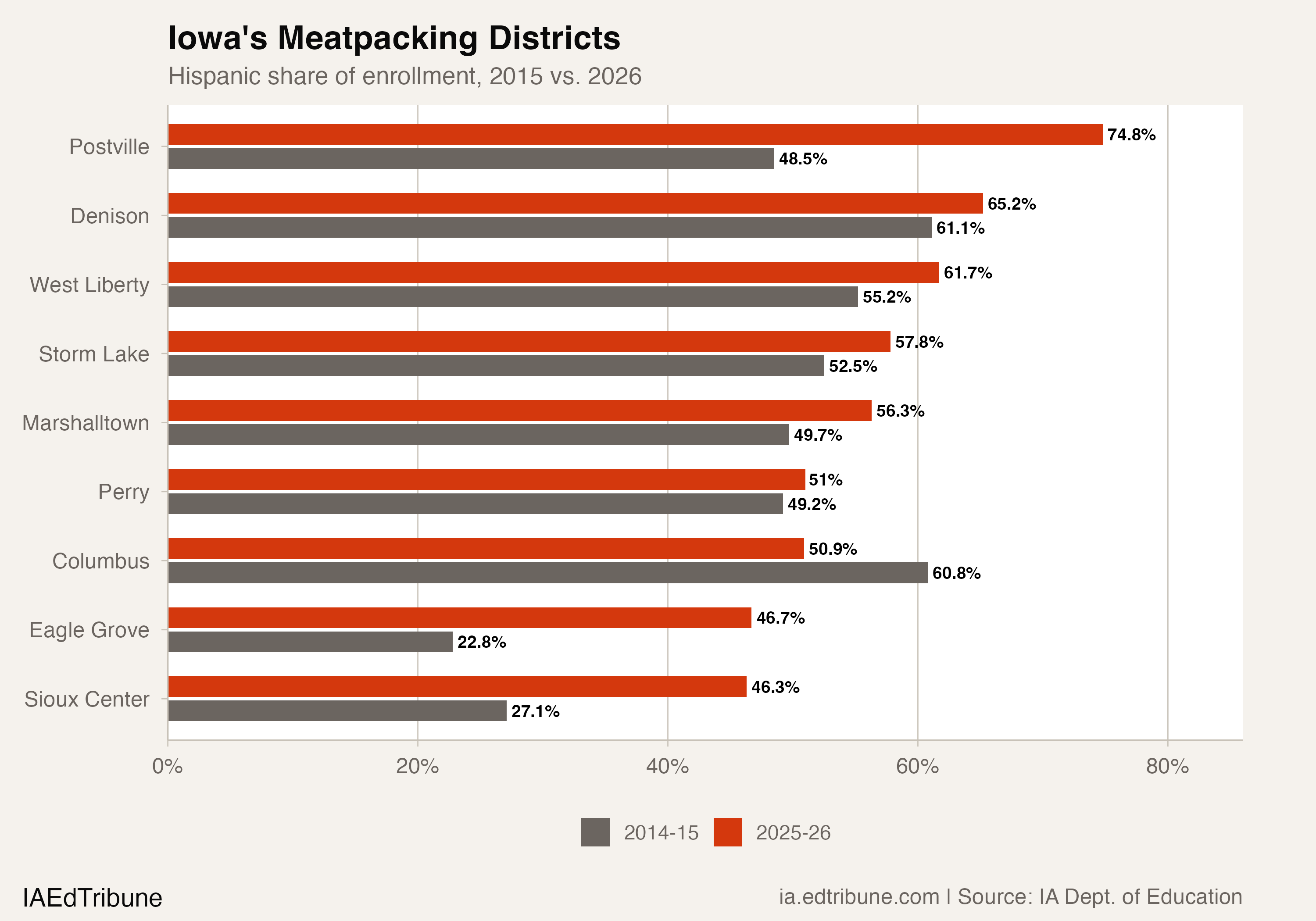
The comparison chart reveals distinct patterns within the meatpacking cohort. Eagle Grove and Sioux Center nearly doubled their Hispanic shares (+23.9pp and +19.2pp respectively), suggesting rapid recent growth. Marshalltown and Storm Lake, which were already majority-Hispanic in 2015, added smaller increments. Columbus stands out as the only district in the group where the Hispanic share actually fell, dropping from 60.8% to 50.9%.
Perry barely moved (+1.8pp) despite starting at 49.2%. Denison, the second-most Hispanic district at 65.2%, grew only 4.1 points. The meatpacking connection creates a floor for Hispanic enrollment, but the ceiling depends on local factors the enrollment data does not capture: plant capacity, housing availability, the presence or absence of established community networks.
The 2026 dip
After a decade in which the Hispanic share rose or held steady every year, Postville's trajectory reversed in 2026. Hispanic enrollment fell by 29 students (from 553 to 524), and total enrollment dropped 36. The Hispanic share dipped from 75.0% to 74.8%, a 0.2-point decline that is within normal fluctuation for a small district but still marks the first reversal in the data window.
The timing aligns with heightened immigration enforcement nationwide. In June 2025, ICE resumed workplace raids at Iowa meatpacking plants, and community members in Postville have expressed concern about a repeat of 2008.
"We need the work of our immigrants. We need their presence. We get enriched through their presence. And yet we will not give them a welcome." -- Sister Mary McCauley, pastoral administrator at St. Bridget church during the 2008 raid, via KCRG, Jan. 2025
Whether the 2026 dip reflects enforcement-driven departures, normal year-to-year variation in a small district, or something else entirely is impossible to determine from enrollment counts alone. A 29-student decline in a district of 701 could be five families leaving. It could be a cohort timing effect. It could be the beginning of a trend. One year of data in a district this small is not a pattern.
A town that runs on one plant
What makes Postville's concentration unusual, even among meatpacking towns, is the degree to which the entire community depends on a single employer. Agri Star's 325 jobs represent roughly one position for every eight town residents. The average household income of $46,522 is about a third below the state average, and the poverty rate is more than double Iowa's.
The plant's environmental record adds another dimension. In March 2024, Agri Star discharged more than 250,000 gallons of untreated food processing waste into the city's wastewater system, forcing a two-day shutdown of the water treatment facility. Postville has recorded the highest number of EPA enforcement cases in Iowa over the past two decades, with four of five linked to Agri Star. The town's school population depends on the plant. So does its infrastructure.
Iowa's birth rate has fallen to 1.7 births per woman, well below replacement level. David Peters, an Iowa State University sociologist, told Iowa Public Radio that "immigrants tend to have larger families for cultural and social reasons, and that has really helped stabilize rural birth rates." Without immigration, the economist Ben Murrey estimated, Iowa would lose "11,000 labor force participants and $300 million in state domestic product" over four years.
Postville is the most concentrated version of this dynamic. Statewide, Iowa lost 11,490 students in the past two years. Meatpacking towns like Postville, Storm Lake, and Marshalltown are among the few rural communities in the state that have grown at all.
What the data does not resolve
The enrollment data tracks students by race, not by immigration status, language, or how long they have lived in the community. A student counted as "Hispanic" in the enrollment file could be a child born in Postville to parents who arrived 15 years ago, or a recent arrival from Guatemala. The data cannot distinguish between the two, and the difference matters for understanding what the district needs: a school serving primarily U.S.-born bilingual students faces different instructional challenges than one receiving new arrivals who have never attended school in English.
The data also cannot measure whether Postville's 2026 dip is the start of a reversal or a one-year blip. In a 701-student district, statistical noise is loud. At 2.4 percentage points per year, the Hispanic share could approach 80% by 2028 if the prior trend resumes. If the 2008 raid's aftermath is any guide, it could also fall sharply and take years to recover.
A test case on repeat
Postville has been here before. The 2008 raid gutted the town's workforce and emptied its schools overnight. The community rebuilt over the next decade, slowly, around the same industry that drew the original workers. Now, with 75% of its students Hispanic, 325 plant jobs holding the town's economy together, and a federal enforcement posture that echoes 2008, Postville faces the same structural vulnerability it faced 18 years ago: a school system and a local economy built almost entirely on the continued presence of immigrant labor in a single meatpacking plant.
The question is not whether Postville's schools can serve a 75% Hispanic student body. They already do. The question is what happens to those 524 students if the plant, or the enforcement climate, changes again.
Detailed code that reproduces the analysis and figures in this article is available exclusively to EdTribune subscribers.
Discussion
Sign in to join the discussion.
Loading comments...