Correction (April 12, 2026): An earlier version of this article described Cedar Rapids' 2026 loss as its "steepest single-year drop." In fact, 2021's loss of 811 students was larger; the 2026 loss of 649 is the second-largest. The article also stated that nine of Iowa's 10 largest districts were at record lows. The correct number is seven; Iowa City, Waukee, and Ankeny are not at record lows. Both errors have been corrected.
In this series: Iowa 2025-26 Enrollment.
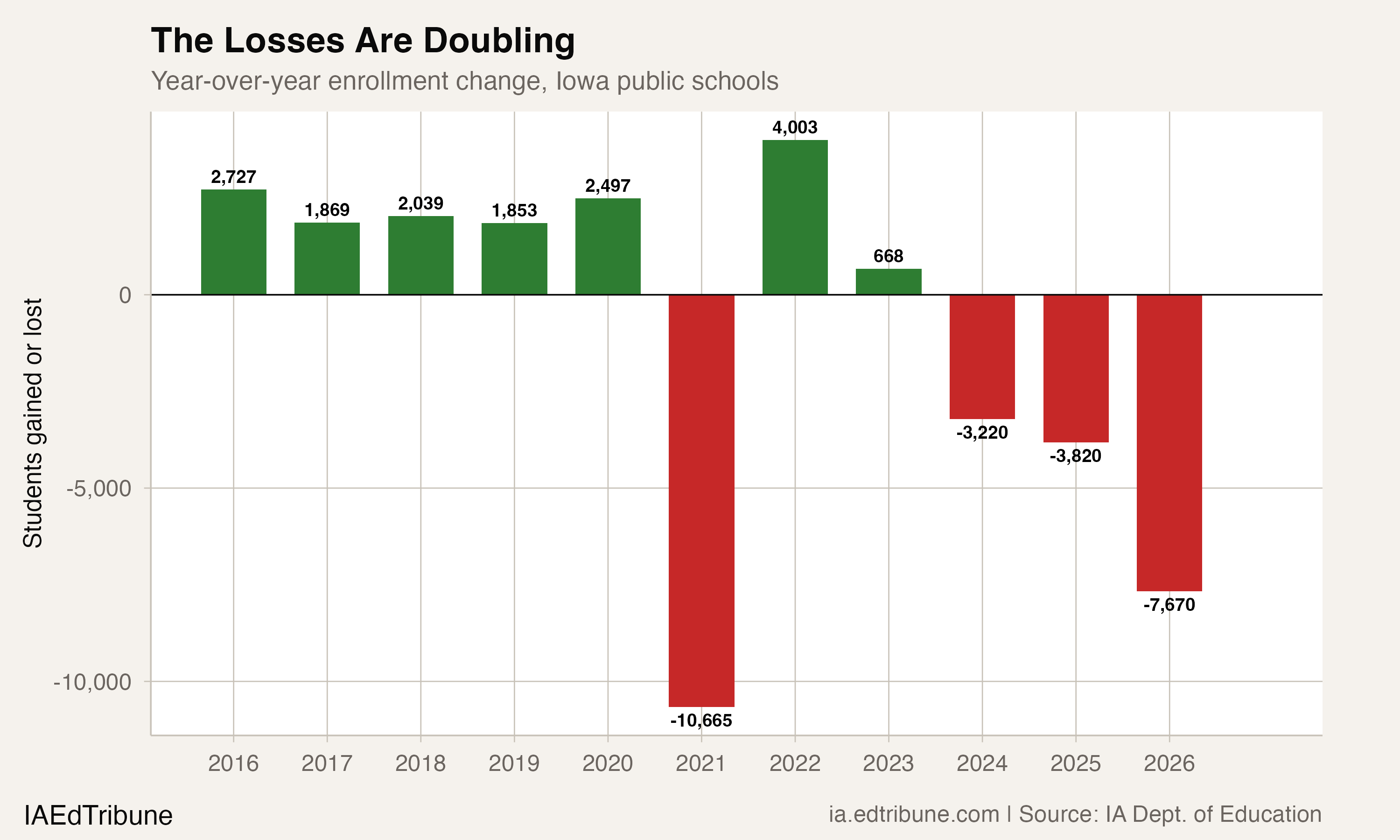
Des Moines lost 1,145 students in 2025-26. Cedar Rapids lost 649. Sioux City, Davenport, West Des Moines, Dubuque, Waterloo, Council Bluffs: every one of Iowa's largest urban districts shrank. The state lost 7,670 students in 2025-26, double the 3,820 it lost the year before, and the cumulative three-year loss of 14,710 students now exceeds the 10,665 Iowa lost in the single worst year of COVID.
This is not a plateau that might reverse. It is acceleration.
The three-year ramp
Iowa's enrollment trajectory has two distinct eras. From 2015 through 2020, the state grew steadily, adding roughly 2,100 students per year and reaching 517,321 at its pre-COVID peak. COVID erased those gains in a single year, dropping enrollment to 506,656 in 2020-21. A partial recovery in 2021-22 and 2022-23 brought the total back to 511,327.
Then the floor gave way. Iowa lost 3,220 students in 2023-24, 3,820 in 2024-25, and 7,670 in 2025-26. The rate of decline has steepened each year, from -0.6% to -0.8% to -1.5%, with the 2026 loss doubling the prior year's.
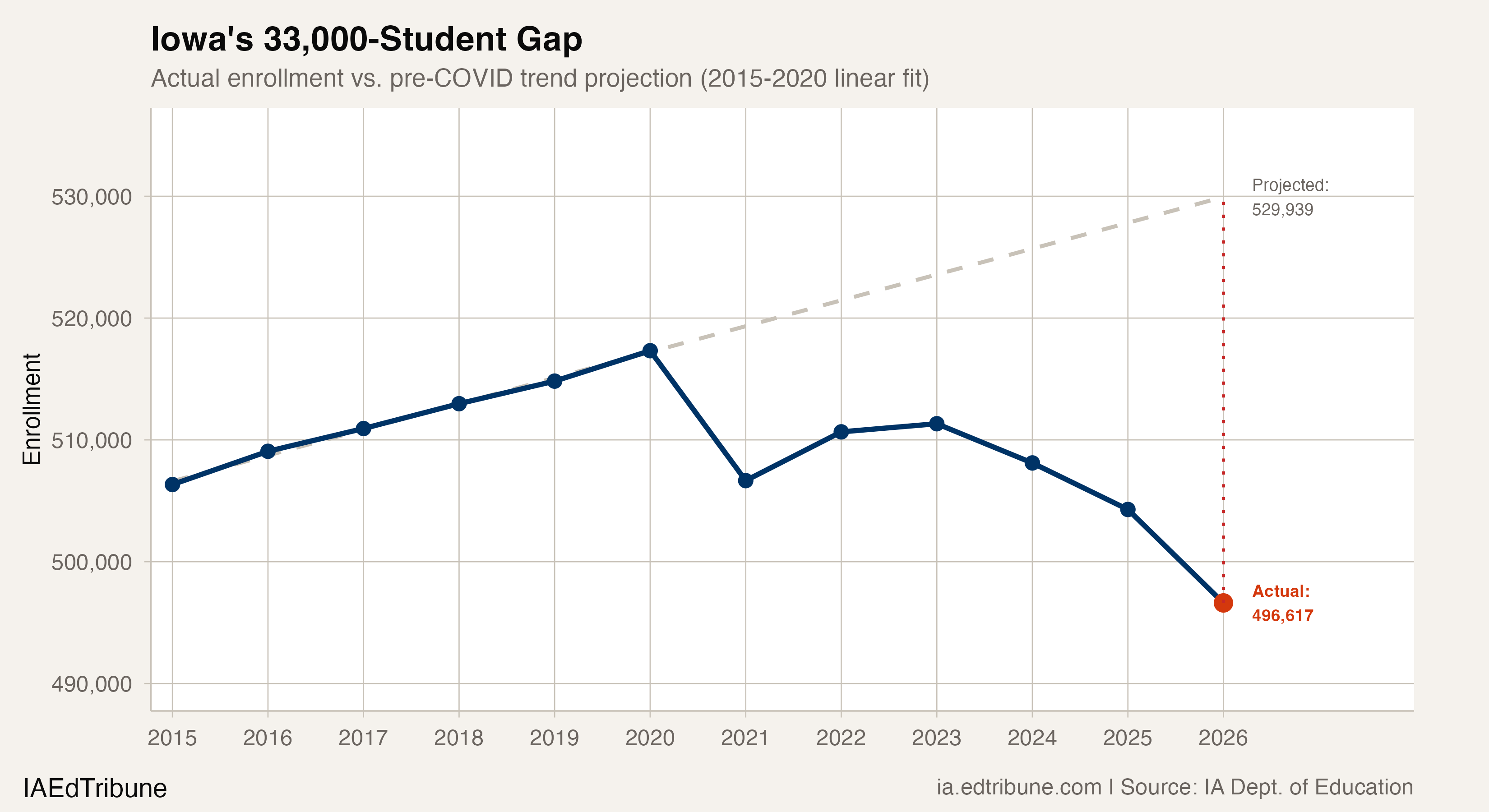
If Iowa had continued growing at its 2015-2020 pace, enrollment in 2025-26 would have been approximately 529,900. The actual figure of 496,617 leaves a gap of more than 33,000 students, a 6.3% shortfall from the pre-pandemic trajectory.
236 of 329 districts lost students
The decline is not concentrated in a few troubled cities. In 2025-26, 236 of Iowa's 329 districts lost enrollment, a rate of 71.7%. The median district lost 11 students. Only three of 18 districts with more than 5,000 students grew: Waukee (+364), Pleasant Valley (+39), and Southeast Polk (+37).
Des Moines, the state's largest district, lost 1,145 students in one year, a 3.8% drop that brought it to 28,903, its lowest enrollment in the 12-year dataset. The district peaked at 34,020 in 2017-18 and has declined every year since. Cedar Rapids lost 649 students (-4.3%), its second-largest single-year loss after the pandemic year's 811.
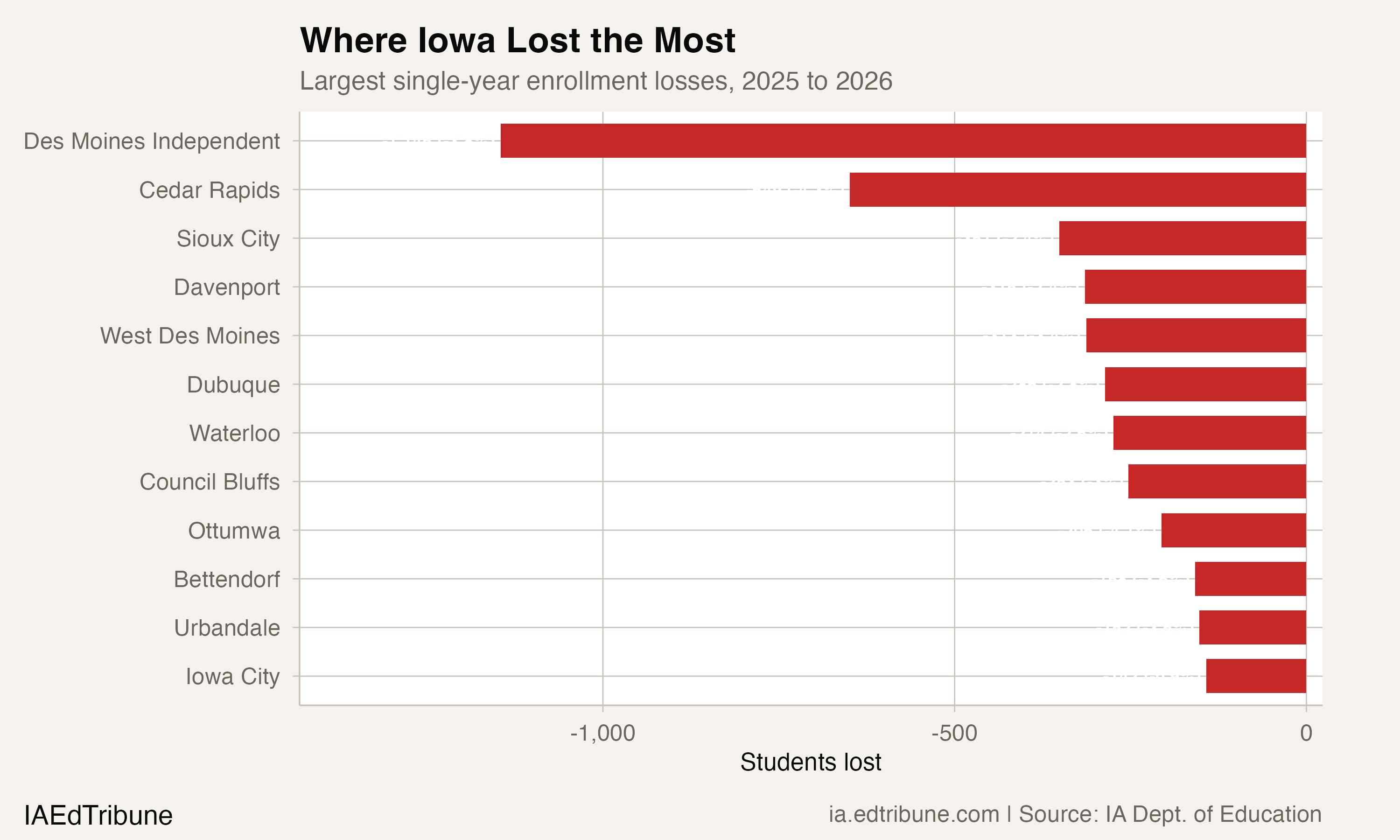
At the other end, 131 of 332 districts sit at their lowest enrollment in the 12-year dataset. Only 31 are at a 12-year high. Among the top 10 largest districts, seven are at record lows within the dataset. The three exceptions are Iowa City, which at 14,871 remains well above its 12-year low of 13,397; Waukee, the fast-growing Des Moines suburb that added 364 students; and Ankeny, at 12,705 compared to its low of 10,607.
Chronic decline is spreading
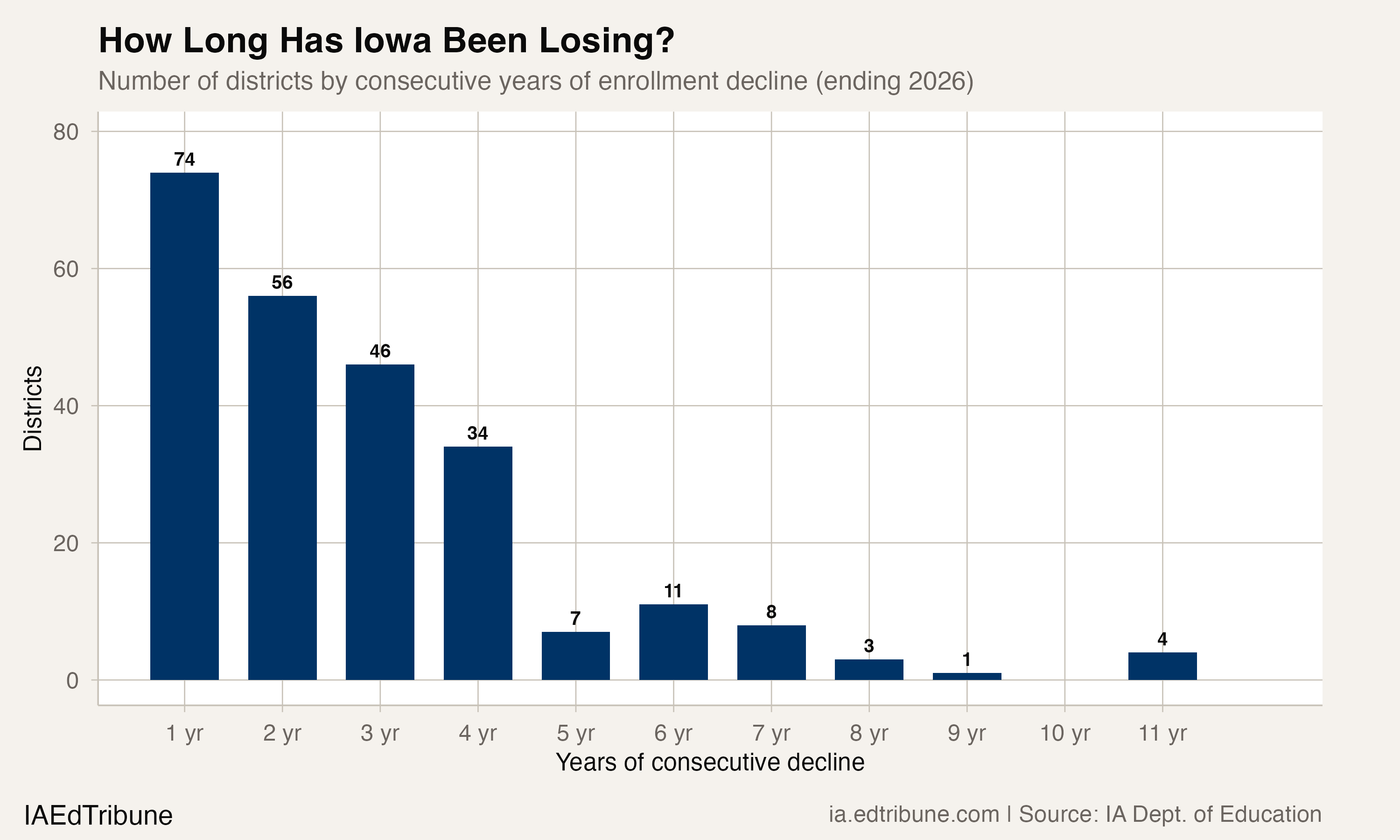
Four Iowa districts have declined every single year for 11 consecutive years, the entire length of the dataset: Anamosa, BCLUW, Davenport, and Muscatine. Another 110 districts are in decline streaks of three or more years. Thirty-four have declined for five or more consecutive years.
The pattern has a geographic signature. Urban cores and rural districts are both losing. Suburban rings are the only sector consistently growing, and even there, the growth is narrowing to a handful of fast-expanding bedroom communities.
Fewer kindergartners, more seniors
The acceleration has a demographic foundation that district leaders cannot reverse through marketing or program innovation. Iowa's kindergarten class has shrunk from 39,948 in 2015 to 34,748 in 2026, a 13.0% decline. Over the same period, the senior class grew from 36,363 to 39,359, an 8.2% increase. The two lines crossed in 2023. Iowa now graduates more students each spring than it enrolls each fall.
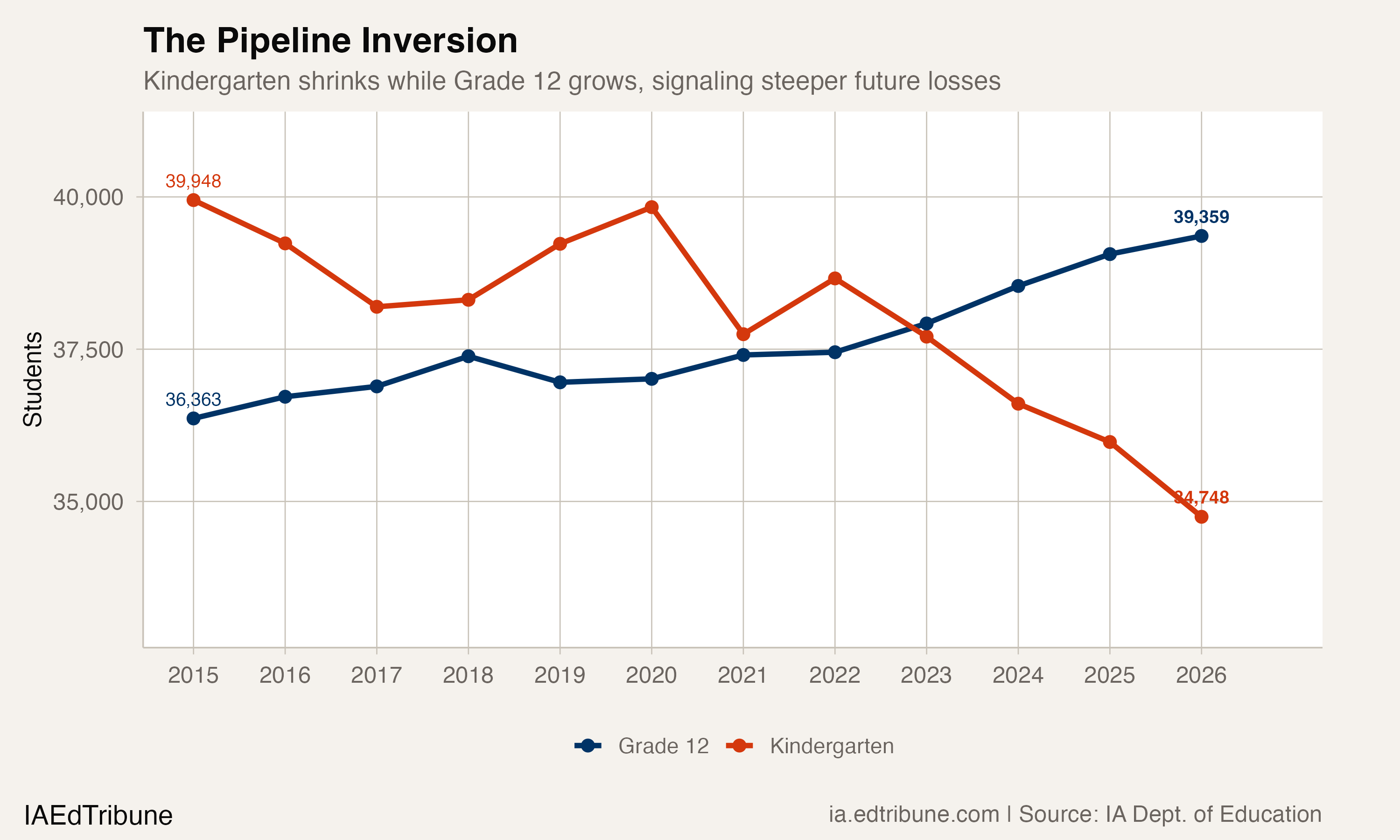
This inversion means that the steepest enrollment declines are still ahead. The small kindergarten cohorts of 2024-2026 will flow through the system for 12 years, shrinking each grade as they advance. Iowa's birth rate fell from 12.6 per 1,000 residents in 2015 to 11.2 in 2023, and the Department of Education projects a 3.5% decline in certified public-school enrollment between 2020 and 2030. That projection, made before the 2026 drop, may already be too optimistic.
Three forces, no single cause
The acceleration has multiple contributing factors, and their relative weight is genuinely uncertain.
The most structurally rooted is the birth rate decline. Smaller kindergarten cohorts are a lagging indicator of births five years earlier, and Iowa has seen falling birth rates for nearly a decade. This alone would produce gradual decline, roughly consistent with what Iowa experienced in 2024 and 2025. It does not fully explain the sharp jump in 2026.
Iowa's Education Savings Account program, which launched in 2023 and expanded to all income levels in 2025-26, is a second factor. Of the 27,866 students using ESAs in 2024-25, the state reported that only 1,905 had left a public school that year to use one. Most ESA recipients were already in private schools. But the cumulative effect is growing: nonpublic enrollment increased by about 3,100 students (6.5%) in 2025-26, and 41,044 students were using ESAs as of October 2025. Cedar Rapids' chief financial officer told KCRG the immediate impact was smaller than feared:
"The impact isn't as much as we thought it was going to be. Right now this year is 91 students. But over 10 years that's 900 students." -- KCRG, Jan. 2025
A third factor, harder to quantify, is the effect of federal immigration enforcement on families in districts with large immigrant populations. Des Moines, where more than 25% of students are English learners, lost 1,145 students in a single year after several years of more moderate declines. Local reporting by Axios Des Moines cited immigration concerns as a contributing factor, though the Refugee Alliance of Central Iowa said the number of students leaving due to immigration enforcement is believed to be relatively low. Sioux City (-351), Ottumwa (-206), and other districts with meatpacking-connected immigrant communities also posted steep declines. Whether these withdrawals are temporary or permanent is unknown.
None of these forces alone accounts for the full 7,670-student loss. Birth rates explain the structural trend. ESAs are redirecting a growing but still modest share of students. Immigration enforcement may have amplified the 2026 drop in specific districts. The data cannot separate their contributions.
The budget guarantee treadmill
For 157 Iowa districts in 2025-26, enrollment has fallen far enough that the state's per-pupil funding formula no longer covers prior-year spending. These districts rely on the budget guarantee, a provision that allows them to maintain a 1% spending increase funded through local property taxes. That number is projected to reach 208 districts in 2026-27.
"80-90% of district budgets fund labor costs, making staffing adjustments critical. Districts must implement 'rightsizing' -- aligning staffing, programming, and facilities with enrollment realities." -- ITR Report Card
With roughly half of Iowa's 327 public school districts enrolling fewer than 2,000 students, and 122 already sharing superintendents, the operational margin for further cuts is thin. The budget guarantee keeps the lights on, but it shifts costs to property taxpayers and does nothing to stabilize enrollment.
The 2027 question
The sharpness of the 2026 drop — double the prior year, after two years of more moderate decline — could be an outlier or a preview. If immigration-related withdrawals stabilize and ESA uptake plateaus, 2027 could moderate. If birth cohorts keep shrinking and private school capacity expands, 2026 is the new baseline.
The arithmetic is harder to argue with than the causes. Iowa now has 4,611 fewer kindergartners than seniors. Every spring, a larger class graduates than the one that enrolled the previous fall. That structural fact will persist for at least six more years regardless of policy changes, housing markets, or immigration enforcement. Iowa's funding formula was designed for stable or growing enrollment. It is being stress-tested by something else entirely.
Detailed code that reproduces the analysis and figures in this article is available exclusively to EdTribune subscribers.
Discussion
Sign in to join the discussion.
Loading comments...