In this series: Iowa 2025-26 Enrollment.
In 2015, white students made up 43.2% of Des Moines Public Schools enrollment. Hispanic students accounted for 24.4%. The two groups were separated by nearly 19 percentage points, and the gap had been narrowing for years without anyone seriously expecting a crossover.
In 2025, it arrived. Hispanic students surpassed white students for the first time, 9,742 to 9,264. By 2026, the margin widened: Hispanic students now represent 32.6% of enrollment compared to 30.3% for white students. Iowa's largest school district, in a state that is 69.8% white, has no racial majority at all.
The three-line story
The demographic shift in Des Moines is not a single trend. It is three trends stacked on top of each other, each operating at a different speed.
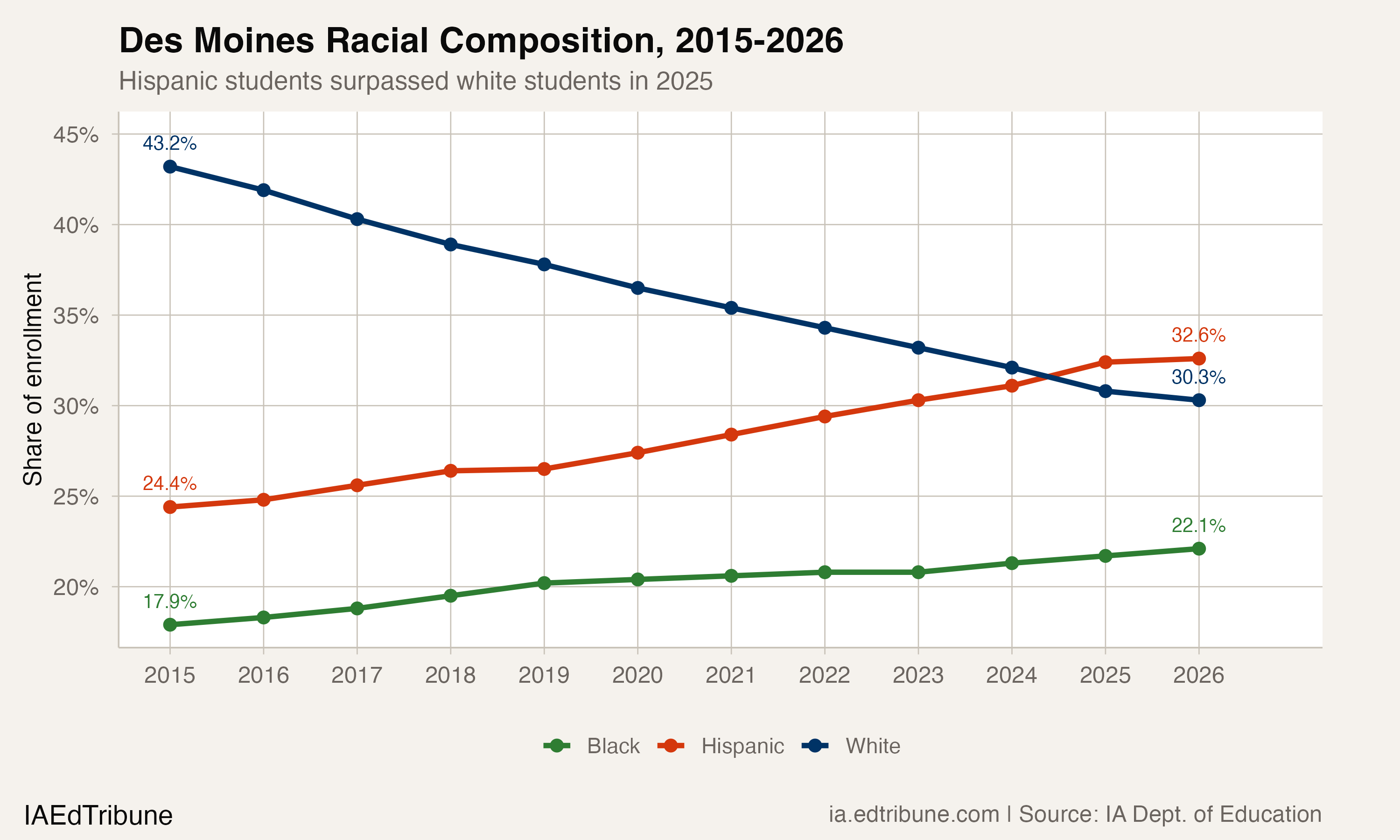
White enrollment has fallen every year in the dataset, from 14,497 to 8,770. That is a loss of 5,727 students, or 39.5%, in 11 years. The decline has been remarkably steady: roughly 500 white students per year, year after year, without a single year of recovery. Not during the pre-COVID growth years, not during the brief post-COVID bounce statewide. The white enrollment line in Des Moines simply does not bend upward.
Hispanic enrollment, meanwhile, grew from 8,196 to 9,425, a gain of 1,229 students (15.0%). That growth has recently stalled. Hispanic enrollment actually fell by 317 students in 2026, the first decline in the dataset, a pattern that coincides with heightened immigration enforcement nationally.
Black enrollment held relatively steady in absolute terms, adding 373 students (6.2%) over the period. Because total enrollment fell, the Black share of the student body rose from 17.9% to 22.1%.
The net effect: Des Moines lost 4,650 students overall (-13.9%) while undergoing a compositional transformation that no other Iowa district of its size has experienced.
The acceleration of 2026
Des Moines has now declined for eight consecutive years, from a peak of 34,020 in 2018 to 28,903 in 2026. The trajectory has not been smooth.
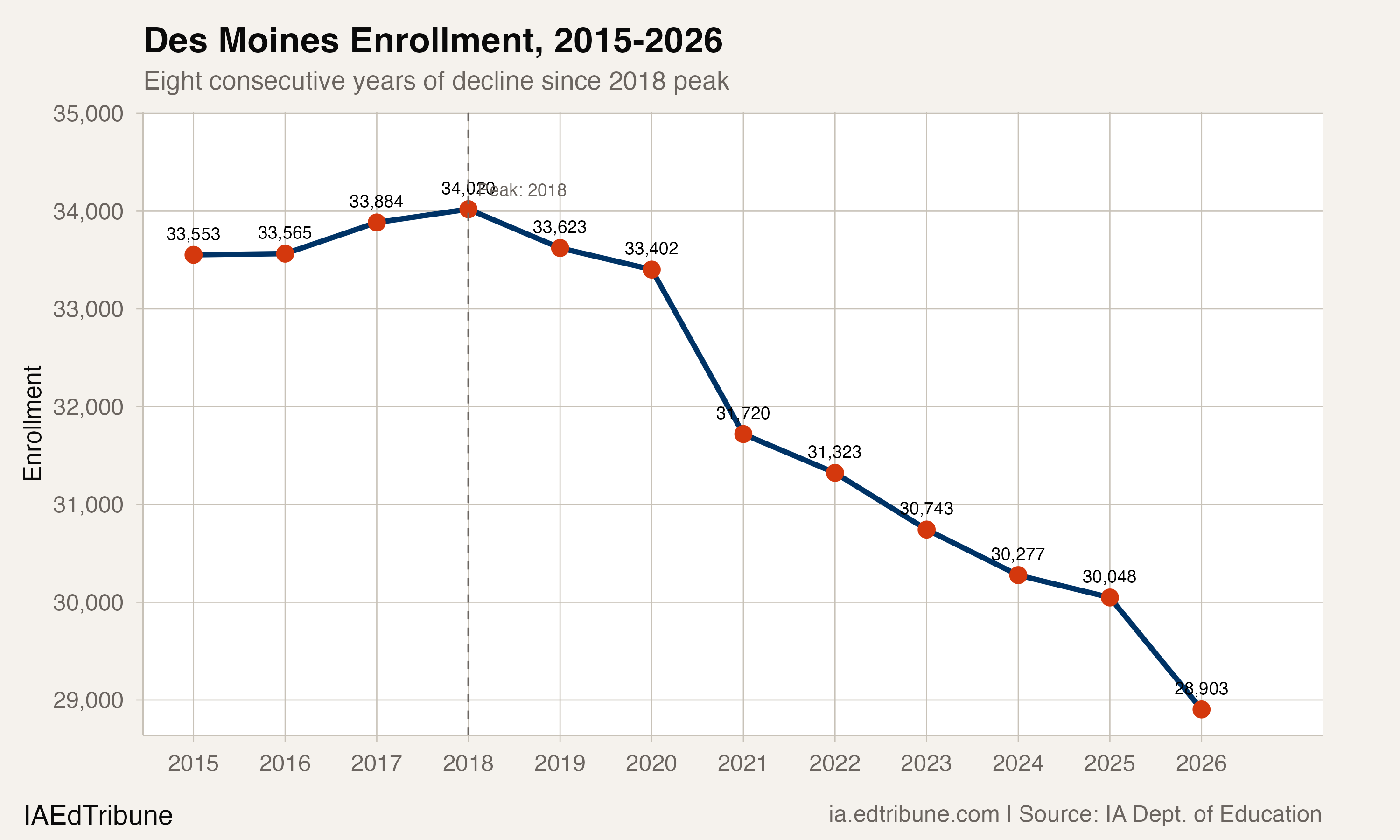
COVID took 1,682 students in a single year (2021). The district partially stabilized through 2025, losing between 229 and 580 students annually. Then 2026 hit: a loss of 1,145 students, or 3.8%, the largest non-COVID single-year decline in the dataset. The 2026 loss was five times larger than the 229-student decline in 2025.
That acceleration is visible in the district's shrinking share of statewide enrollment. Des Moines accounted for 6.6% of Iowa's students in 2015. By 2026, that share had fallen to 5.8%. The state's capital city is losing students faster than the state itself.
Where white enrollment went
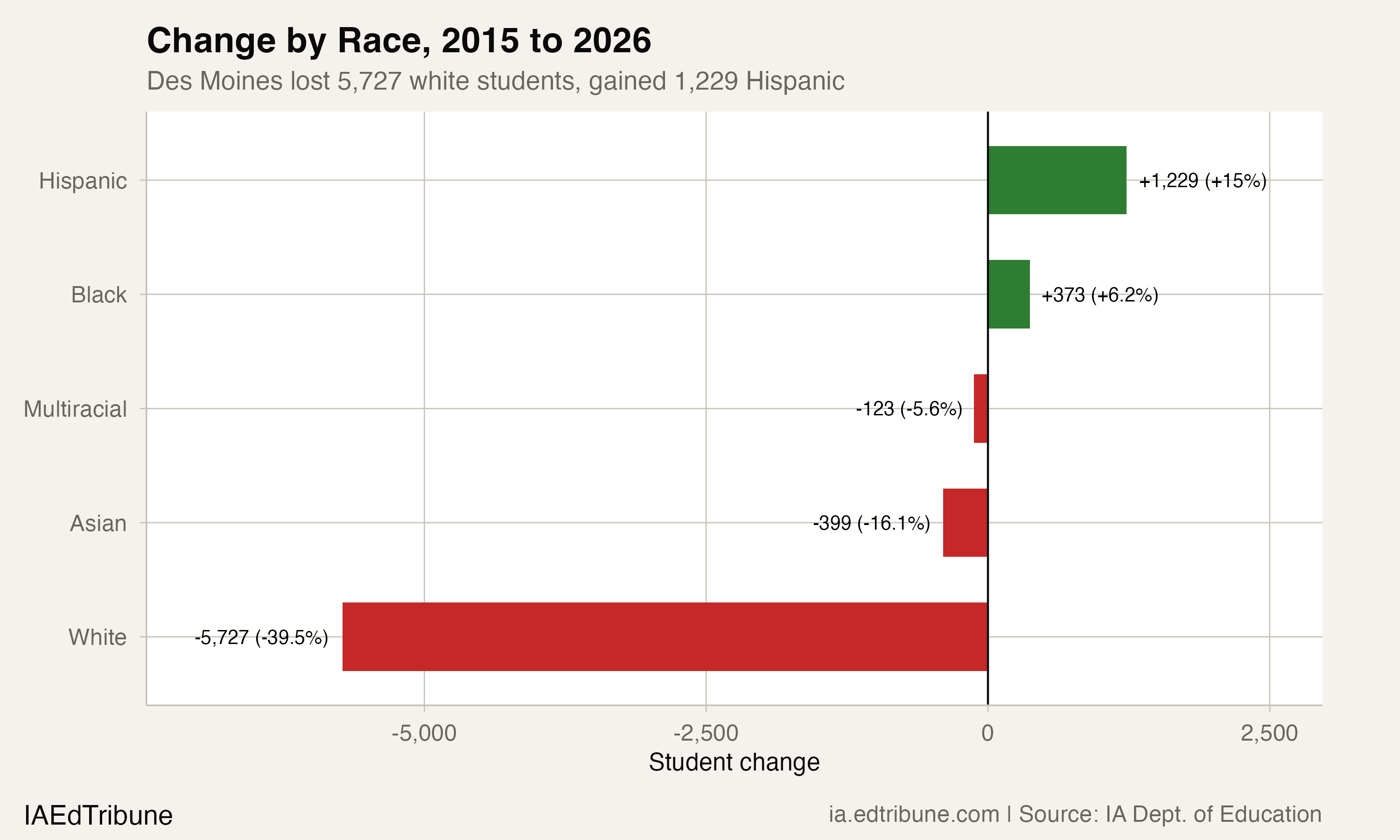
The 5,727 white students who left Des Moines did not vanish from the Iowa education system. The most likely explanation is a combination of open enrollment to suburban districts and residential migration to those same suburbs.
In 2024-25, approximately 2,900 students transferred out of DMPS through open enrollment, nearly double the roughly 1,500 who open-enrolled out in 2019-20. Most of the transfers came from neighborhoods along the district's northwest and east borders, close to Johnston, Urbandale, and Southeast Polk. The enrollment data does not break down open enrollment by race, but the geography of the outflow suggests it is disproportionately drawing from whiter neighborhoods at the district's edges.
A second channel opened in 2023 with Iowa's Education Savings Account program. In 2024-25, 2,242 students living within DMPS boundaries used ESAs to attend private schools. By 2025-26, that number had grown to 3,121, an increase of 879 students in a single year. At $7,988 per student, the ESA program now redirects roughly $24.9 million in state funding that would otherwise flow through Des Moines.
School board chairperson Kim Martorano attributed the decline to state law changes: "Public school districts are operating in a more competitive education environment across the Des Moines metro."
The suburban donut
The geography fills in context. While Des Moines lost 4,650 students, Waukee, roughly 20 miles to the northwest, gained 5,642. These are not the same students. Waukee's growth is primarily driven by new housing construction in Dallas County, one of Iowa's fastest-growing counties. But open enrollment means the two districts also compete directly for families who live near the boundary.
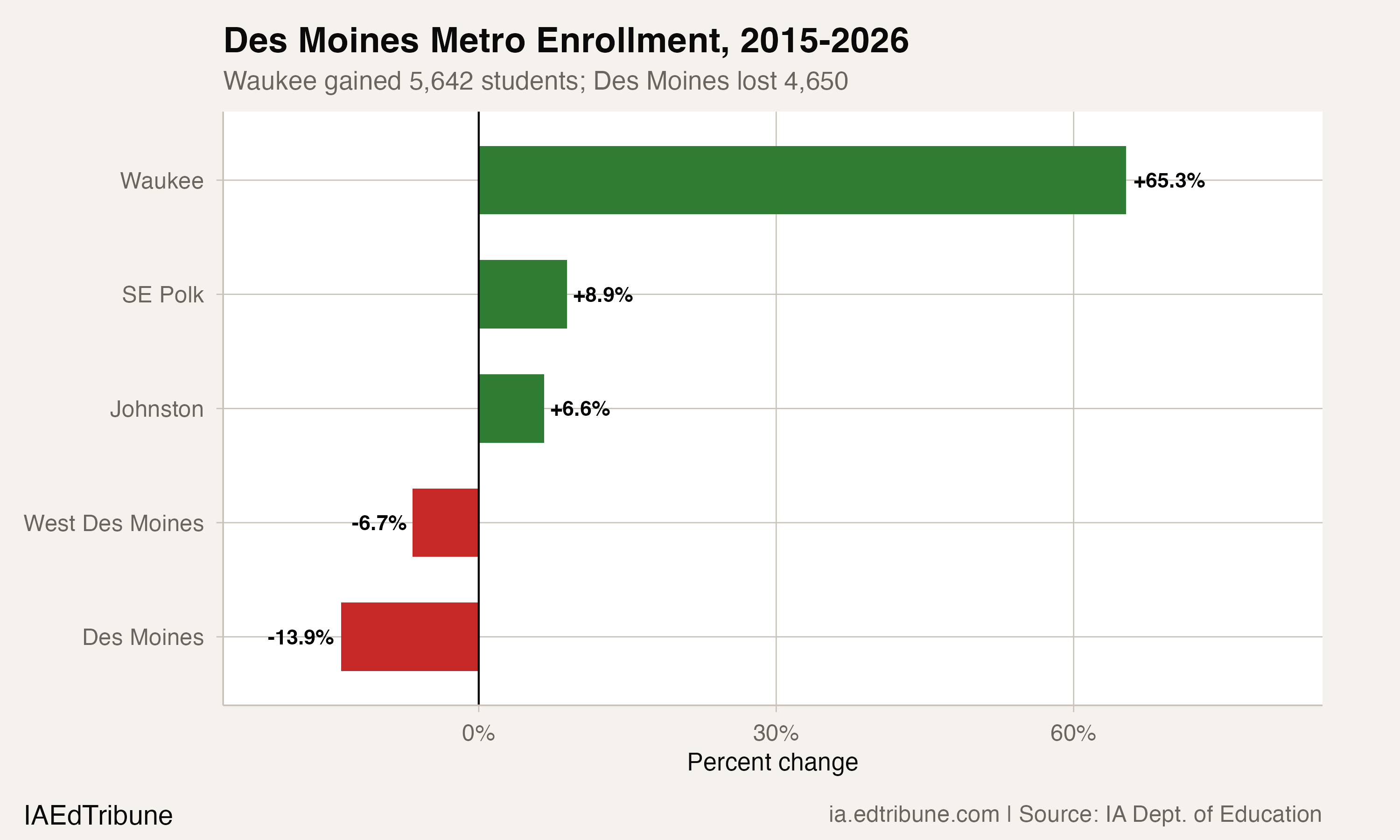
Waukee's 65.3% growth is the largest among Des Moines metro districts. Southeast Polk grew 8.9%. Johnston grew 6.6%. Even West Des Moines, which shares many of the same demographic pressures, lost only 6.7% compared to Des Moines' 13.9%.
The pattern is a textbook suburban donut: a central-city district losing enrollment to its ring suburbs. Open enrollment accelerates the dynamic because families do not have to move to switch districts. A family on Des Moines' northwest side can open-enroll a child in Waukee or Johnston while continuing to live in their current home.
The pipeline is shrinking faster
The grade-level data reveals that Des Moines' enrollment floor has not yet arrived.
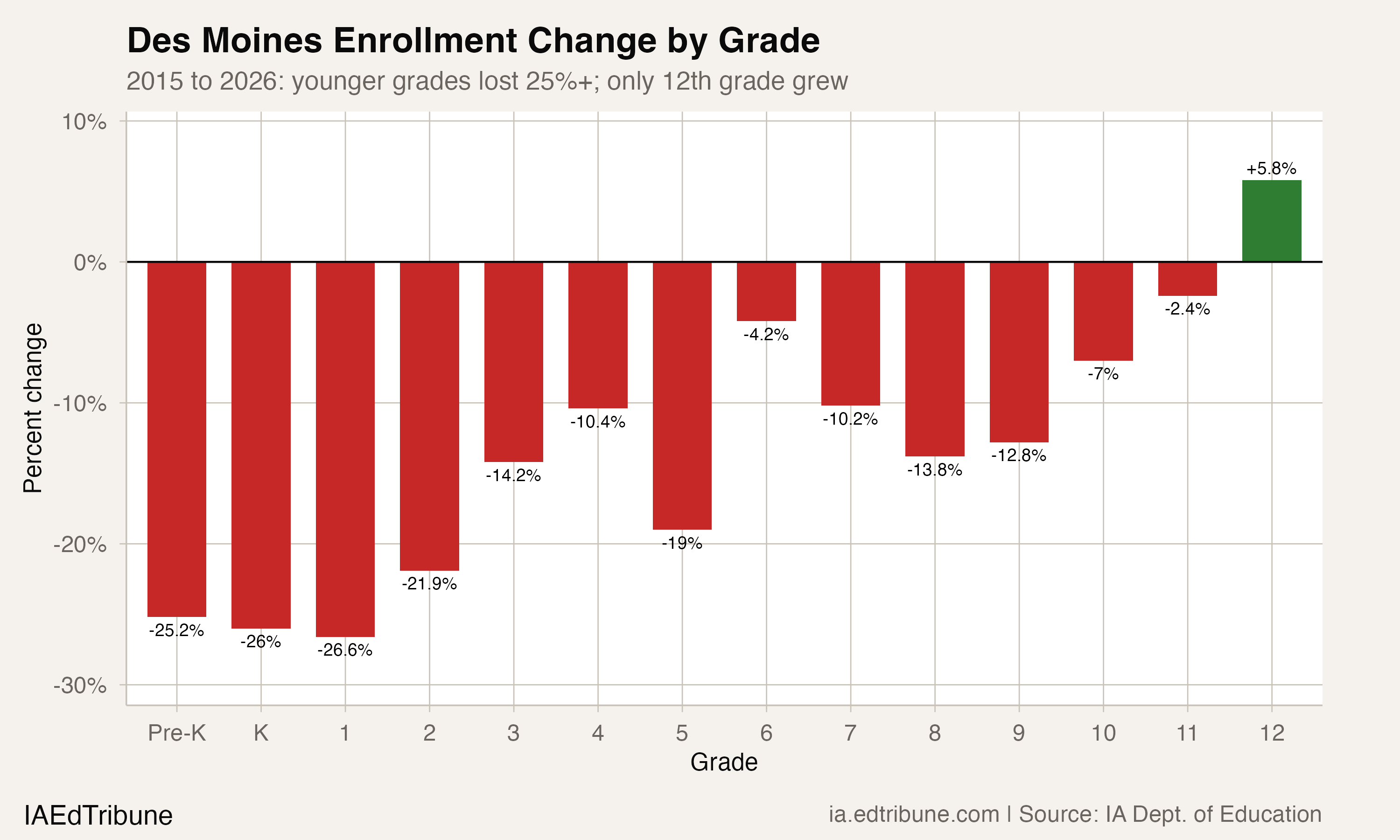
Pre-K enrollment is down 25.2% since 2015. Kindergarten is down 26.0%. First grade has lost 26.6%. The only grade that grew was 12th, up 5.8%, reflecting larger cohorts from a decade ago aging through the system. As those graduating classes are replaced by the smaller incoming cohorts, the district's overall decline will deepen further, even if outflow to suburbs and private schools stops entirely. The structural arithmetic is simple: Des Moines enrolled 2,497 twelfth graders in 2026 and 1,949 kindergarteners. Each graduating class will be replaced by one that is roughly 550 students smaller.
Immigration enforcement and the 2026 cliff
The 2026 loss was unusually large, and the timing overlaps with events that shook the district.
In September 2025, Des Moines superintendent Ian Roberts was detained by ICE during a traffic stop on the city's south side. Roberts, born in Guyana, had entered the U.S. on a student visa in 1999 and had received a final order of removal in May 2024. He was placed on paid leave and his administrative license was revoked.
The district cited immigration enforcement as one factor in the enrollment drop. Axios Des Moines reported that DMPS believes part of its decline is tied to immigrant families voluntarily leaving the country to avoid the risk of separation. More than 25% of the district's students are English language learners.
The enrollment data is consistent with this account. Hispanic enrollment in Des Moines fell by 317 students in 2026, its largest single-year decline in the dataset and only the third year of any Hispanic loss (after minor dips of 59 in 2019 and 149 during COVID in 2021). Whether those families left the district, left the state, or simply withdrew without a forwarding address is not something enrollment data can distinguish. The 2026 Hispanic decline could also partly reflect the same birth rate and migration dynamics affecting other groups.
What the data cannot resolve
The 39.5 percentage-point gap between Des Moines' white share (30.3%) and the statewide average (69.8%) is the widest in the dataset, having grown from 35.1 points in 2015. The gap has expanded by 4.4 percentage points in 11 years. Des Moines is becoming more different from the rest of Iowa, not more similar.
What is unclear is how much of the white enrollment loss reflects families choosing to leave DMPS specifically versus the broader suburbanization of Des Moines' metro population. The city of Des Moines itself lost approximately 4,400 residents between its 2017 peak and the 2024 Census estimate. Open enrollment data does not include race, so the overlap between open enrollment outflow and white enrollment decline can only be inferred, not measured.
The ESA program's demographic composition is also unreported at the district level. Whether the 3,121 DMPS-boundary ESA students are disproportionately white is plausible given the demographics of Iowa's private school sector, but is not something the public data confirms.
Reimagining a smaller district
In November 2025, DMPS voters approved a $265 million bond for the district's "Reimagining Education" plan. The plan includes signature schools with specialized programs, expanded full-day preschool, and moving sixth grade back to elementary buildings. Its stated goal for 2030 is that open enrollment into the district will exceed open enrollment out.
"This is about making Des Moines Public Schools a premier destination of choice." — Associate Superintendent Matt Smith, Iowa Public Radio, Jan. 2025
The $265 million is a bet that programming, not demographics, will determine the district's trajectory. The plan was pitched against a backdrop of $14 million in budget cuts ahead of the 2024-25 school year. At approximately $7,800 in per-pupil state funding, every 100 students who leave take $780,000 with them. The 1,145 students lost in 2026 alone represent roughly $8.9 million in annual revenue.
The question the bond cannot answer is whether 1,949 kindergarteners can sustain the buildings that 2,497 seniors will leave behind. Des Moines is not just managing a demographic shift. It is managing a pipeline that delivers fewer students each year into a system designed for more.
Detailed code that reproduces the analysis and figures in this article is available exclusively to EdTribune subscribers.
Discussion
Sign in to join the discussion.
Loading comments...