In this series: Iowa 2025-26 Enrollment.
Four Iowa school districts have now lost students every single year for 11 consecutive years. Davenport. Muscatine. Anamosa. BCLUW. Not one year of growth between them since the data begins in 2015. They are the leading edge of a pattern that, in 2025-26, swept nearly three quarters of the state.
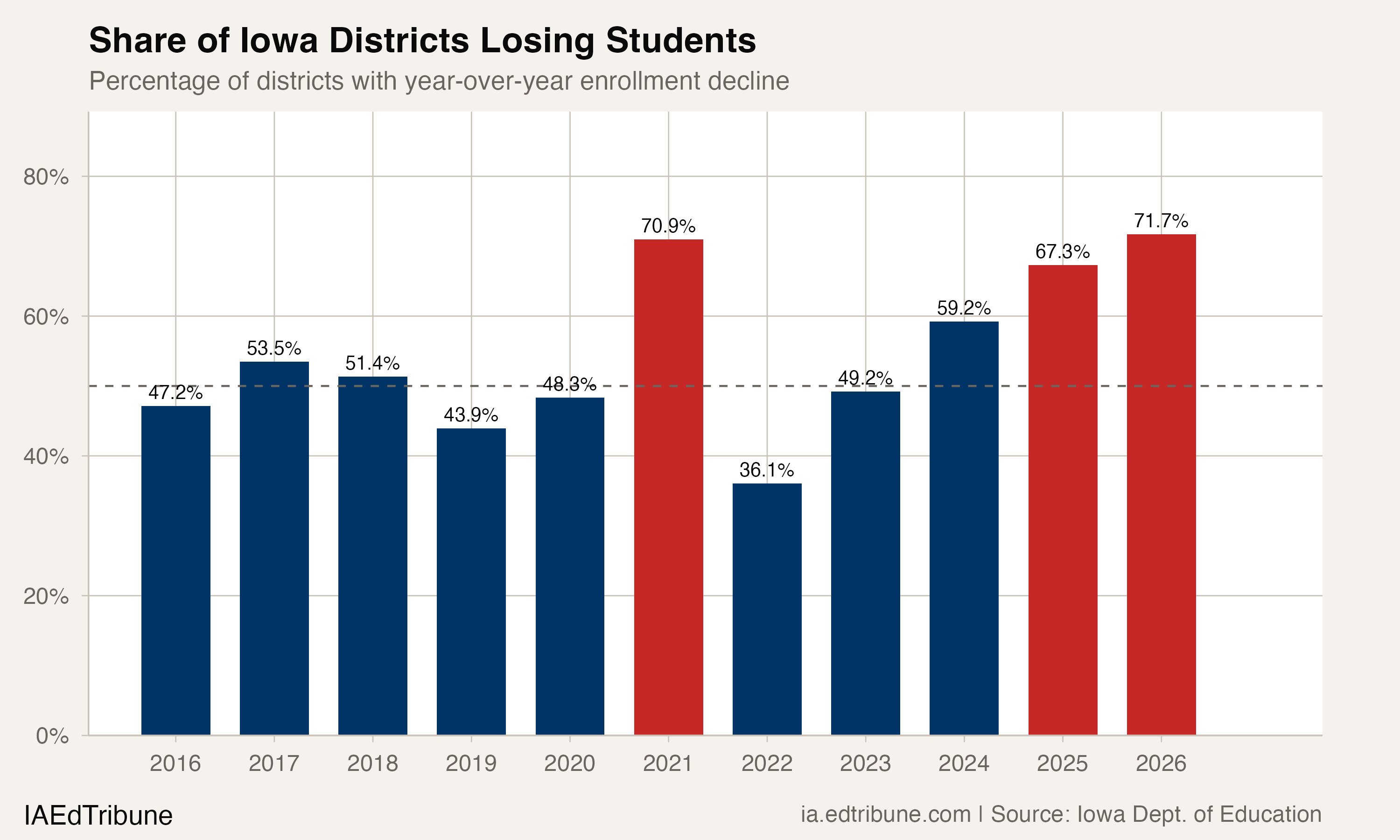
Of Iowa's 329 school districts, 236 lost enrollment in 2025-26, a rate of 71.7%. Only 90 grew. Three held flat. The median district lost 11 students. That makes 2026 the worst year in the data for the sheer breadth of decline, narrowly surpassing even the COVID crash of 2021, when 70.9% of districts lost students.
The difference: in 2021, the losses were sudden and largely temporary. In 2026, they are the third consecutive year of widening decline, following rates of 59.2% in 2024 and 67.3% in 2025. The state as a whole lost 7,670 students, the largest single-year drop outside the pandemic.
The shape of the losses
The 236 declining districts lost a combined 10,309 students. The 90 growing districts added just 2,218. That asymmetry, nearly five students lost for every one gained, means growth is not keeping pace anywhere close to offsetting the losses.
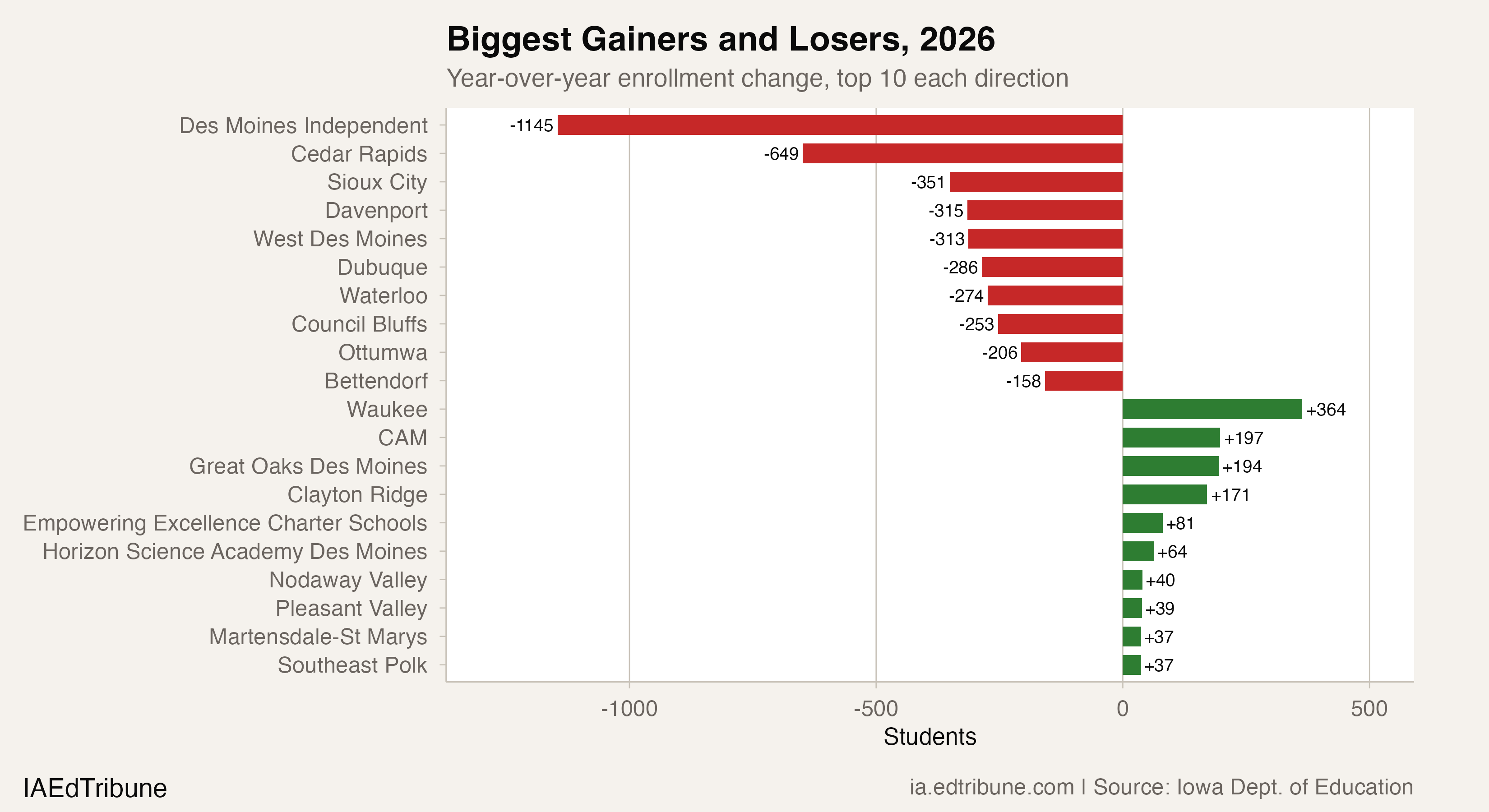
Des Moines alone accounted for 1,145 of those losses, a 3.8% drop to 28,903 students. Cedar Rapids lost 649 (4.3%). Sioux City lost 351. Davenport lost 315. The top 10 losing districts contributed 3,950 students, or 38.3% of the total loss. The pain is concentrated at the top, but it is not confined there.
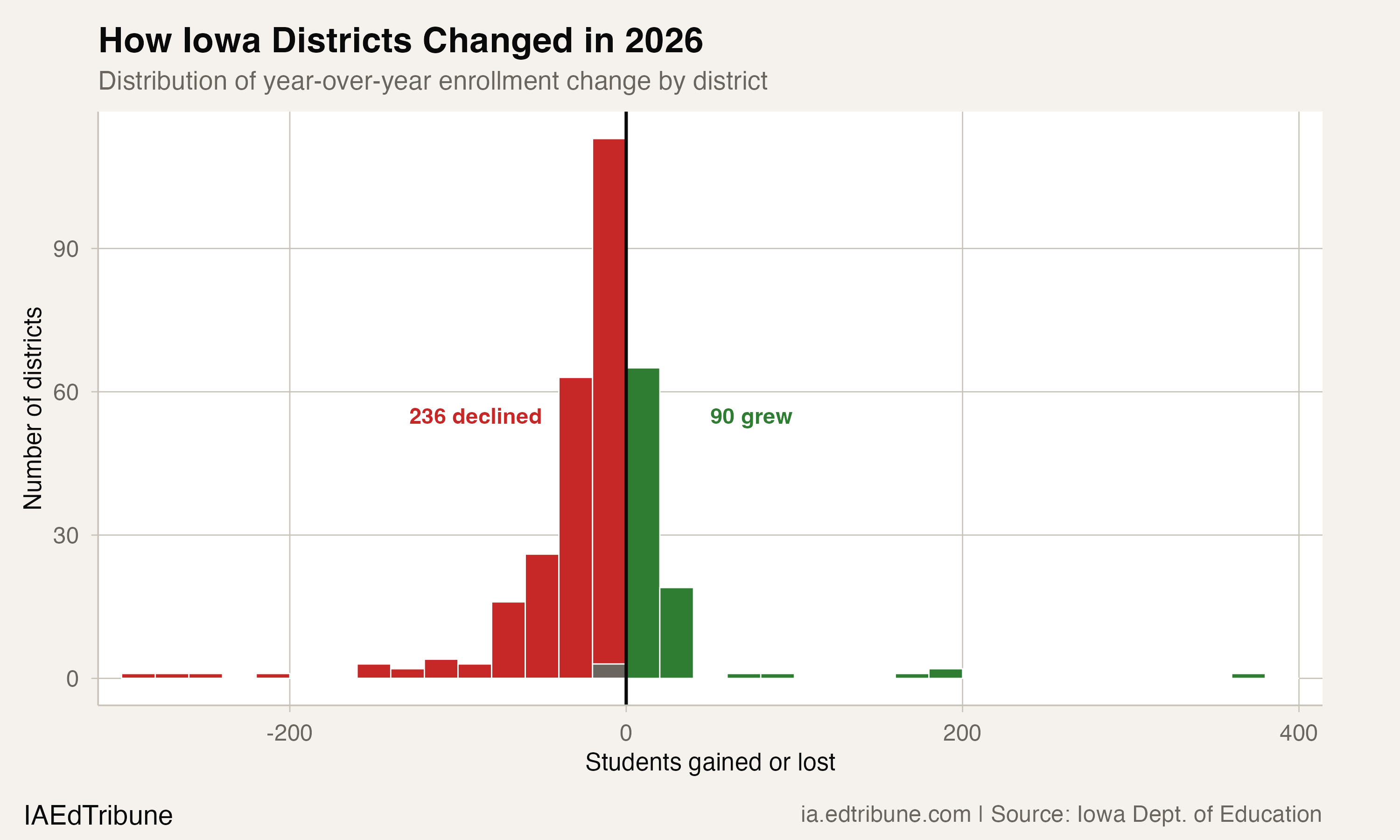
Eighteen districts lost 100 or more students. Thirty lost between 50 and 99. Another 62 lost between 25 and 49. The remaining 126 declining districts each lost fewer than 25. For a small district enrolling 300 students, losing 11 means losing 3.7% of its enrollment in a single year. That loss likely eliminates a teaching position.
Bigger districts, steeper losses
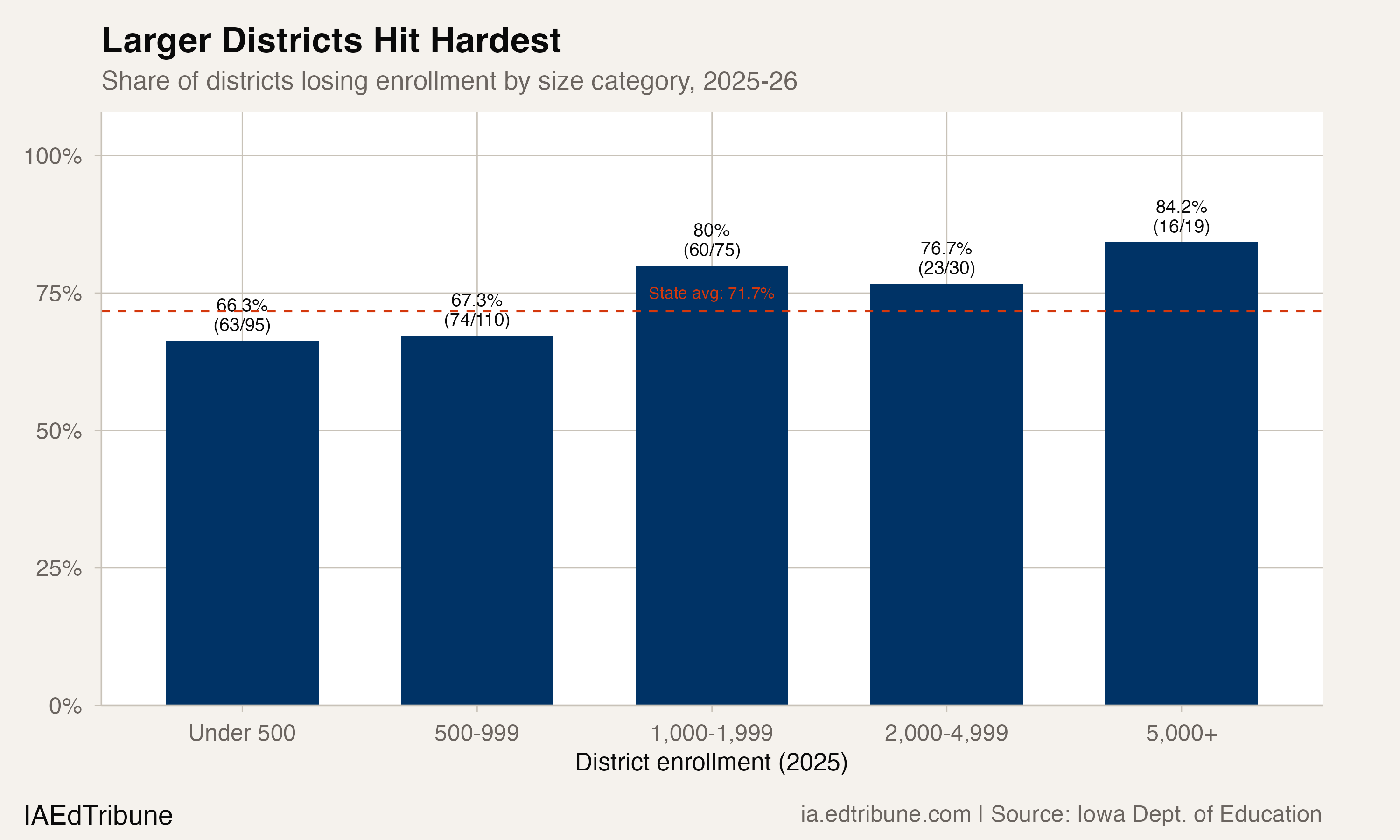
Enrollment loss in 2026 was not distributed evenly by district size. Among Iowa's 19 districts with 5,000 or more students, 16 declined, a rate of 84.2%. Mid-sized districts (1,000 to 1,999 students) lost at an 80.0% rate. The smallest districts, those under 500 students, had the lowest decline rate at 66.3%, though that still represents nearly two in three.
This inverts the pattern many states saw during COVID, when smaller districts weathered the storm better. In Iowa in 2026, larger districts are losing students at higher rates, and they are losing them in greater absolute numbers, compounding the fiscal impact of each departure.
Districts that never stopped shrinking
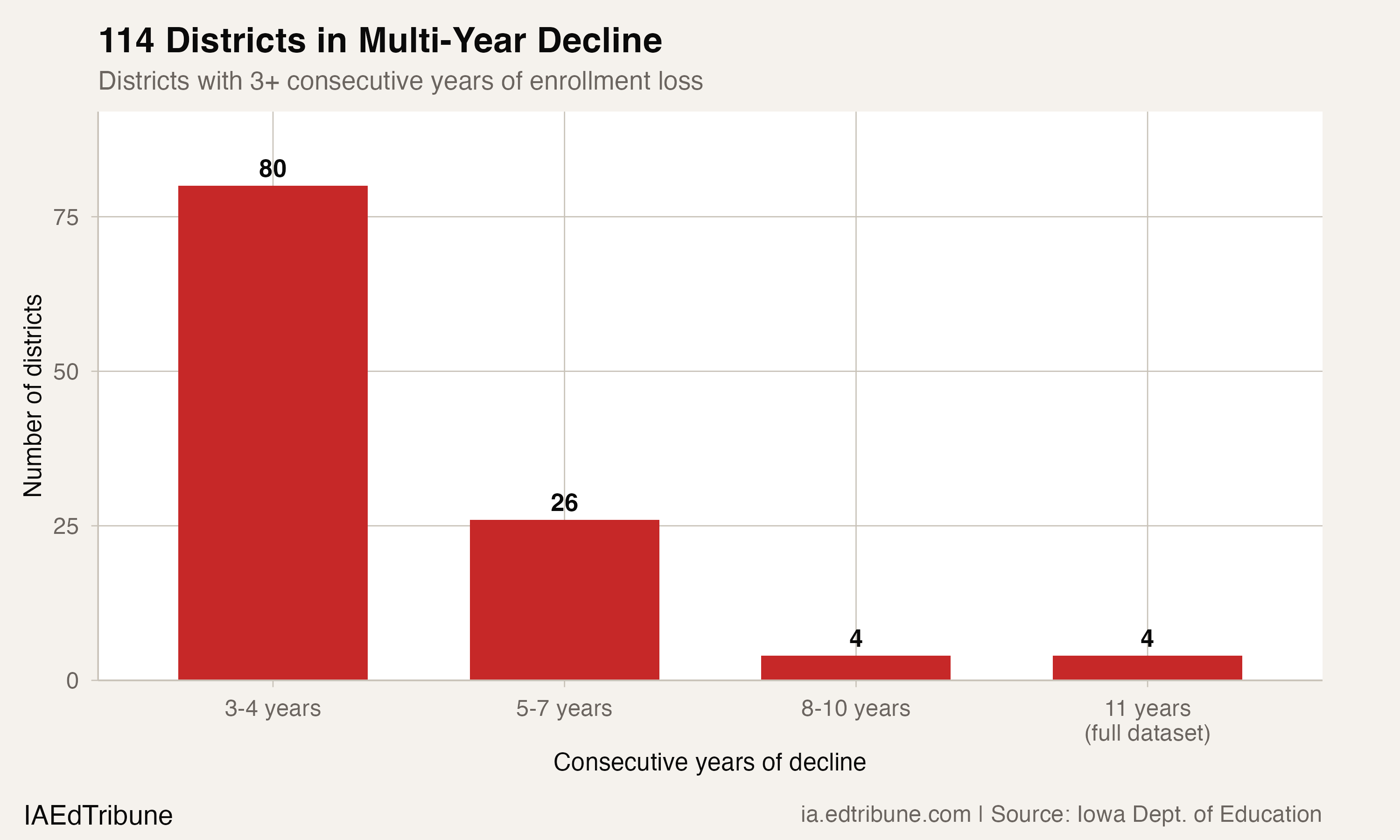
Behind the single-year snapshot, 114 districts are in active multi-year decline streaks of three or more consecutive years. Thirty-four have been declining for five or more years. Eight have been declining for eight or more.
The four 11-year streak districts range from Davenport, which has fallen from 16,180 to 12,855 students (a 20.5% loss), to BCLUW, a small district that has shrunk from 641 to 458 (28.5%). Muscatine dropped from 5,521 to 4,251 (23.0%). Anamosa fell from 1,301 to 1,101 (15.4%). None of these districts has seen a single year of enrollment growth in more than a decade.
Des Moines, the state's largest district, is on an eight-year streak. So is Centerville. Dubuque and Council Bluffs have been declining for six consecutive years.
Three forces pulling in the same direction
The breadth of decline across Iowa's districts reflects at least three reinforcing pressures, though disentangling their individual contributions is difficult with enrollment data alone.
The most structurally certain is the birth rate. Iowa kindergarten enrollment has fallen 13.0% since 2015, from 39,948 to 34,748, while total enrollment has dropped only 1.9%. Smaller entering cohorts are working their way through the system. The Iowa Department of Education acknowledged in its December 2025 certified enrollment release that "declining K-12 enrollment is a long-standing national trend driven by lower birth rates."
The second is the state's Education Savings Account program, which now subsidizes 27,866 students at private schools at a cost of $314 million. Nonpublic school enrollment rose from 33,692 in 2022-23 to 41,892 in 2025-26, a gain of more than 8,000 students. However, a Princeton University study found that roughly two-thirds of ESA recipients in the program's first year had already attended private school or could have afforded it without government help. The actual number of students who switched from public to private is likely far smaller than the headline participation figure suggests.
The third is rural depopulation. About two-thirds of Iowa counties lost population in the last decade, and the enrollment data reflects that migration. The districts that are growing, Waukee (+364), Pleasant Valley (+39), Southeast Polk (+37), are overwhelmingly suburban. Waukee has grown 65.3% since 2015. The pattern is not school choice; it is families moving to where the jobs and housing are.
Fiscal consequences arriving now
The operational reality for declining districts is the budget guarantee, a state provision that ensures district budgets increase by at least 1% annually even when enrollment drops. For 2025-26, 157 districts activated the guarantee. That number is projected to reach 208 for 2026-27, including 19 of Iowa's 24 largest districts.
"To see two-thirds of districts on budget guarantee is really unprecedented. I haven't seen this in my 27 years in school finance." -- Margaret Buckton, Iowa School Finance Information Services, KCRG, Feb. 2026
The budget guarantee buys time, but not indefinitely. Cedar Rapids has already cut $11 million from its current budget and is planning $13 million more in cuts next year, including school closures. As KCRG reported, Cedar Rapids school board member Cindy Garlock noted the challenge: districts are not losing 600 students from one building. Class sizes shrink slightly across many buildings, but the overhead for each building remains.
The state legislature passed a 1.75% per-pupil funding increase for 2026-27. School finance advocates had sought 5%. At 1.75%, more districts will need the guarantee, and the guarantee itself will carry more of the load.
What the data leaves open
The enrollment data cannot distinguish how much of the 2026 decline is driven by families leaving the state, families choosing private school, or simply smaller cohorts aging into the system. The ESA program's true enrollment impact on public schools is genuinely uncertain: the participation number (27,866) overstates the effect because most participants were already in private school, but the marginal switchers, estimated at roughly 1,905 in the program's first year, are growing as eligibility has expanded. Without student-level tracking between sectors, no precise accounting is possible.
It is also unclear whether the 90 growing districts represent durable pockets of growth or temporary fluctuations. Several of the top gainers, including Great Oaks Des Moines (+194), Empowering Excellence Charter Schools (+81), and Horizon Science Academy Des Moines (+64), are new charter schools still in their startup growth phase. If charter growth merely redistributes students within the same metro area, the net effect on state enrollment is zero.
The question ahead
Before COVID, Iowa's enrollment grew modestly every year from 2015 through 2020, adding 2,000 to 2,500 students annually. The state peaked at 517,321 in 2020. Six years later, it has lost 20,704 students and the rate of loss is accelerating: 3,220 in 2024, 3,820 in 2025, 7,670 in 2026. The post-COVID bounce of 2022-23 is fully exhausted.
For the 114 districts in multi-year decline streaks, the question is not whether they will lose students next year. They will. The question is whether the fiscal mechanisms designed to cushion the decline, the budget guarantee, shared superintendencies, whole-grade sharing agreements, can keep schools open long enough for smaller cohorts to stabilize. The 2026 kindergarten class, Iowa's smallest on record, will not be the answer.
Detailed code that reproduces the analysis and figures in this article is available exclusively to EdTribune subscribers.
Discussion
Sign in to join the discussion.
Loading comments...