In this series: Iowa 2025-26 Enrollment.
No Iowa district over 10,000 students has declined as far, as fast, or as relentlessly as Davenport. The district enrolled 16,180 students in 2014-15. By 2025-26, that figure had fallen to 12,855, a loss of 3,325 students, or 20.6%. Every single year in the 12-year data window shows a decline. There is no pause, no recovery year, no plateau. Davenport is one of only four Iowa districts to post losses in all 11 consecutive year-over-year comparisons.
The state as a whole declined 1.9% over the same period. Davenport's rate of loss is more than 10 times the statewide average. The district's 3,325 lost students account for 34.2% of Iowa's entire net enrollment decline, from a district that serves 2.6% of the state's students.
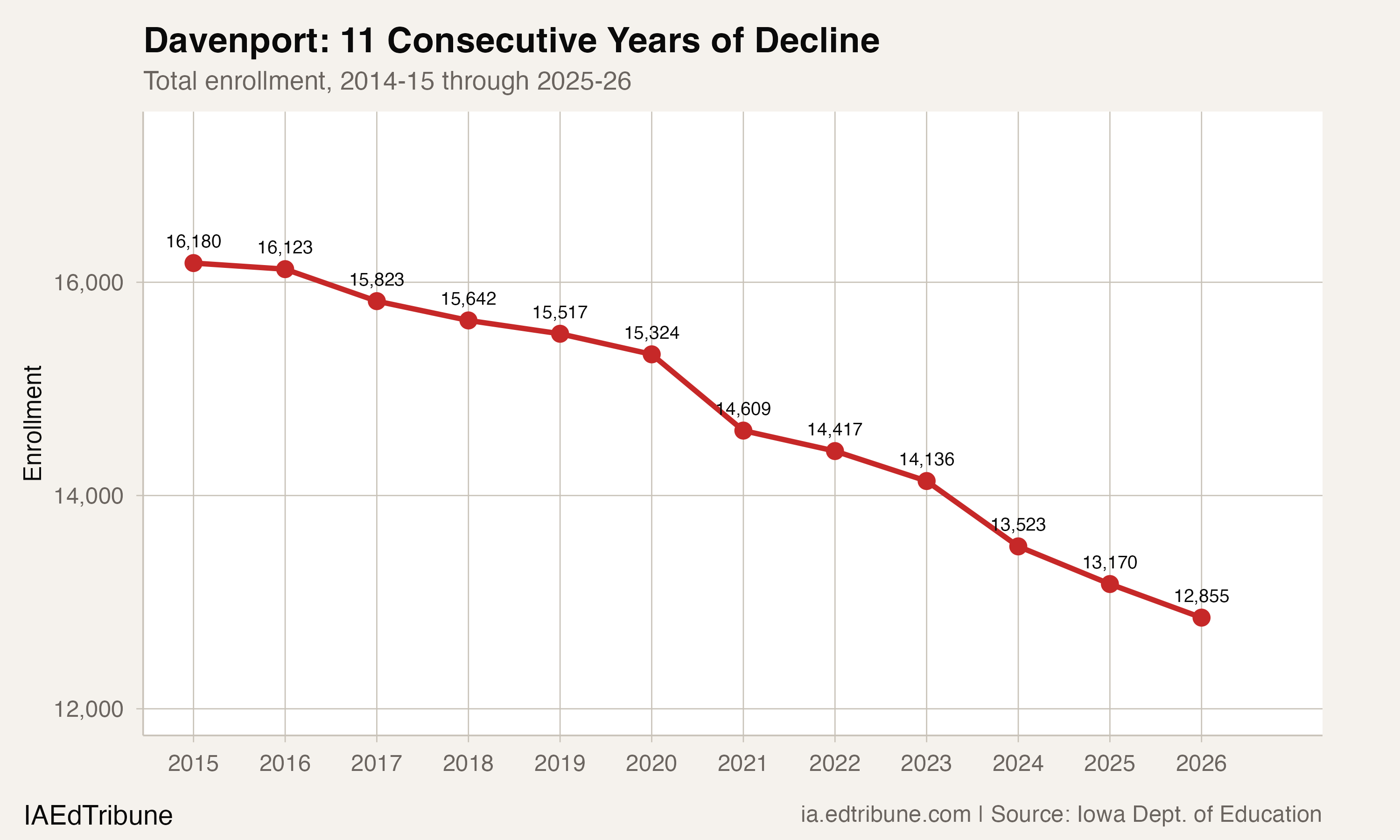
Not a steady bleed
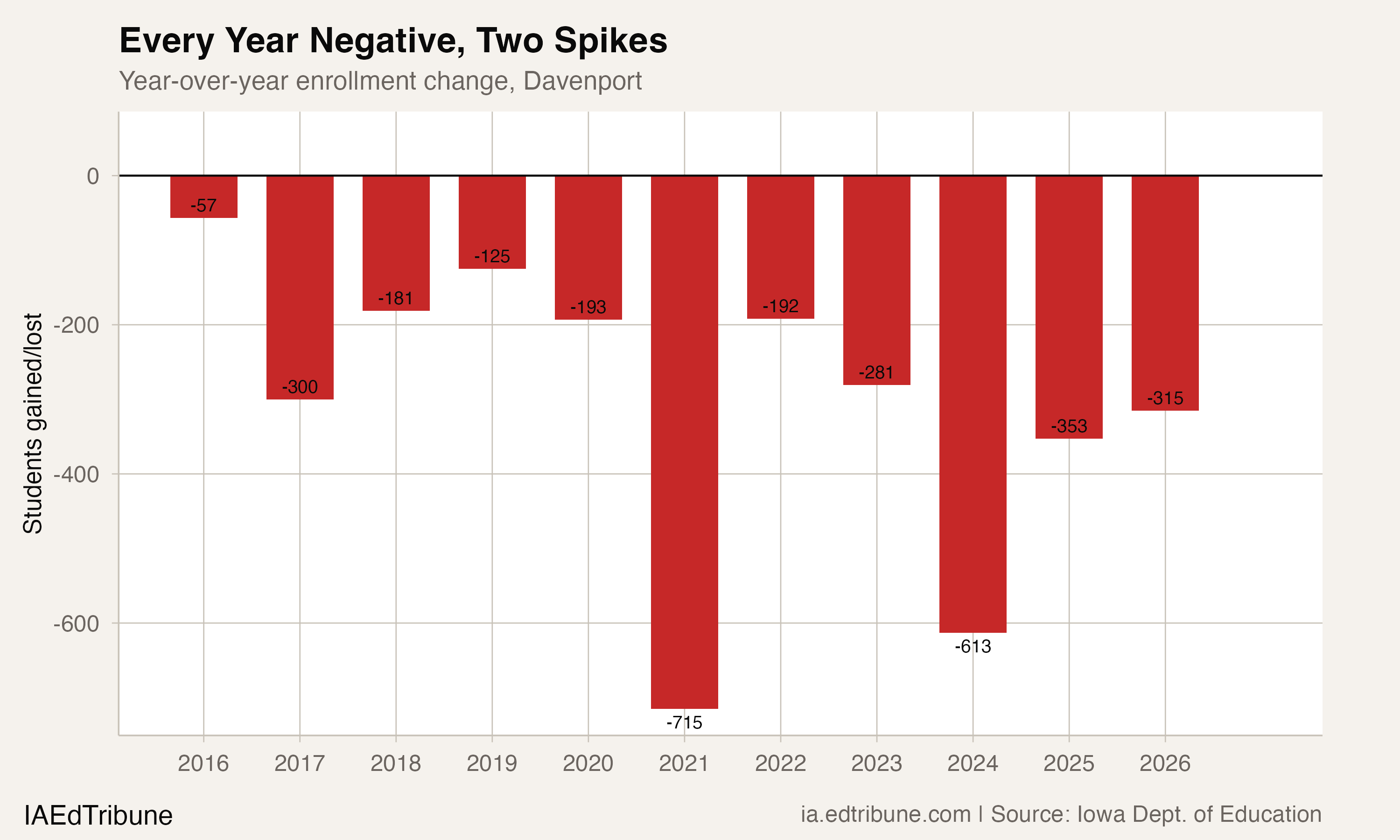
The year-over-year pattern is uneven. The pre-COVID years saw moderate losses: 57 in 2016, 300 in 2017, 181 in 2018, 125 in 2019. Then came two spikes. COVID drove a loss of 715 students in 2020-21, the worst single year. The district partially stabilized in 2022, losing 192, but then shed 613 in 2024, the second-worst year on record.
The two worst years were three years apart. The first spike is easy to explain: COVID. The second is harder. It coincided with the full rollout of Iowa's Education Savings Account program and the removal of the March 1 open enrollment deadline, both of which made it easier for families to leave mid-year. Whether those policy changes drove the 2024 spike or merely coincided with it, the enrollment data alone cannot determine.
The suburban inversion
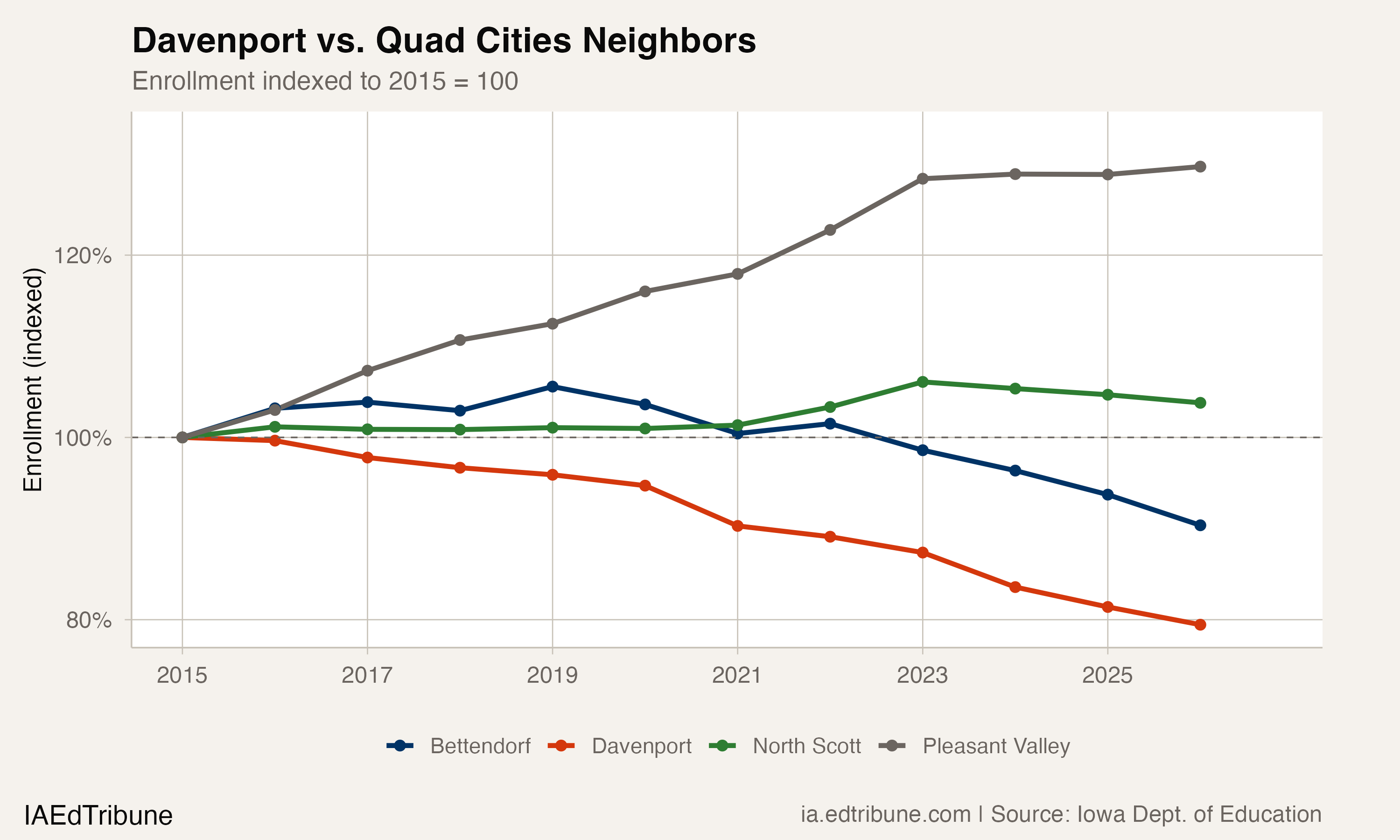
Davenport's decline is sharpest when measured against its Quad Cities neighbors. Since 2015, Pleasant Valley has grown 29.7%, adding 1,343 students. North Scott gained 3.8%. Bettendorf declined 9.6%, a more moderate version of Davenport's trajectory. The result is a widening gap: in 2015, Davenport enrolled more than three times as many students as Pleasant Valley. By 2026, the ratio had narrowed to barely two-to-one.
Open enrollment is the most visible mechanism. Davenport's net open enrollment loss grew from 425 students in 2018-19 to 790 in 2022-23, representing roughly 6% of the student body. Bettendorf, by contrast, posted a net gain of 362 students through open enrollment in the same year. Pleasant Valley gained 216.
The pattern is familiar in metro areas across the Midwest: a central-city district loses enrollment to suburban neighbors that benefit from newer facilities, higher test scores, or perceived safety advantages. Iowa's open enrollment system, which carries per-pupil state funding with each departing student, converts those departures directly into budget losses.
"One of the biggest issues we have is the fact that there's no deadline." -- Davenport Superintendent TJ Schneckloth, Quad City Times, Aug. 2023
The removal of the March 1 open enrollment deadline in 2021 made year-round departures possible, compounding the planning problem.
A different district than it was
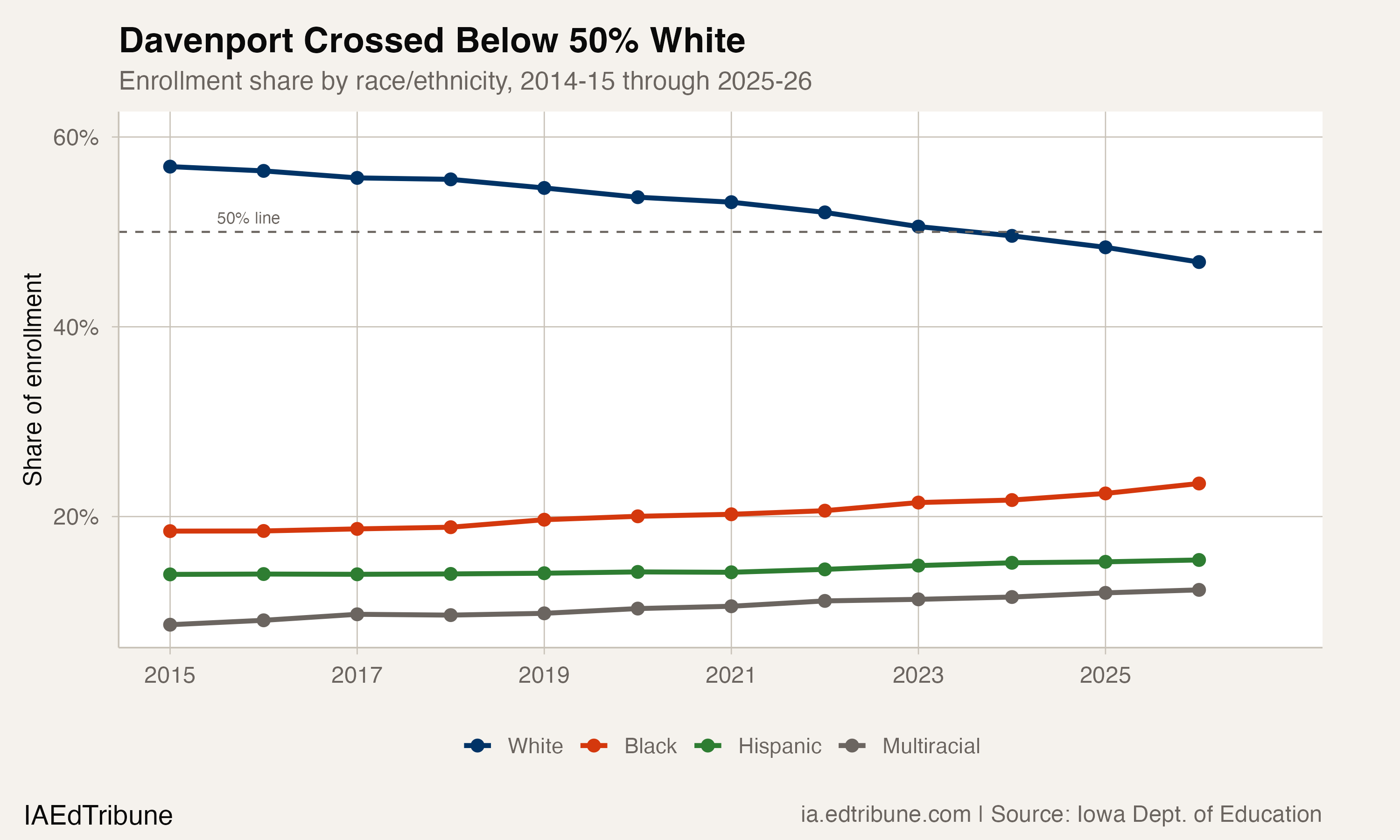
The enrollment decline has not been evenly distributed across racial groups. White enrollment fell from 9,203 to 6,019, a loss of 3,184 students and a 34.6% decline that accounts for nearly all of Davenport's total loss. Black enrollment held essentially flat at around 3,000 students. Hispanic enrollment declined 11.9%, from 2,250 to 1,983. Multiracial enrollment grew 13.4%.
The compositional shift is significant. In 2015, Davenport was 56.9% white. By 2024, white enrollment had dropped below 50% for the first time, hitting 49.6%. In 2026, the share stands at 46.8%. Davenport is now a majority-minority district in a state where public school enrollment is still nearly 70% white.
The data cannot distinguish how much of the white enrollment decline comes from families leaving the district versus demographic change in the underlying population. Some portion reflects open enrollment departures. Some reflects the same birth rate decline and aging that affects Iowa broadly. The overlap between white enrollment loss and open enrollment departures is suggestive, but the enrollment data contains no individual-level tracking.
Three charter schools arrive
Davenport had never hosted a charter school until August 2025, when Horizon Science Academy Davenport opened its doors with a first-year cap of 210 students in grades K-6, operated by Ohio-based Concept Schools. Two more charters are approved to open by fall 2026: Davenport Prep (grades 6 and 9) and Great Oaks High School and Career Center, a dropout recovery program targeting students ages 16-21.
Combined, the three schools could serve close to 600 students in their first year. If most of those students transfer from Davenport Community Schools rather than arriving from private schools or neighboring districts, the enrollment impact on Davenport would be equivalent to adding another 2024-scale loss year.
The district's response has been cautious. "The Davenport Community School District is continuing to evaluate the impact that charter schools will have on the broader Iowa Quad City region," the district told KWQC in January 2025.
Great Oaks, notably, is designed to serve students who have already dropped out. If it draws from the non-enrolled population rather than from Davenport's current enrollment, its effect on the district's numbers could be negligible. The 2025-26 certified enrollment file includes Horizon Science Academy Davenport, while Great Oaks Davenport had not yet opened.
Kindergarten signals more to come
The pipeline is not encouraging. Davenport's kindergarten class has shrunk from 1,229 in 2015 to 863 in 2026, a 29.8% decline that outpaces even the district's overall loss rate. Grade 12, by contrast, has held relatively steady near 1,100. The gap between the entering and exiting cohorts means that as larger graduating classes age out and smaller kindergarten classes replace them, the arithmetic of decline accelerates.
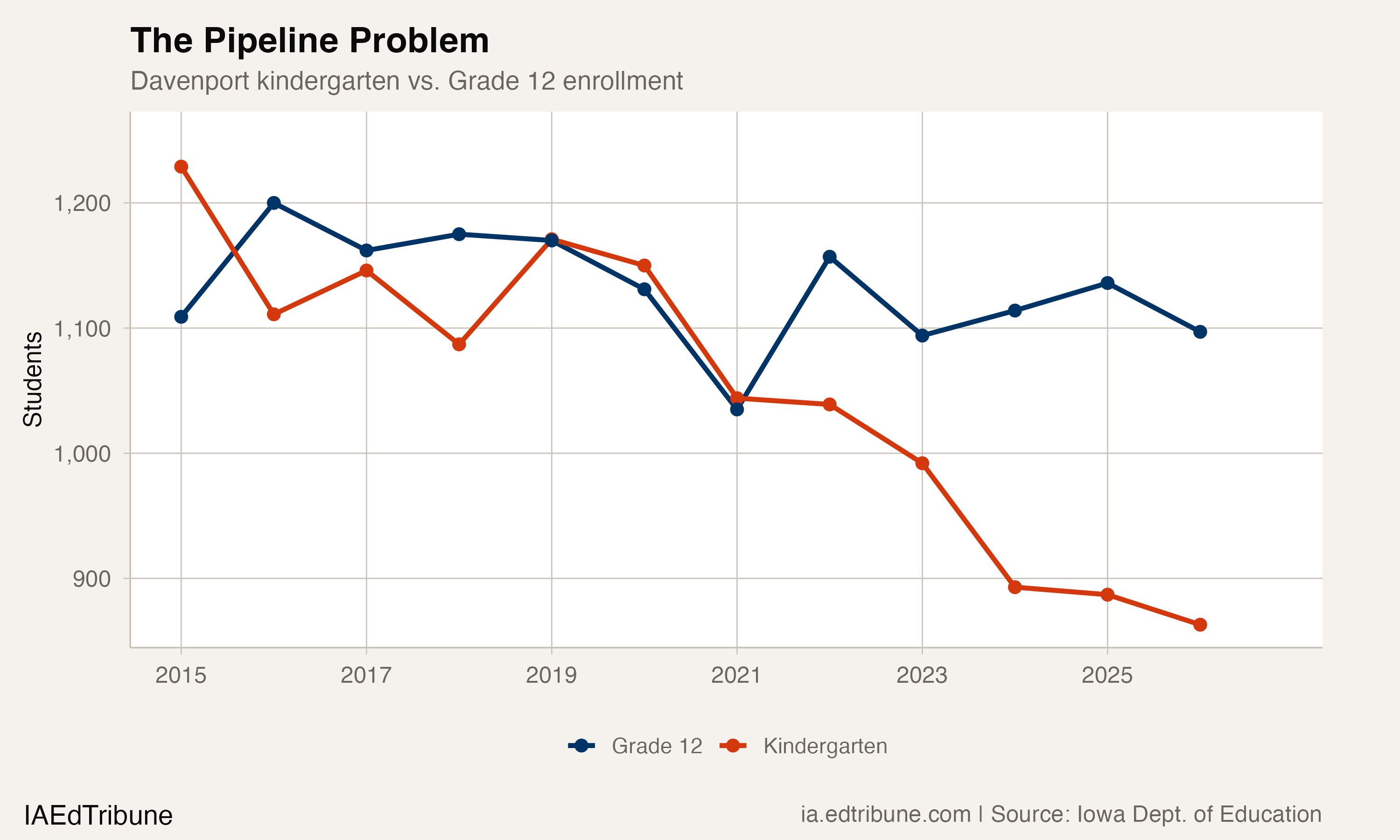
Grades 1 and 2 have each lost roughly 30% of their 2015 enrollment. The elementary grades now entering middle school are already substantially smaller than the middle schoolers ahead of them. Davenport closed three elementary schools (Buchanan, Monroe, and Washington) at the end of the 2022-23 school year to address the shrinking footprint. The district also moved sixth-graders back to middle school buildings in 2024-25 to consolidate capacity.
From third to sixth
In 2015, Davenport was Iowa's third-largest district behind Des Moines and Cedar Rapids. By 2026, it had fallen to sixth, overtaken by Iowa City (+11.0%), Waukee (+65.3%), and Sioux City, which declined only 3.8% from a slightly smaller starting point. Among Iowa's 11 districts that enrolled at least 8,000 students in 2015, Davenport's 20.6% decline is the worst. Des Moines, at -13.9%, is the next closest. Waukee, which has nearly doubled in the same period, represents the opposite end of the same metro-area dynamic playing out 170 miles to the west.
Davenport is the largest of the four Iowa districts with unbroken 11-year decline streaks. The others are Muscatine (5,521 to 4,251, -23.0%), Anamosa (1,301 to 1,101, -15.4%), and BCLUW (641 to 458, -28.5%). Only Muscatine, another eastern Iowa river city, approaches Davenport's scale of loss.
What to watch
The 2026-27 enrollment count will be the first to capture charter school impact. If Horizon Science Academy's 210 students came primarily from Davenport schools, the district should expect a loss of roughly 500 or more in a single year, the charters compounding the baseline outflow. If the loss stays near recent norms of 300-350, the charter schools are drawing from other sources.
The deeper question is whether Davenport's decline has a floor. The district has closed buildings, reconfigured grades, and absorbed more than $5 million in annual open enrollment costs. At the three-year average loss rate of roughly 425 students per year, enrollment would approach 12,000 by 2028. Each departed student carries roughly $7,600 in per-pupil state funding, meaning the 3,325 students already lost represent approximately $25.3 million in annual revenue the district no longer receives.
At some point, a shrinking district reaches equilibrium: the families who want to stay have stayed, birth rates stabilize, and the outflow to suburbs and charters levels off. The enrollment data shows no sign that Davenport has reached that point.
Detailed code that reproduces the analysis and figures in this article is available exclusively to EdTribune subscribers.
Discussion
Sign in to join the discussion.
Loading comments...