In this series: Iowa 2025-26 Enrollment.
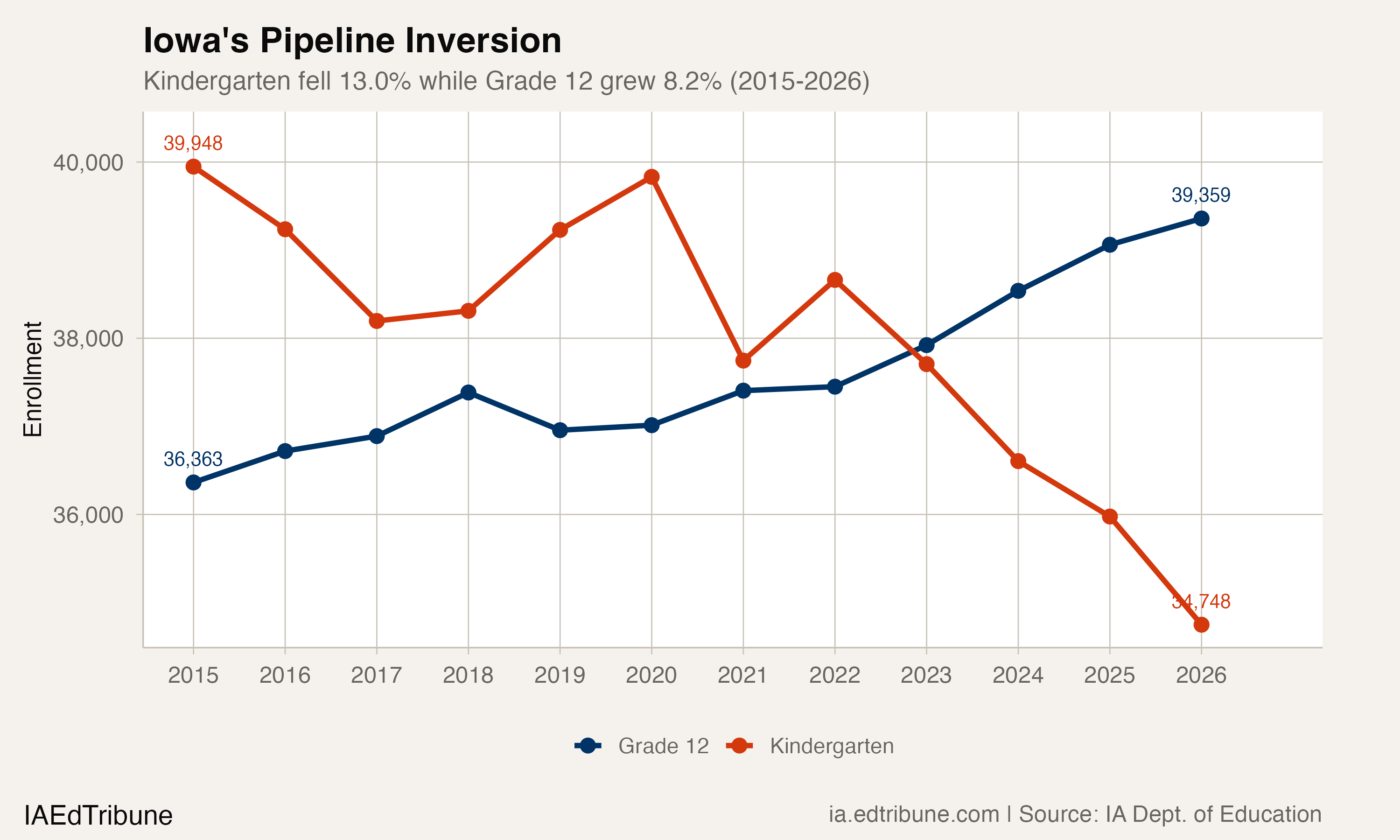
Iowa enrolled 34,748 kindergartners in 2025-26. That is the smallest kindergarten class in the 12-year data series, 5,200 fewer children than in 2014-15, and a 13.0% decline. Over the same period, total enrollment fell just 1.9%.
The gap between those two numbers is the story. The 2025-26 kindergartners become the next first-graders, then second-graders, then the graduating class of 2038. Every year that a smaller cohort enters the front of the system, the losses compound as that cohort ages through it. Iowa's steepest enrollment drops are not in the past. They are still working their way up the grade ladder.
A perfect gradient from K to 12
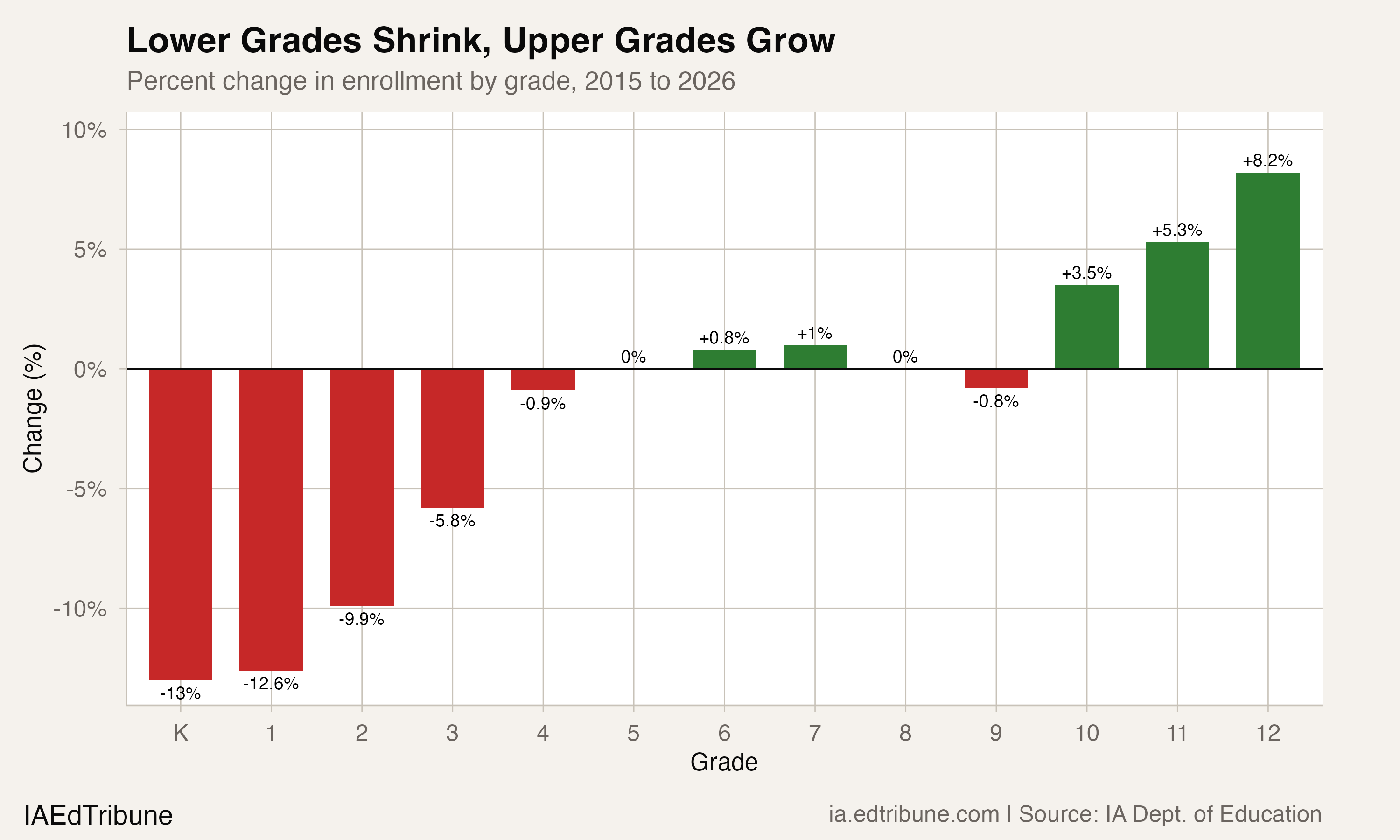
The grade-by-grade pattern from 2015 to 2026 is remarkably orderly. Kindergarten lost 13.0%. First grade lost 12.6%. Second grade lost 9.9%. Third grade lost 5.8%. Fourth grade lost 0.9%. Fifth grade was flat. And from sixth grade upward, every grade shows gains: 0.8% in sixth, 1.0% in seventh, all the way to 8.2% in 12th.
The inflection point sits between fourth and fifth grade, the precise boundary between cohorts born before and after Iowa's birth rate began its steepest decline. Children in fourth grade in 2026 were born around 2016, when Iowa's birth rate was already falling from its 2015 level of 12.6 per 1,000 residents. Children in 12th grade were born around 2008, near the tail end of higher fertility.
The result is an inverted distribution. In 2026, 12th grade holds the largest share of K-12 enrollment at 8.41%, while kindergarten holds the smallest at 7.43%. In 2015, kindergarten was the largest grade at 7.89% and 12th grade sat at 7.18%. The pyramid has flipped.
Not one bad year but a structural pattern
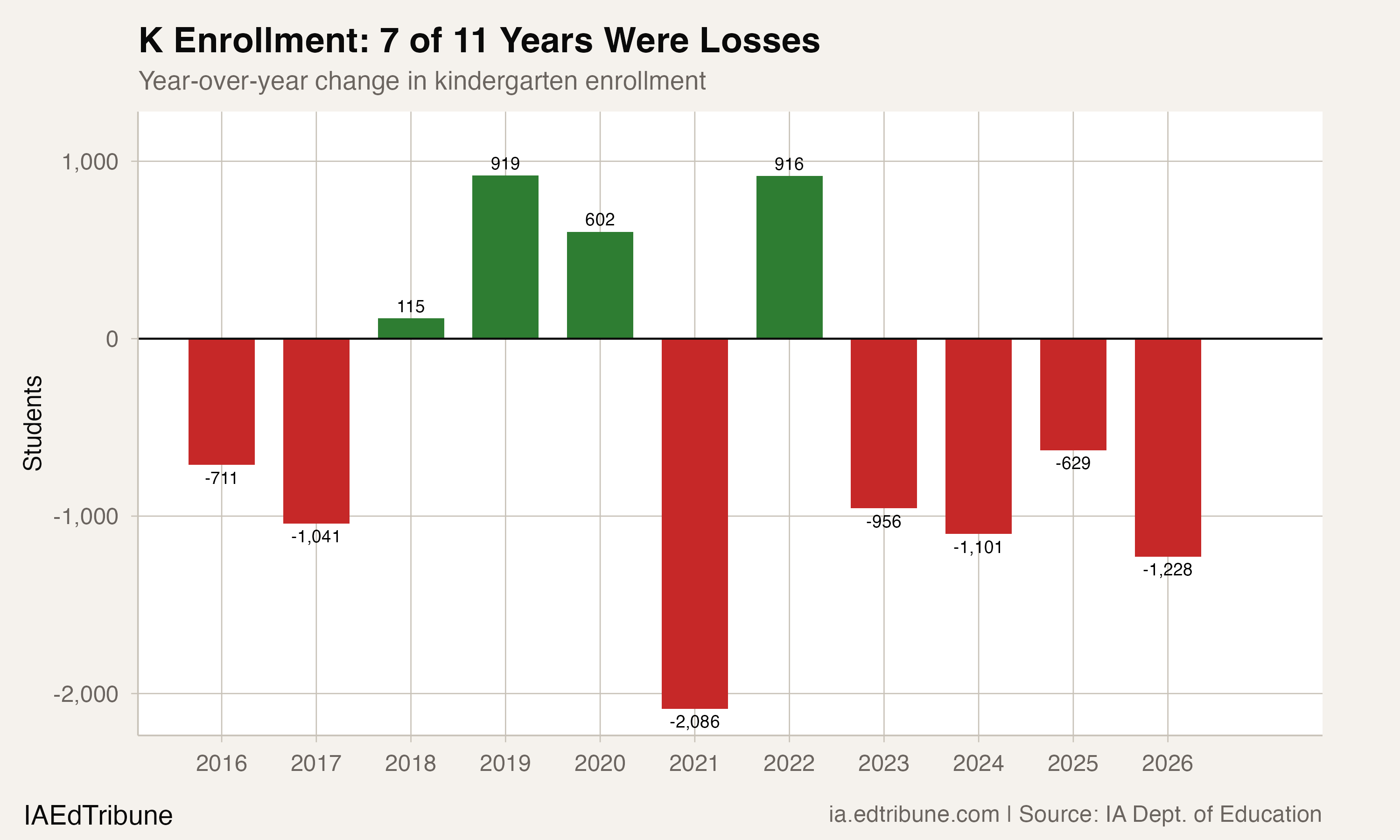
Of the 11 year-over-year changes in kindergarten enrollment since 2016, seven were losses. The only gains came in 2018 (+115), 2019 (+919), 2020 (+602), and 2022 (+916). Each recovery was temporary. The post-COVID rebound of 2022 gave way to four consecutive years of decline: -956 in 2023, -1,101 in 2024, -629 in 2025, and -1,228 in 2026.
The 2026 loss of 1,228 kindergartners is the second-largest in the series after COVID's 2,086-student drop in 2021. Unlike the pandemic year, there is no obvious one-time event to blame or to expect a bounce from.
The weight is shifting to high school
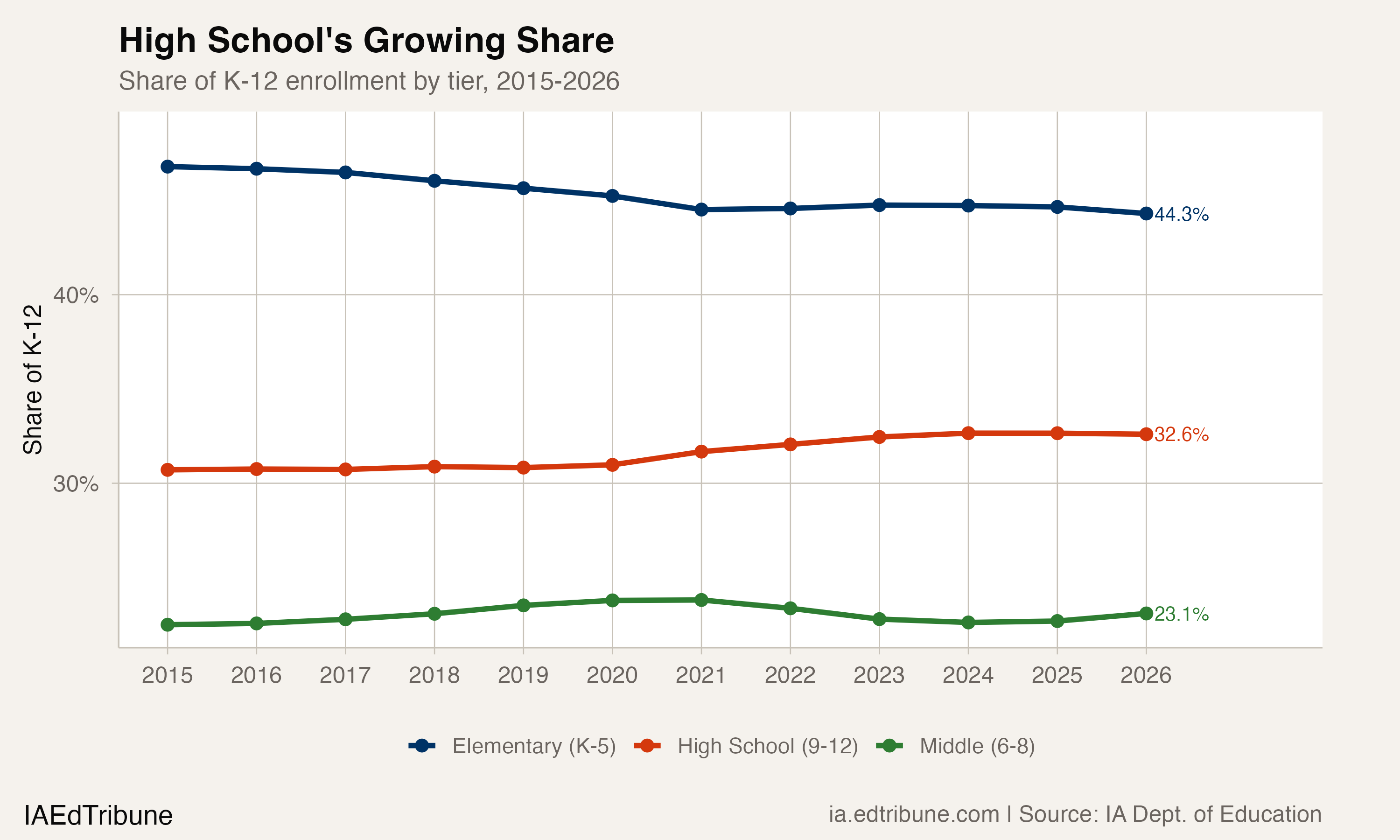
The pipeline effect has already reshaped the distribution of students across tiers. Elementary enrollment (K through fifth grade) fell from 223,406 in 2015 to 207,329 in 2026, a loss of 16,077 students and a 7.2% decline. High school enrollment (9th through 12th) grew from 146,618 to 152,548, adding 5,930 students. Middle school enrollment was essentially flat, up 660 students over 11 years.
As a share of K-12 enrollment, elementary dropped from 46.8% to 44.3%. High school's share rose from 30.7% to 32.6%. That 1.9 percentage-point high school gain may sound small, but it represents a fundamentally different cost structure. High school programs carry higher per-pupil costs for electives, lab sciences, career-technical education, and extracurriculars. Districts are simultaneously losing the per-pupil funding that follows elementary students out the door and absorbing larger cohorts into their most expensive programs.
Where the pipeline thinned most
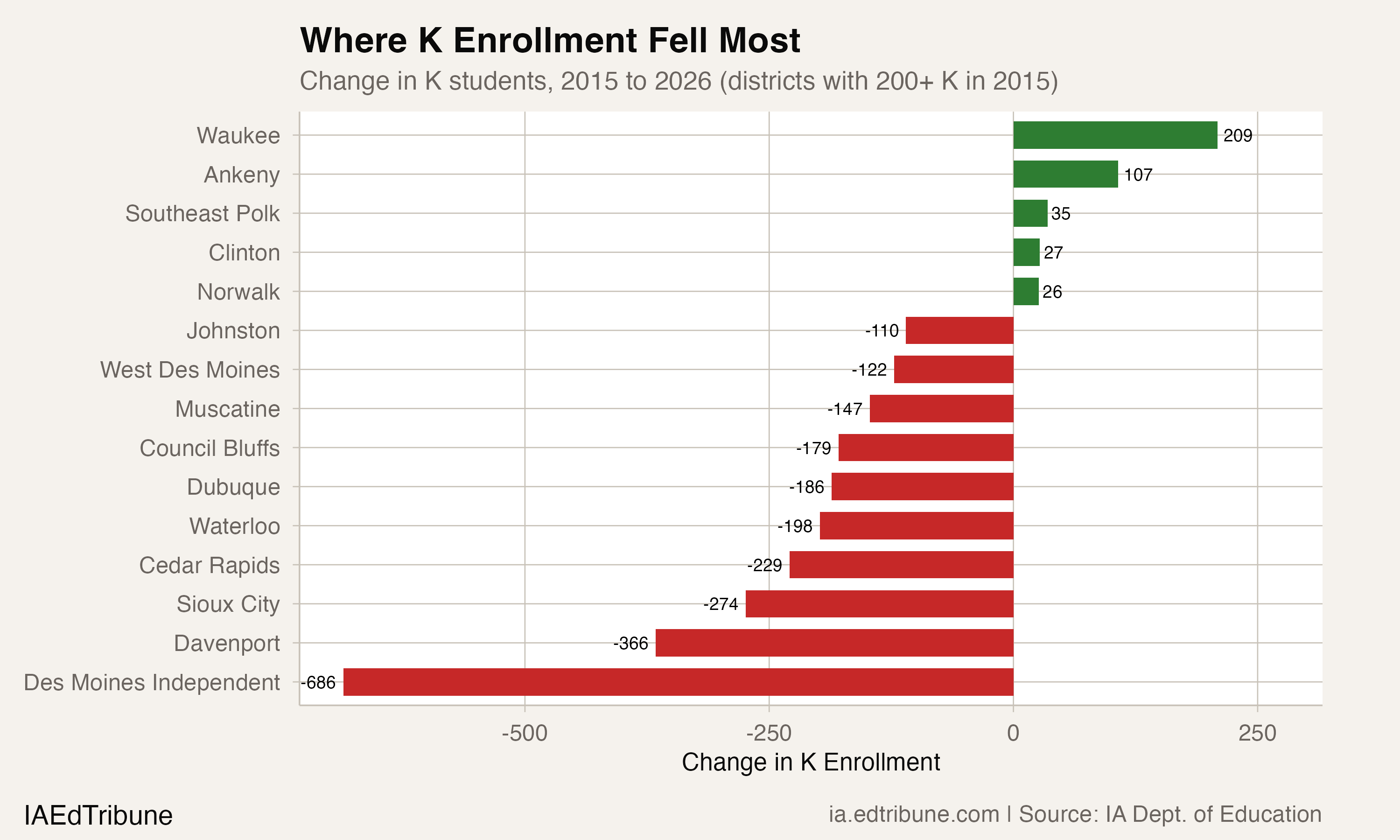
The kindergarten decline was not evenly distributed. Among districts that enrolled at least 200 kindergartners in 2015, Des Moines lost 686, a 26.0% decline. Davenport lost 366, down 29.8%. Sioux City lost 274 (-21.0%), Cedar Rapids lost 229 (-17.5%), and Waterloo lost 198 (-21.4%). Des Moines's loss alone accounts for 13.2% of the statewide K decline.
The losses in Des Moines extend beyond demographics. Open enrollment transfers out of the district nearly doubled from about 1,500 in 2019-20 to 2,900 in 2024-25, costing the district $7,800 per departing student. The district has responded with a 10-year "Reimagining Education" plan that includes school closures, moving sixth grade back into elementary buildings, and expanding full-day preschool. Voters approved a $265 million bond referendum for the plan in November 2025.
Muscatine's 36.7% kindergarten decline, the steepest rate among midsized districts, and Fort Madison's 48.7% drop in a smaller district underscore that the pattern extends beyond the metro areas into river towns and manufacturing communities.
On the other side of the ledger, Waukee gained 209 kindergartners (+24.9%) and Ankeny gained 107 (+12.1%). Both are Des Moines suburbs in the fast-growing Dallas and Polk County corridor. The suburban donut is visible at the kindergarten level: the urban core is losing the youngest students at two to three times the statewide rate while adjacent suburbs add them.
Fewer births, fewer families, and a funding formula built on headcount
The most straightforward explanation is that Iowa is producing fewer children. The state's birth rate fell from 12.6 per 1,000 residents in 2015 to 11.2 in 2023, a decline that tracks closely with the kindergarten enrollment drop five years later. A kindergartner in 2026 was born in roughly 2020 or 2021, years when the birth rate was still falling.
Migration compounds the birth-rate effect. Roughly two-thirds of Iowa's 99 counties lost population over the last decade, and the families leaving tend to be younger. The Iowa Department of Education projects a 3.5% decline in certified public-school enrollment between 2020 and 2030, but that projection was made before the 2026 data showed the steepest single-year loss since COVID.
"Iowa's K-12 enrollment is declining as birth rates fall and fewer young families move into the state, and that trend is expected to continue for at least the next decade." — ITR Report Card, 2025
Iowa's per-pupil funding formula means smaller kindergarten classes translate directly into less revenue. Already, 157 districts rely on the budget guarantee to stay above prior-year spending, with 208 projected next year.
What kindergarten numbers cannot tell us
The pipeline signal is clear: smaller kindergarten cohorts will age through the system for at least the next six to eight years, mechanically reducing enrollment as they replace the larger 2025-26 high school cohorts. What the data cannot resolve is how much of the kindergarten decline reflects fewer children existing versus families choosing alternatives.
Iowa's ESA program enrolled 41,044 students in 2025-26, and the state does not publish private school enrollment by grade level, making it impossible to know how many five-year-olds who would have entered public kindergarten are instead enrolling in private or parochial schools. Open enrollment transfers move roughly 44,500 students across district boundaries, reshuffling the geographic pattern without changing the statewide total.
The birth-rate decline is the primary structural driver, but school choice likely amplifies the losses in specific districts, particularly urban ones, while redistributing some students to suburban and private alternatives.
The 2032 question
The 2015 kindergarten class of 39,948 is roughly the 2025-26 11th-grade class of 37,958. The 2026 kindergarten class of 34,748 will become the 12th-grade class of approximately 2038. Between now and then, every grade from K through 7 will cycle through cohorts smaller than the ones filling high schools in 2025-26.
Cedar Rapids, which lost 229 kindergartners since 2015, has already cut $11 million from its current budget and plans $13 million more for next year. The losses trickle across classrooms rather than emptying entire buildings, which makes them harder to manage:
"This second-grade class might have two fewer students in it, that doesn't mean eliminate that teaching position." — Cindy Garlock, Cedar Rapids school board member, KCRG, Feb. 2026
The question for Iowa's 327 districts is whether the kindergarten pipeline stabilizes or continues to narrow. The children who will enter kindergarten in 2031 are being born in the mid-2020s, at birth rates lower than the ones that produced Iowa's record-low 2025-26 K class. If the pattern holds, 208 districts on the budget guarantee will not be the ceiling.
Detailed code that reproduces the analysis and figures in this article is available exclusively to EdTribune subscribers.
Discussion
Sign in to join the discussion.
Loading comments...