In this series: Iowa 2025-26 Enrollment.
Waukee added 364 students last year. It is the only district among Iowa's 10 largest that can say it grew at all.
The other nine lost a combined 3,516 students in a single year. Seven of them are now at their lowest enrollment in 12 years of data: Des Moines, Cedar Rapids, Sioux City, Davenport, Waterloo, Dubuque, and West Des Moines. Of the remaining two, Iowa City and Ankeny sit just below recent peaks but are not at their floor. The pattern is not subtle. Iowa's urban core is hollowing out.
Statewide, 131 of 332 districts, 39.5%, are at their 12-year enrollment low. Just 31 districts, 9.3%, are at their highs. For every district setting a record, four are scraping their floor.
Where Iowa's largest districts stand
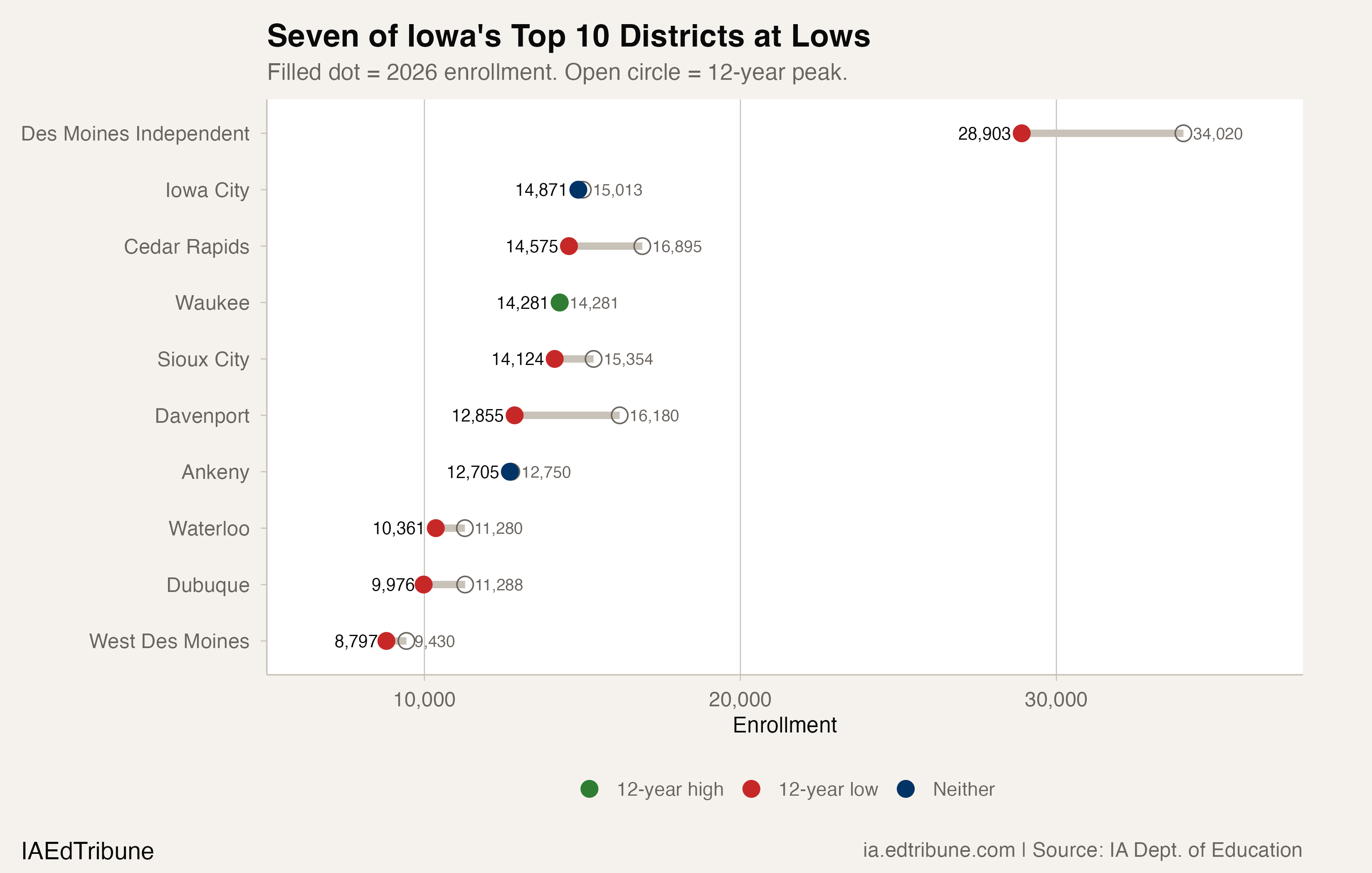
The gap between current enrollment and peak enrollment tells the story of what has been lost. Des Moines peaked at 34,020 in 2018 and has fallen to 28,903, a loss of 5,117 students, or 15.0%. Davenport peaked at 16,180 in 2015 and has not had a single year of growth since, losing 3,325 students over 11 consecutive years of decline, the longest active streak among Iowa's large districts. That is 20.6% of its enrollment, gone.
Cedar Rapids peaked at 16,895 in 2018 and has dropped to 14,575, a decline of 13.7%. The district faces a $11 million budget gap and may close as many as six elementary schools. Sioux City peaked at 15,354 in 2020 and has lost 1,230 students since. Dubuque peaked at 11,288 in 2015 and has dropped 11.6%.
The two that are not at their lows offer little comfort. Iowa City's 14,871 students represent a 142-student decline from last year and sit just 0.9% below its 2025 peak. Ankeny, which reached 12,750 in 2023, is at 12,705, barely 45 students off its high but trending the wrong direction.
The 2026 losses
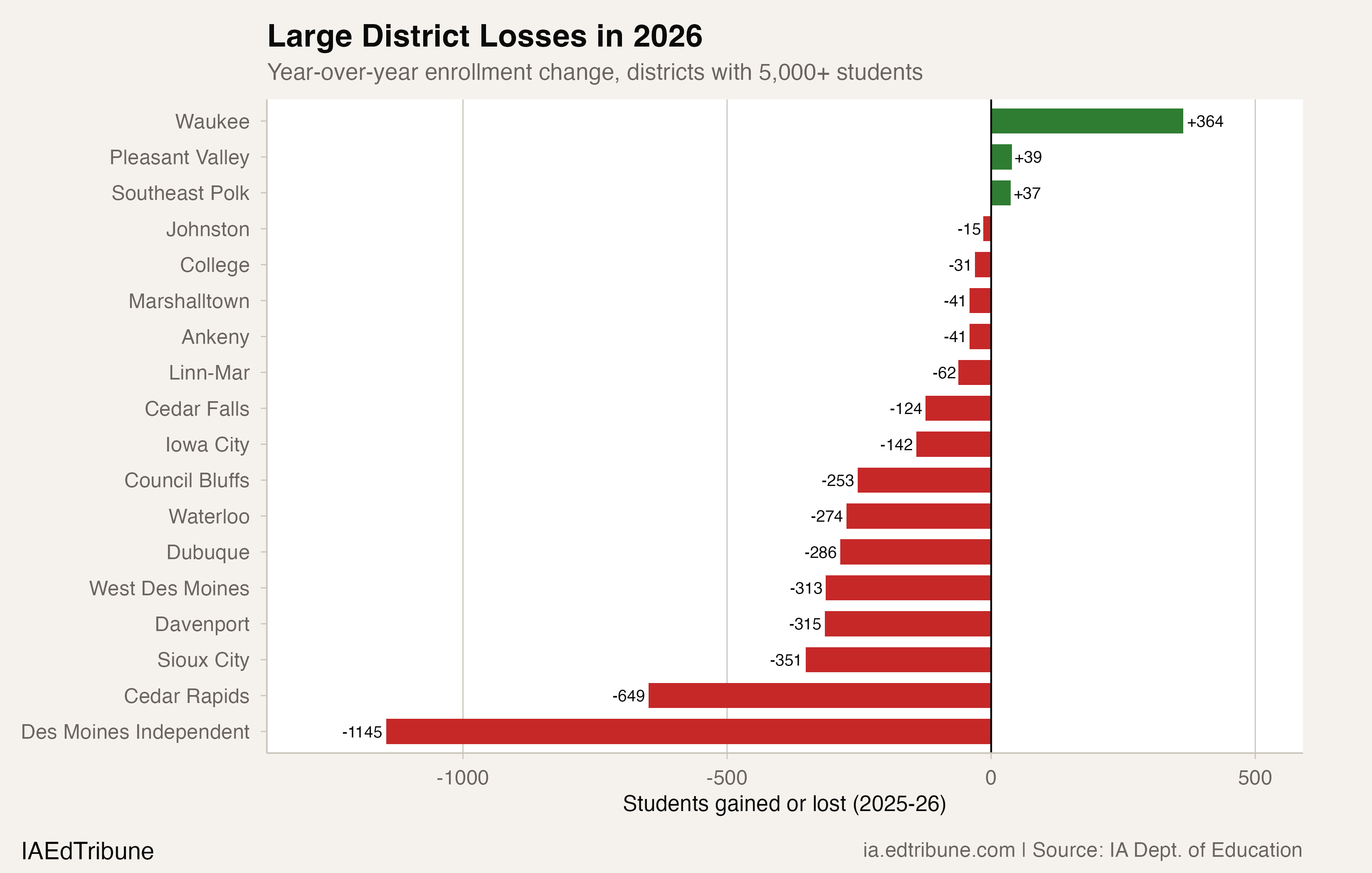
Among all 18 Iowa districts with 5,000 or more students, 15 lost enrollment in 2025-26. Des Moines alone lost 1,145 students, its steepest single-year decline in the dataset outside of the COVID year. Cedar Rapids lost 649. The three that gained, Waukee (+364), Pleasant Valley (+39), and Southeast Polk (+37), are all suburbs.
Des Moines' 2026 loss is five times larger than its 2025 loss of 229 students. Open enrollment out of DMPS roughly doubled from about 1,500 students in 2019-20 to approximately 2,900 in 2024-25, each taking roughly $7,800 in state funding to their new district. The district's Reimagining Education plan is an explicit attempt to reverse that outflow. Immigration enforcement concerns have also been cited as a contributing factor, with more than 25% of the district's students being English language learners. The relative weight of these forces is not clear from enrollment data alone.
The streak chart
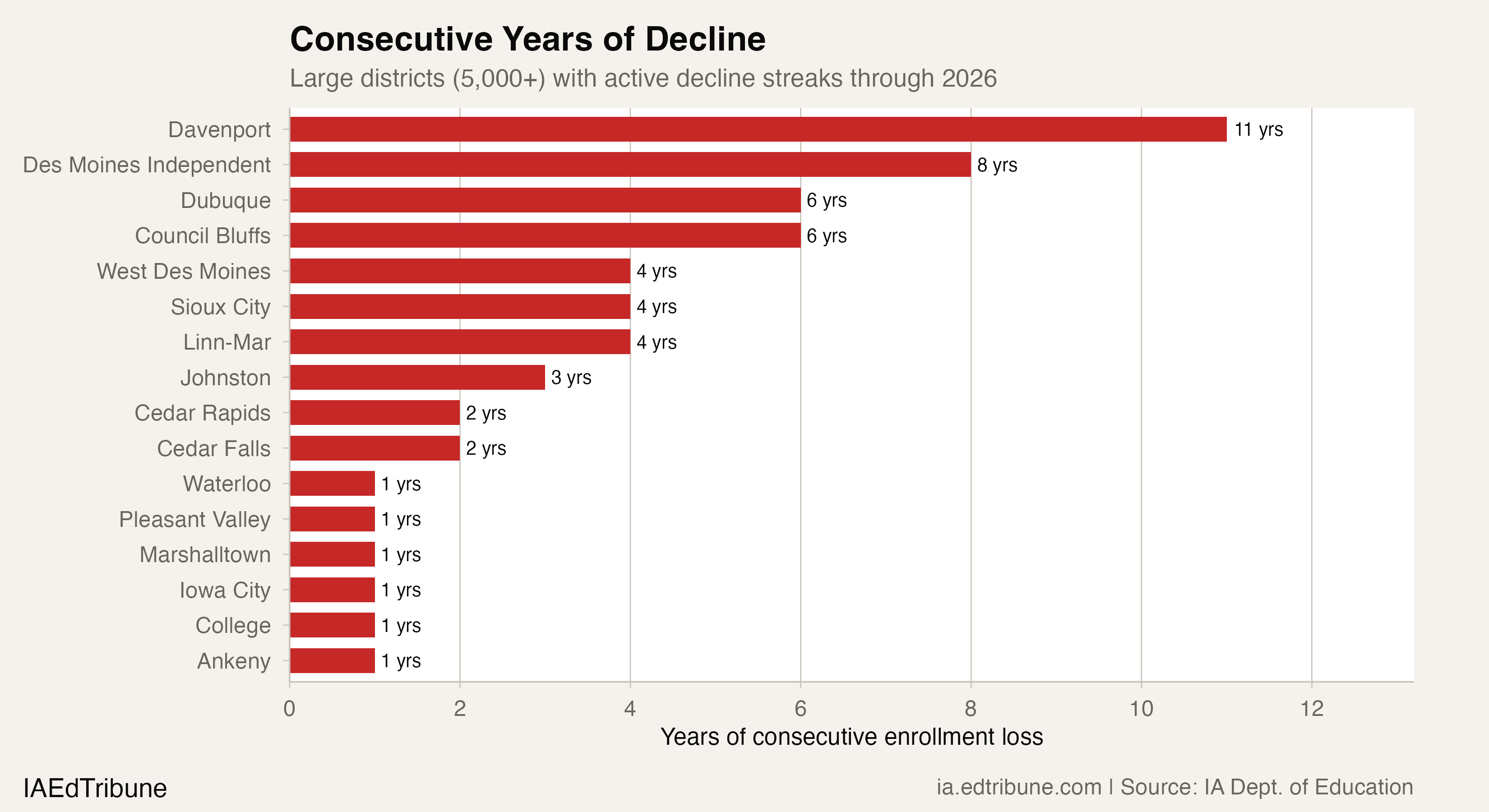
Davenport has declined every year since its 2015 peak. No single year was catastrophic; the losses ranged from 57 to 715 students. But compounded over 11 years, the district is one-fifth smaller. Des Moines has declined for eight consecutive years. Dubuque and Council Bluffs each carry six-year streaks. Every one of these districts is on the state's budget guarantee, the state funding provision that partially cushions districts whose enrollment losses outpace per-pupil aid increases.
"To see two-thirds of districts on budget guarantee is really unprecedented." -- Margaret Buckton, Iowa School Finance Information Services, KCRG, Feb. 2026
For 2025-26, 157 Iowa districts qualified for the budget guarantee, up from 140 the prior year. Most of the state's largest districts are on the guarantee. The provision fills the gap between what the state funding formula generates per pupil and what districts need to maintain operations when enrollment drops. It is a safety net, not a solution. As Cedar Rapids school board member Cindy Garlock told KCRG: "It's difficult to do year after year. You can do it for a year or two, but it catches up."
Size does not protect
Half of Iowa's 18 districts with 5,000 or more students are at their 12-year low. That rate, 50.0%, is higher than any other size category. Among districts with 1,000 to 1,999 students, 44.4% are at their floor. Even among districts with fewer than 500 students, 42.0% are at record lows.
The pattern inverts at the top. The largest districts are disproportionately at lows while the districts at highs tend to be smaller: suburban bedroom communities like Waukee (14,281), Southeast Polk (7,538), Pleasant Valley (5,863), Norwalk (3,599), and Clear Creek Amana (3,190). Growth is concentrating in suburban rings while the cities and smaller rural districts both lose ground.
Waukee: the exception that proves the pattern
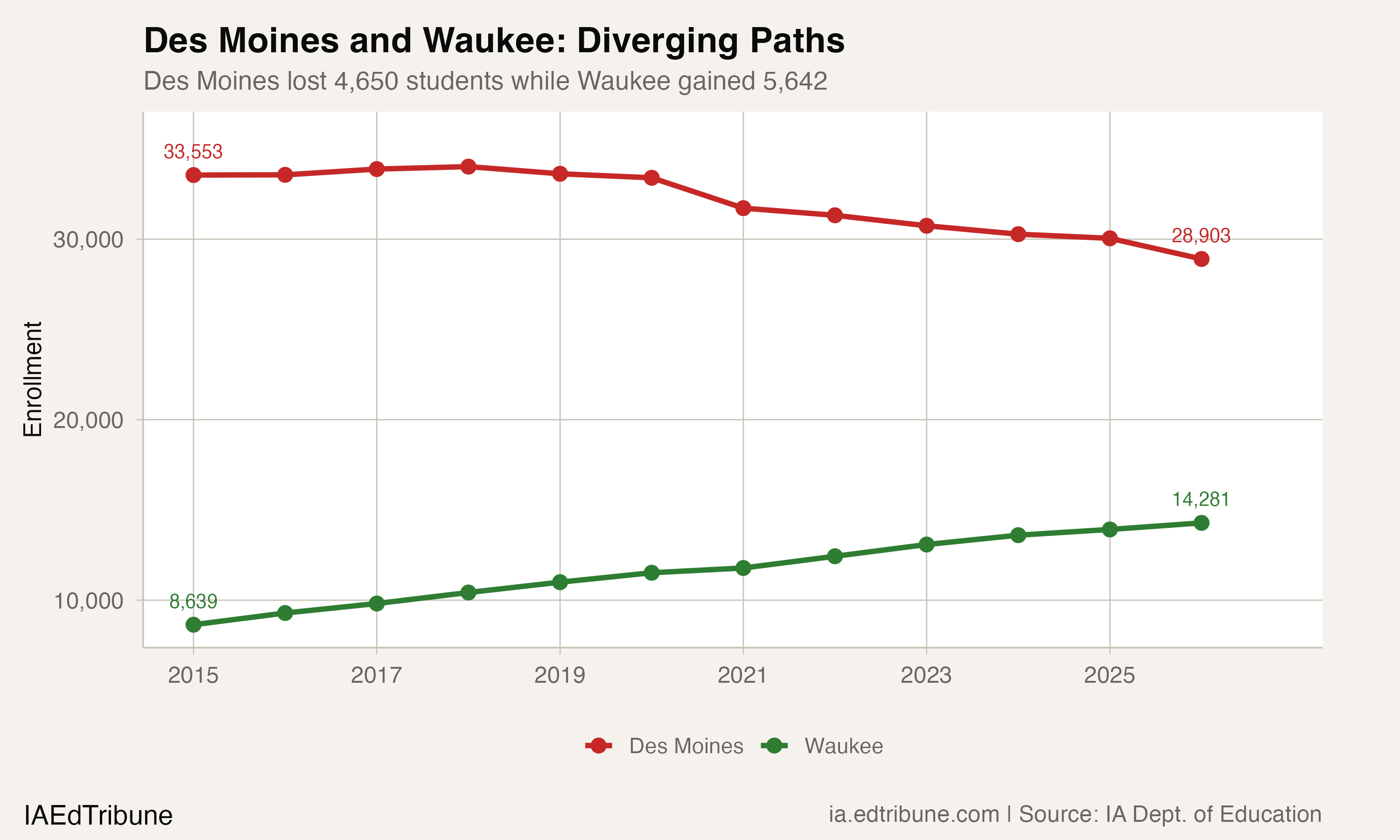
In 2015, Des Moines enrolled 33,553 students and Waukee enrolled 8,639. Eleven years later, Des Moines is at 28,903 (-4,650, or -13.9%) and Waukee is at 14,281 (+5,642, or +65.3%). Waukee has gained more students than Des Moines lost. The gap between them has shrunk from 24,914 to 14,622.
Waukee's growth tracks the residential boom in Dallas County, the fastest-growing county in Iowa. The district opened a second high school in 2021 and a new middle school in 2025. But Waukee's growth is not simply Des Moines' loss. Statewide enrollment fell by 7,670 in 2026. Waukee's 364-student gain offset less than 5% of that loss.
Across all 332 districts
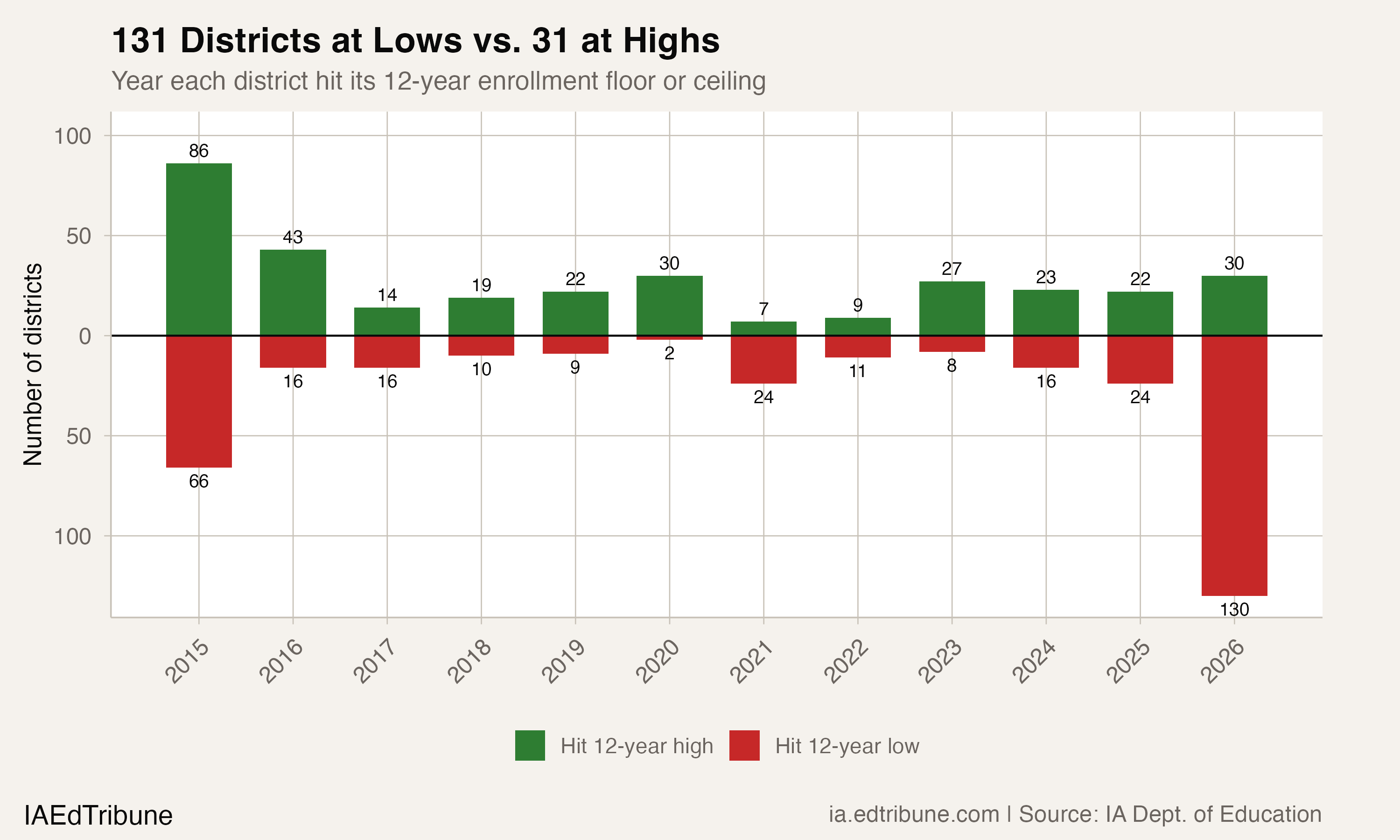
The 2026 bar dwarfs every other year. Before 2021, the number of districts at their lowest point in any given year ranged from two to 16. In 2021, the COVID year, 24 districts hit their floor. In 2026, 130 did. (One additional district hit its low in 2025 and stayed flat in 2026, bringing the total currently at their floor to 131.)
Students in these 131 districts account for 231,554 enrollments, 46.6% of Iowa's total public school population. Nearly half the state's students attend a district that has never been smaller.
Why the losses keep broadening
The causes are layered and district-specific. Cedar Rapids officials pointed to nearly 200 students leaving for the new CR Prep charter school in a single year, plus families choosing ESA-funded private alternatives. Des Moines' steeper 2026 drop may partly reflect immigration enforcement fears, though the district has not published data isolating that effect.
But most of Iowa's record-low districts are small, and for them the explanation is simpler: fewer children exist. Iowa's kindergarten cohort has shrunk 13% since 2015. Open enrollment moves 44,500 students across district boundaries each year, and the state's ESA program now covers 41,044 students in private schools. The enrollment data records departures, not destinations.
Caveats
This analysis uses 12 years of data (2015-2026). A district "at its 12-year low" may have been smaller before 2015. For Davenport, which has declined all 11 years, the trajectory is unambiguous. For Iowa City, which peaked in 2025 and dipped 0.9%, it is too early to call structural.
The fiscal reality ahead
The question for Iowa's large districts is whether the 2026 acceleration is a one-year anomaly or the start of a new baseline. If the current trajectory holds, districts already on budget guarantee face a compounding problem: the guarantee cushions the first year of loss but does not restore the enrollment. Each year, the gap between the formula's output and the district's operating costs widens.
Des Moines is betting on restructuring. Voters approved a $265 million bond in November 2025 for the Reimagining Education initiative to consolidate and specialize schools. Cedar Rapids is proposing $11 million in cuts and potential school closures. Both strategies assume the decline is structural. Waukee, meanwhile, is planning a third high school for the 2030s. In Iowa, the districts planning for growth and the districts planning for contraction are no longer in the same conversation.
Detailed code that reproduces the analysis and figures in this article is available exclusively to EdTribune subscribers.
Discussion
Sign in to join the discussion.
Loading comments...