In this series: Iowa 2025-26 Enrollment.
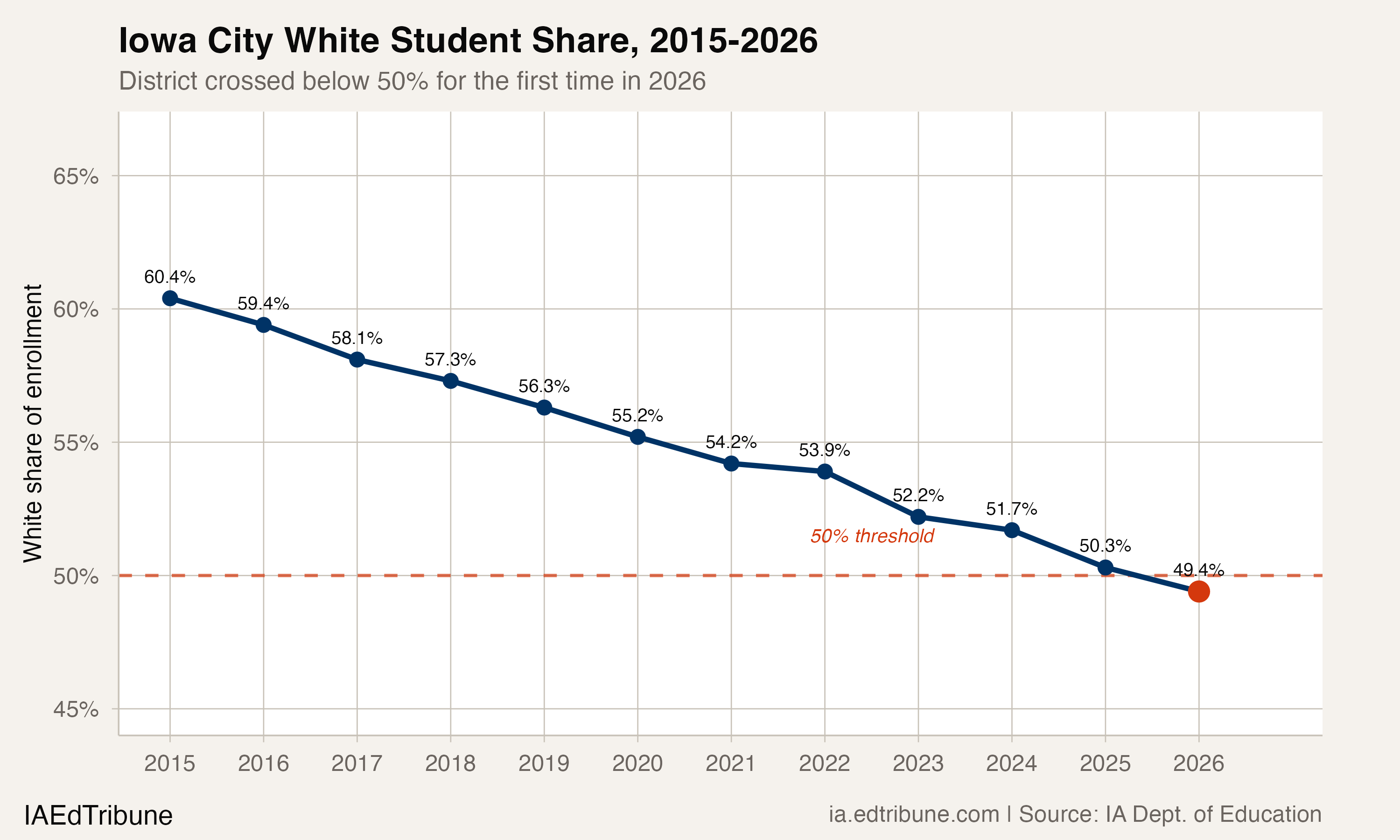
For eleven straight years, the white share of enrollment in Iowa City Community School District moved in one direction. It fell from 60.4% in 2015 to 50.3% in 2025, a steady decline of about one percentage point per year, unremarkable in isolation. Then, in 2025-26, the district crossed below 50% for the first time: 49.4% white, making Iowa's second-largest district a majority-minority system.
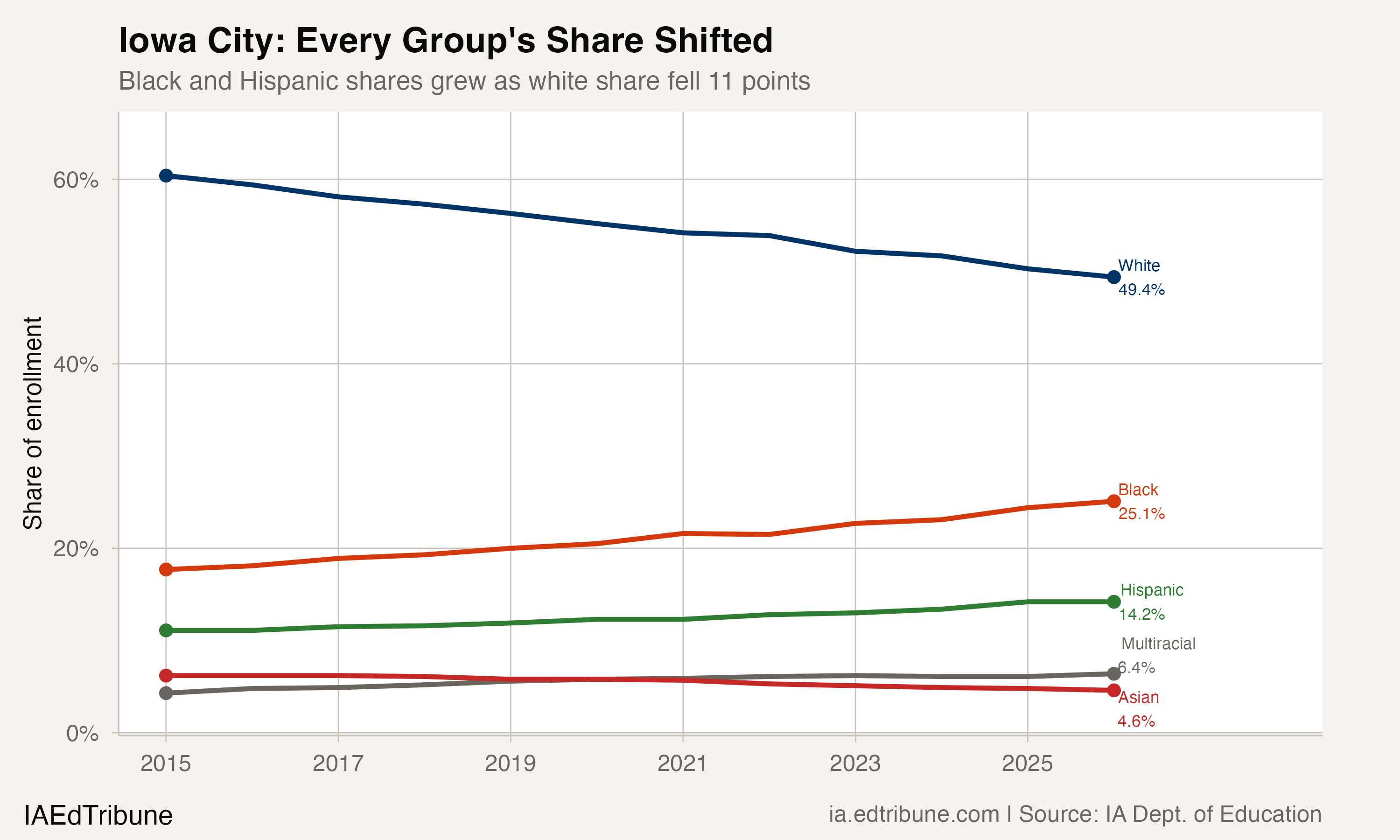
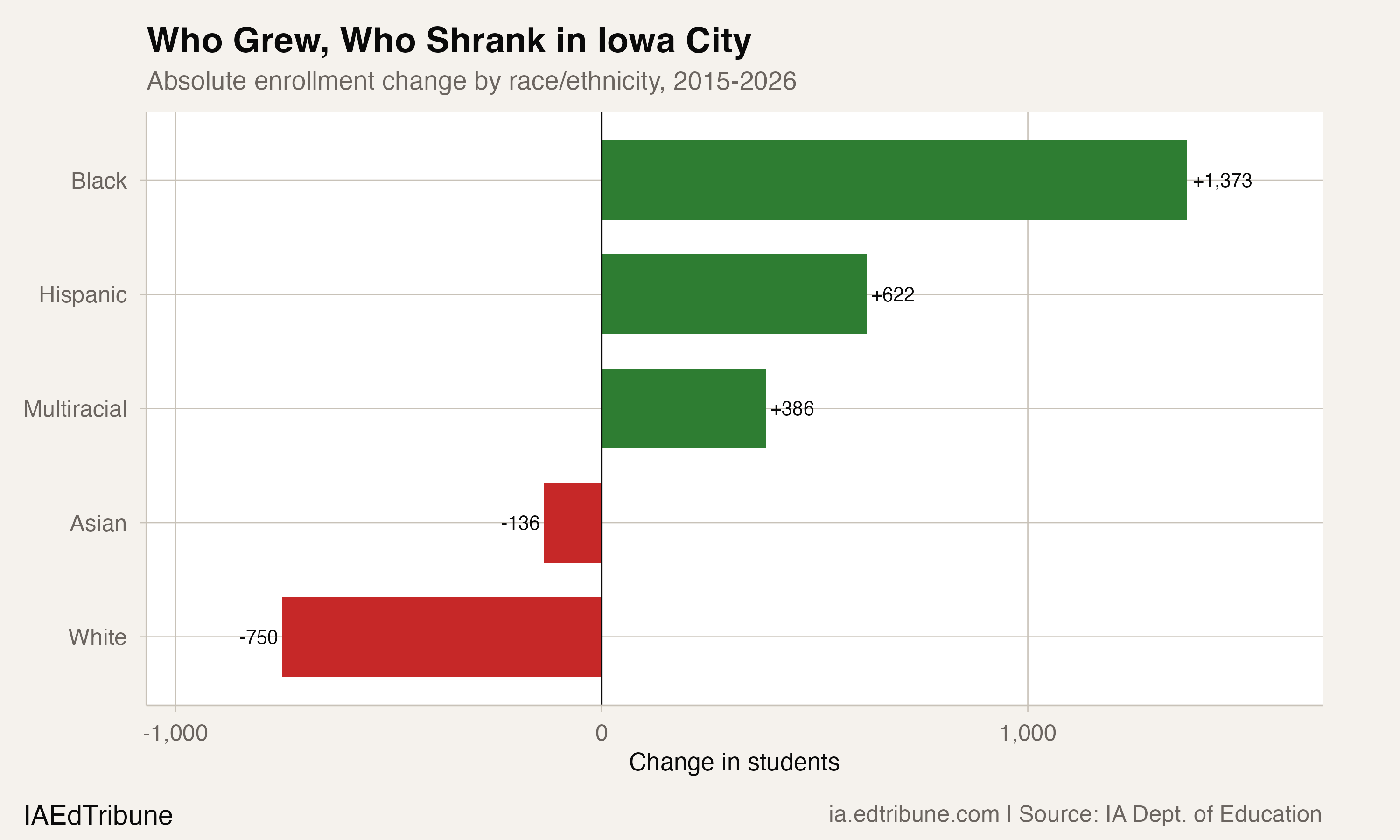
Iowa City is not Des Moines or Waterloo, districts that crossed this threshold years ago with large preexisting minority populations. It is a university town, home to the University of Iowa, with a student body of nearly 15,000 that now reflects a demographic profile most Iowans would not associate with the state. One in four students is Black. One in seven is Hispanic. The district added 1,474 students since 2015, but the entire net gain came from students of color: 2,224 more nonwhite students, offset by 750 fewer white students.
Not just Iowa City
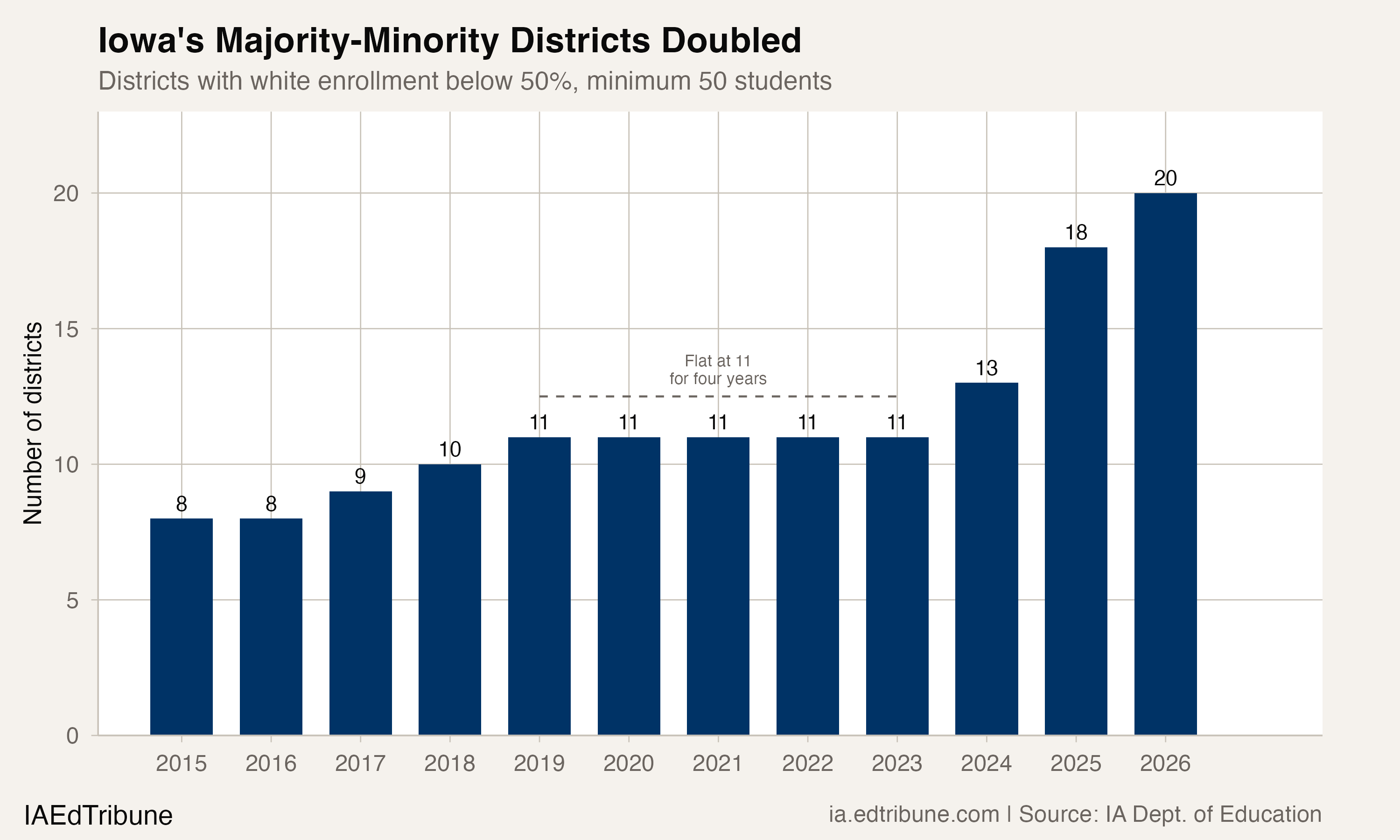
The crossing is part of a broader acceleration. Iowa had eight majority-minority school districts in 2015. That count reached 11 by 2019 and then stalled, holding at exactly 11 for four consecutive years through 2023. Something changed. By 2026, the count jumped to 20.
The districts that flipped since 2023 include some of the state's largest: Davenport (12,855 students, crossed in 2024), Ottumwa (4,818, crossed in 2025), and Iowa City itself. Smaller communities crossed too, including Sioux Center (1,722 students), a historically Dutch Reformed community in northwest Iowa where white enrollment fell from 53.4% to 49.0% in three years.
The composition of Iowa City's shift
The demographic change in Iowa City is driven primarily by growth in the Black student population, which rose 58% from 2,367 to 3,740 students since 2015. Iowa City now enrolls the second-largest Black student population in the state, behind only Des Moines (6,381). Hispanic enrollment grew 41.9%, from 1,486 to 2,108. Multiracial students increased 67.7%, from 570 to 956.
White enrollment, meanwhile, fell from 8,092 to 7,342, a loss of 750 students, or 9.3%. Asian enrollment dropped 16.5%, from 824 to 688.
The net effect is that the district grew by 1,474 students overall while its white population shrank. This is the signature of a composition shift rather than a collapse. Iowa City is not emptying out. It is being replenished by different families.
What is driving the growth in Black enrollment
Iowa City's 58% increase in Black students is unusually large for a midsize Iowa district, and the most likely contributing factor is the region's established refugee resettlement infrastructure. The International Rescue Committee operates an office in Iowa City that resettles refugees from the Democratic Republic of Congo, Eritrea, Iraq, and other countries. Johnson County has multiple organizations supporting immigrant families, including the Refugee and Immigrant Association, which serves both Johnson and Linn Counties.
Research from the University of Iowa found that approximately 30,000 of Iowa's 3.2 million residents were born in Africa. Some refugees first arrived in other states, including California and Michigan, before making their way to Iowa, drawn by employment opportunities, faith communities, and family networks.
A competing explanation is that the shift reflects natural demographic change rather than migration: higher birth rates among existing nonwhite families and lower birth rates among white families, compounded by differential open enrollment patterns. Iowa's statewide birth rate fell from 12.6 per 1,000 residents in 2015 to 11.2 in 2023, and the decline is steeper among white families nationally. The enrollment data alone cannot distinguish between these mechanisms. The most likely answer involves both.
A statewide pattern, district by district
White enrollment share fell in every one of Iowa's 18 largest districts between 2015 and 2026. The magnitude varies. Sioux City lost 18.2 percentage points (53.1% to 34.9%). Cedar Rapids lost 17.8 points (70.1% to 52.3%). Iowa City's 11-point drop is in the middle of the pack among large districts, but it is the one that tipped past the 50% mark.
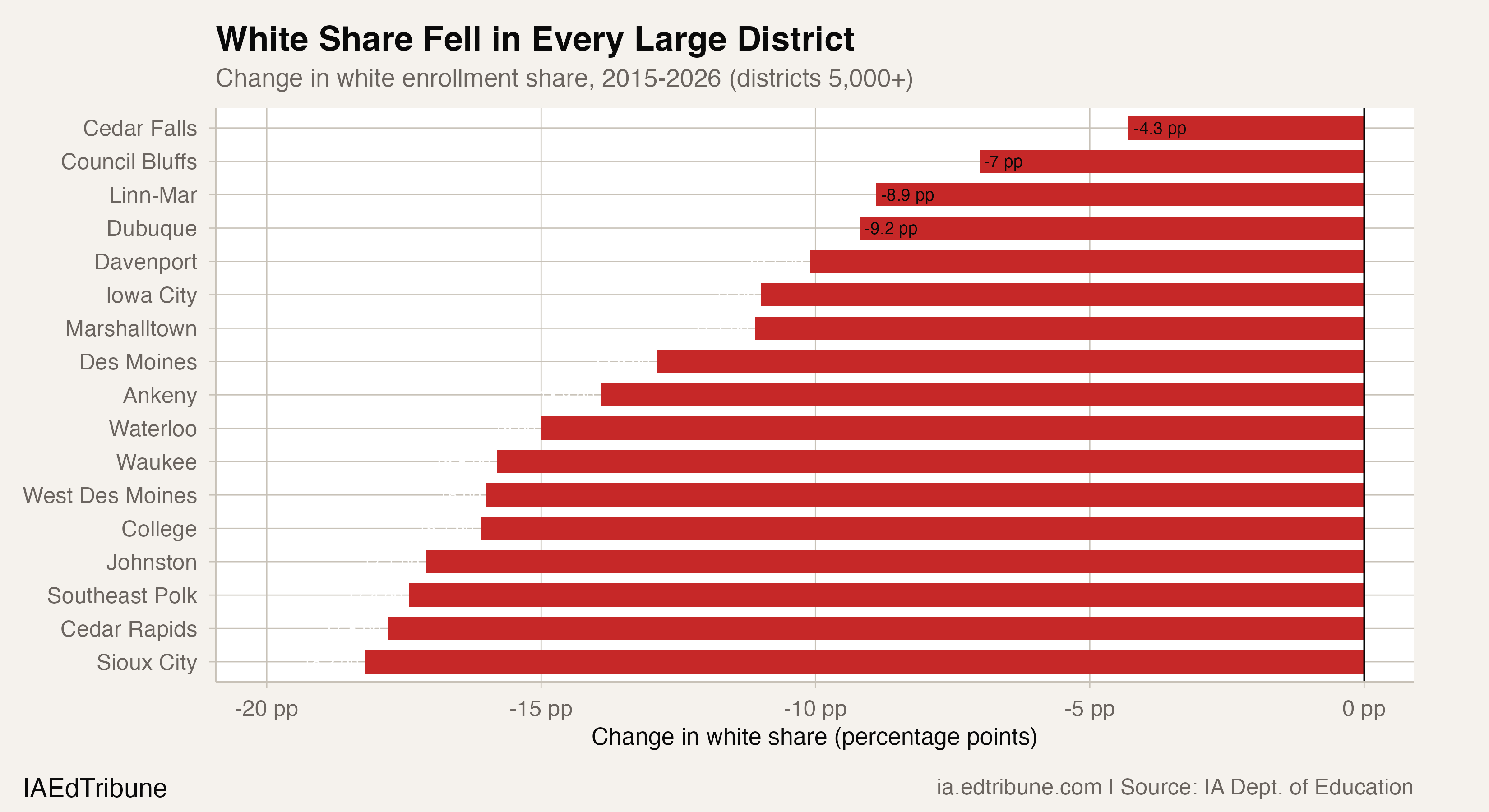
Cedar Rapids, at 52.3% white and declining roughly 1.6 percentage points per year, is the next large district likely to cross. West Des Moines sits at 52.6%. At their current trajectories, both could cross below 50% within two to three years.
Statewide, Iowa's public school enrollment is 69.8% white, down from 78.3% in 2015. The state lost 49,582 white students in 11 years while gaining 17,974 Hispanic students, 9,769 Black students, and 9,350 multiracial students.
Budget pressure arrives alongside the shift
Iowa City's demographic transition is colliding with a financial crisis. The district is planning approximately $8 million in cuts across administrative offices and schools after payroll costs exceeded budget projections by more than $13 million. Superintendent Matt Degner told community members that "scaling down resources is gonna be a new normal part" of the district's operations, and that the $8 million in cuts "will not be enough to address the district's long-term financial challenges."
The district also took out a $10 million loan in August without notifying school board members, and plans an additional $3 million loan to cover expenses. Statewide, 157 Iowa school districts are on the budget guarantee for 2025-26, up from 140 the prior year, a provision that provides minimum spending growth funded through local property taxes when enrollment-driven state aid declines.
The fiscal pressure creates a specific operational tension for a diversifying district. Growing shares of students who are English learners or refugees need specialized instructional programs that carry higher per-pupil costs. If the budget is shrinking while the need for those programs is growing, the gap between what the funding formula provides and what the student body needs will widen.
What enrollment data cannot show
The enrollment data tracks headcounts by race, not migration patterns, birth cohorts, or reasons for departure. Whether white families are leaving the district through open enrollment, moving out of the Iowa City metro, choosing private schools via Iowa's expanded Education Savings Account program, or simply having fewer children is invisible in these numbers. Iowa does not publish district-level data on open enrollment by race, which would clarify how much of the shift reflects differential choice rather than differential demographics.
The "majority-minority" label itself carries limits. It groups all nonwhite students together, obscuring significant differences in experience, need, and family background between a Congolese refugee family and a multiracial household with two Iowa-born parents. The label describes a statistical threshold, not a unified community.
The question ahead
Iowa City's crossing below 50% white is a milestone, but it is not an endpoint. The trend line shows no sign of leveling off. Cedar Rapids and West Des Moines are next. The real question is whether Iowa's school funding system, designed for an era when most districts were demographically homogeneous, can adapt to a student body that increasingly is not. The answer will arrive one budget cycle at a time.
Detailed code that reproduces the analysis and figures in this article is available exclusively to EdTribune subscribers.
Discussion
Sign in to join the discussion.
Loading comments...