This is part of the Iowa Graduation Rate series, examining trends in the Class of 2019-2024.
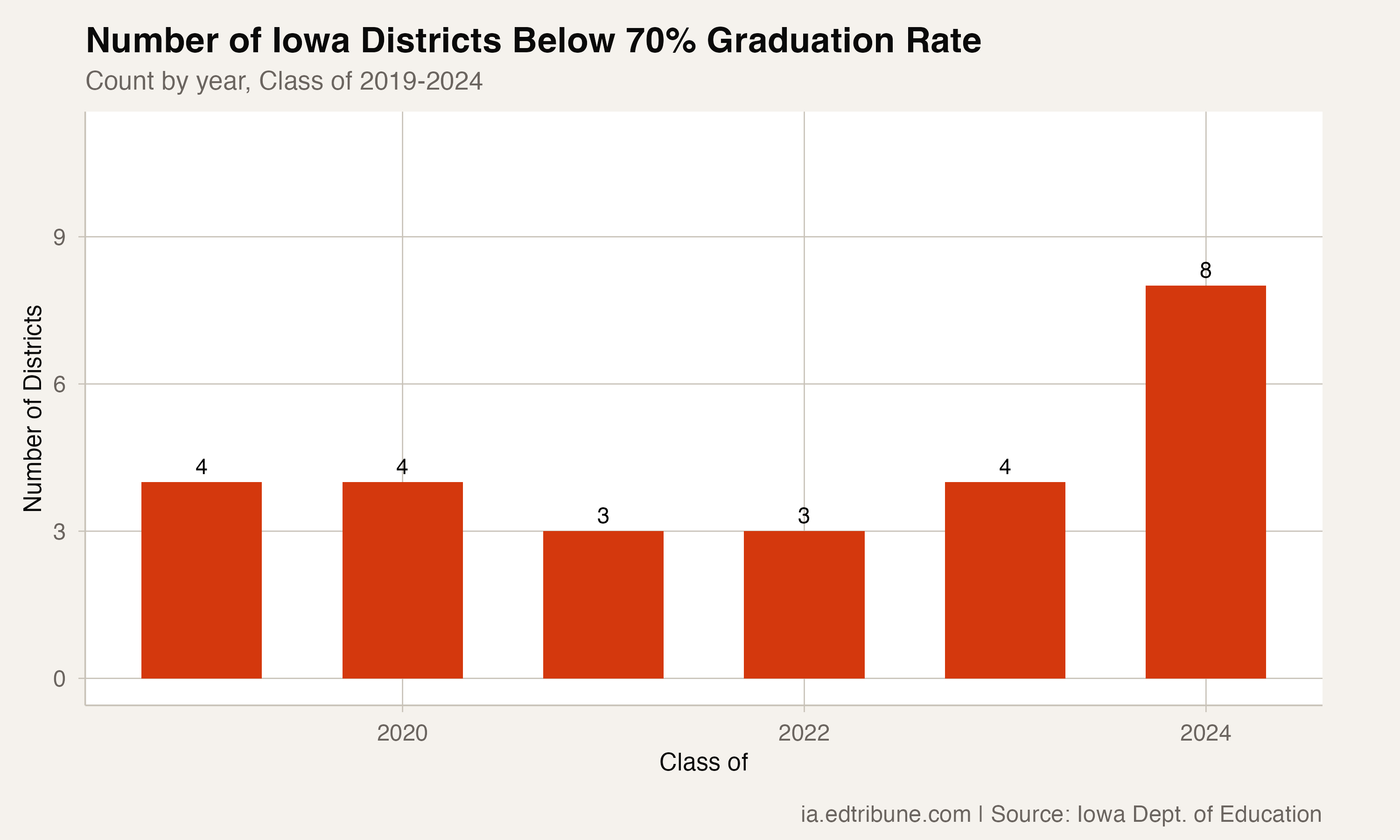
Eight Iowa districts graduated fewer than 70% of their students in 2024. A year earlier, there were four. Two years before that, three.
The doubling is not a statistical artifact. Several mid-size cities with cohorts large enough to produce stable rates joined the list for the first time in 2024, suggesting a real expansion of the graduation crisis beyond the handful of districts that have long struggled.
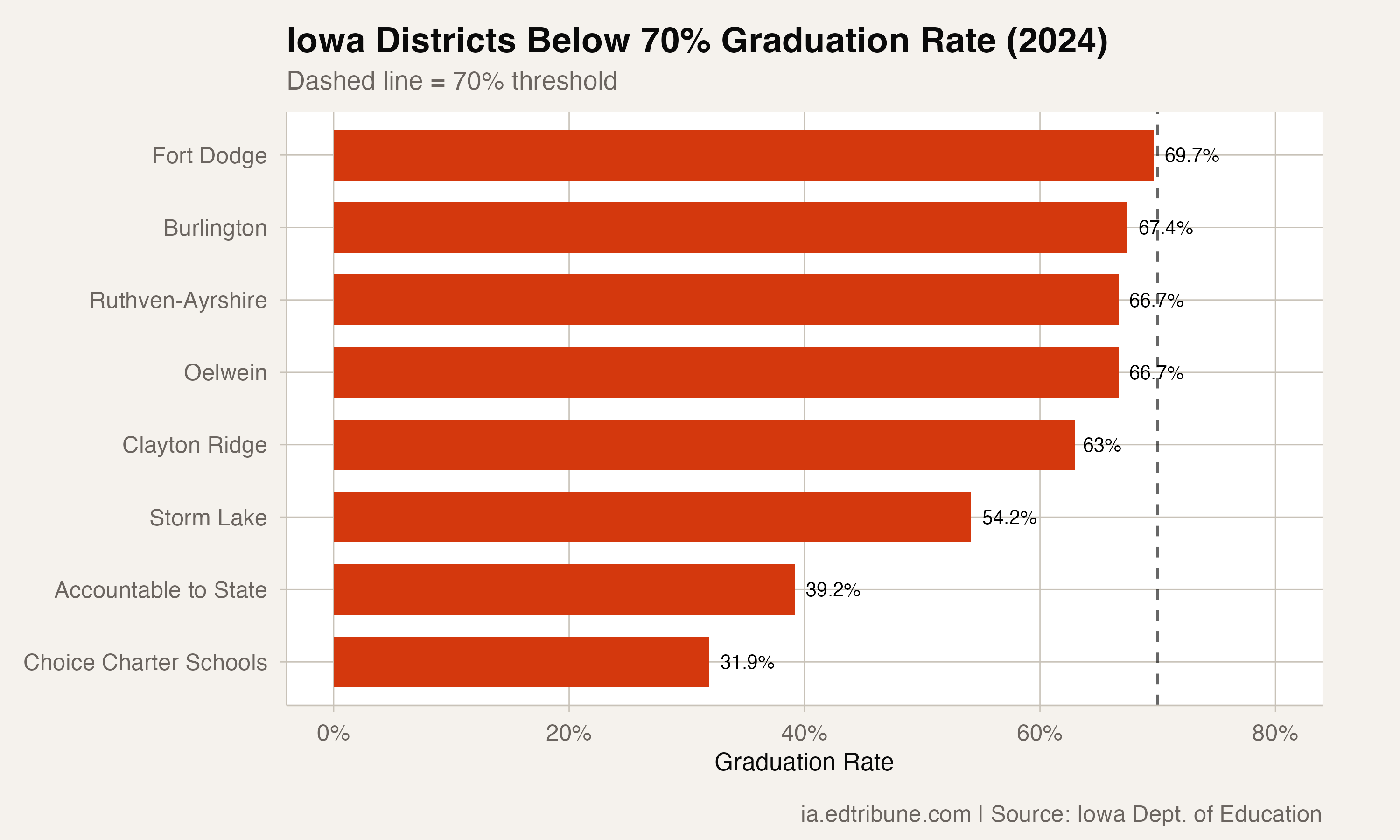
The list
| District | Graduation Rate | Cohort Size |
|---|---|---|
| Choice Charter Schools | 31.9% | 47 |
| Accountable to State | 39.2% | 125 |
| Storm Lake↗ET | 54.2% | 192 |
| Clayton Ridge | 63.0% | 200 |
| Oelwein↗ET | 66.7% | 132 |
| Ruthven-Ayrshire | 66.7% | 12 |
| Burlington↗ET | 67.4% | 258 |
| Fort Dodge↗ET | 69.7% | 267 |
Two of the eight are not traditional community school districts. Choice Charter Schools is a charter entity, and "Accountable to State" is a catch-all category for students in state-supervised settings. Ruthven-Ayrshire's cohort of 12 makes its rate inherently volatile. Four students graduating or not could swing it by 33 points.
That leaves five traditional districts with graduation rates below 70% and cohorts large enough to take seriously: Storm Lake, Clayton Ridge, Oelwein, Burlington, and Fort Dodge. Together, they represent more than 1,000 students in the 2024 cohort, of whom roughly 370 did not graduate on time.
Fort Dodge and Burlington
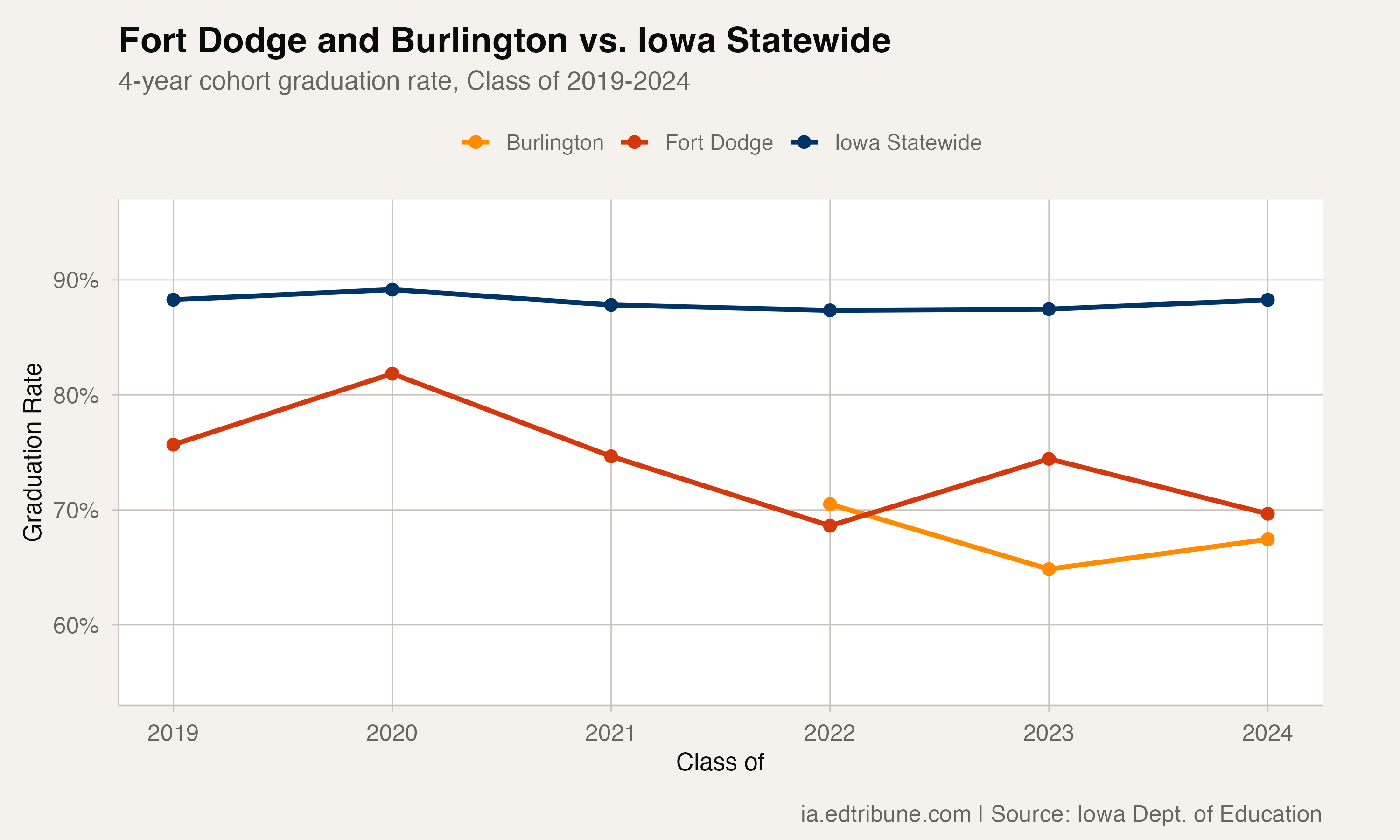
Fort Dodge↗ET is a city of about 25,000 in central Iowa. Its graduation rate has swung between 69% and 82% over the past six years, with no consistent direction. The 2024 rate of about 70% sits just above its 2022 low of 69%.
Inside Fort Dodge's numbers, students who receive special education services graduated at 41%. Students who are economically disadvantaged, who make up 66% of the cohort, graduated at 58%. Black students graduated at 47%, though the cohort of 19 is small.
Burlington↗ET, on the Mississippi River in southeastern Iowa, graduated 67% of its students in 2024. The rate dropped to 65% in 2023 before recovering slightly. In Burlington, students who receive special education services graduated at 41%, and students who are economically disadvantaged graduated at 56%.
Both districts share a profile: former manufacturing centers with higher-than-average poverty rates, where the graduation challenge is concentrated among students who are low-income and students who receive special education services.
The Clayton Ridge question
Clayton Ridge's presence on the list is notable because the district has an unusual composition. Its cohort of 200 is large for a district of its enrollment size, inflated by virtual program students. Clayton Ridge hosts Iowa Virtual Academy, drawing students from across the state.
In prior years, Clayton Ridge graduated between 69% and 84%. The 2024 rate of 63% represents a sharp drop. Whether this reflects changes in the virtual student population or broader challenges is not clear from the graduation data alone.
Oelwein's slide
Oelwein, a small city in northeast Iowa, has been on a steady downward trajectory. Its graduation rate fell from 89% (Class of 2020) to 67% (Class of 2024), a 22-point decline over four years. The cohort grew from 80 to 132 during the same period, suggesting the decline is not simply a function of smaller classes producing volatile rates.
A growing problem
The number of districts below 70% has doubled from the 2019-2023 average of about 4 to 8 in 2024. While Iowa's statewide rate returned to its pre-pandemic level of 88%, the tail end of the distribution has gotten worse.
At a state average of 88%, a district graduating below 70% is an extreme outlier, roughly 18 or more points below the norm. In these communities, approximately one in three students is not completing high school on time. The statewide recovery has not reached them.
Detailed code that reproduces the analysis and figures in this article is available exclusively to EdTribune subscribers.
Discussion
Sign in to join the discussion.
Loading comments...