This is part of the Iowa Graduation Rate series, examining trends in the Class of 2019-2024.
Correction (July 23, 2026): An earlier version said seven subgroups improved their graduation rates between 2019 and 2024. Six improved and six declined.
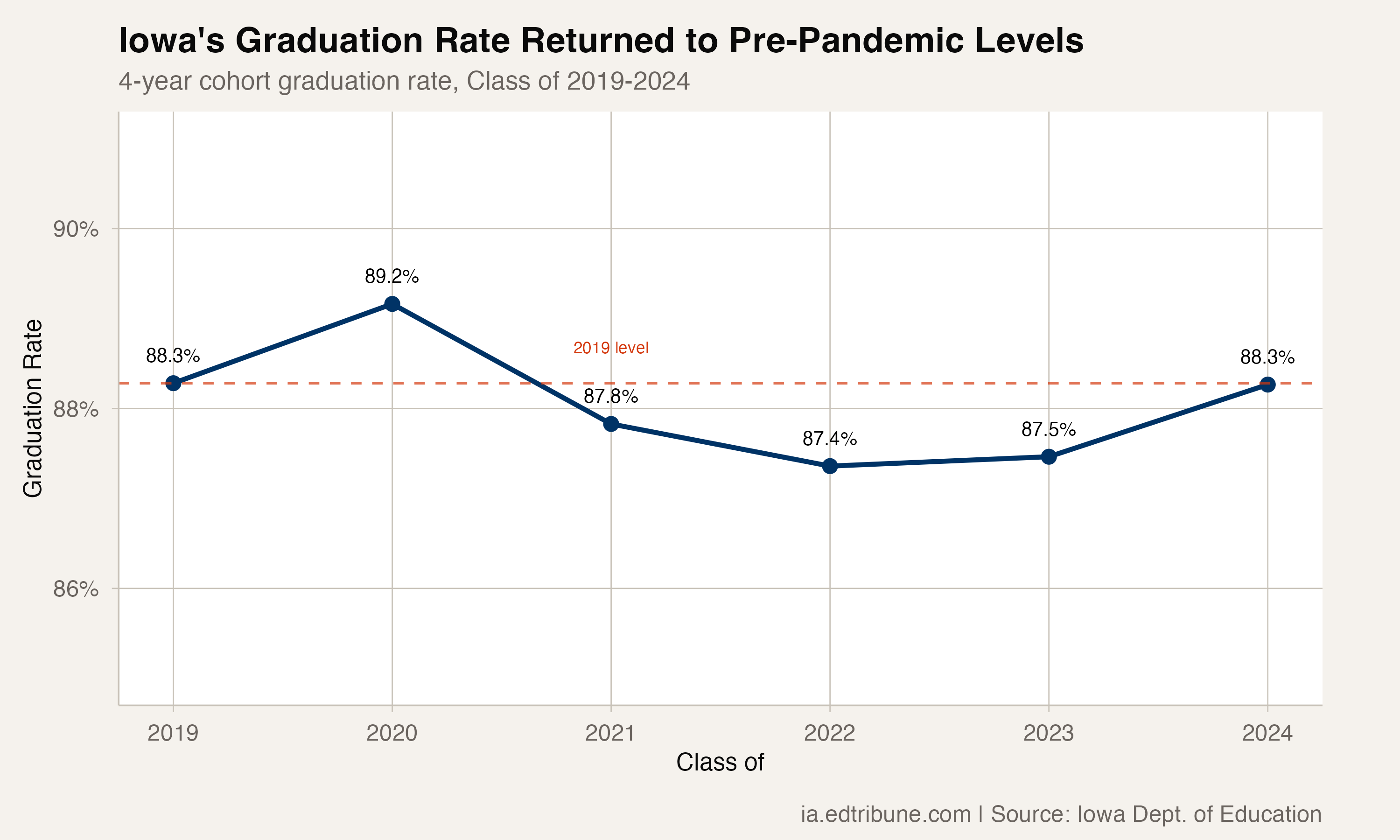
Iowa's Class of 2024 graduated at 88.3% -- the exact same rate as the Class of 2019, before the pandemic reshaped American education.
The headline number invites relief. After four years of rates below the 2019 mark, Iowa has recovered. The state graduated 34,158 students in 2024, more than any year in the dataset, from its largest cohort ever at 38,699.
But the statewide number is an average, and in this case the average obscures a split. Some groups came back stronger. Others fell further behind.
The K-shaped recovery
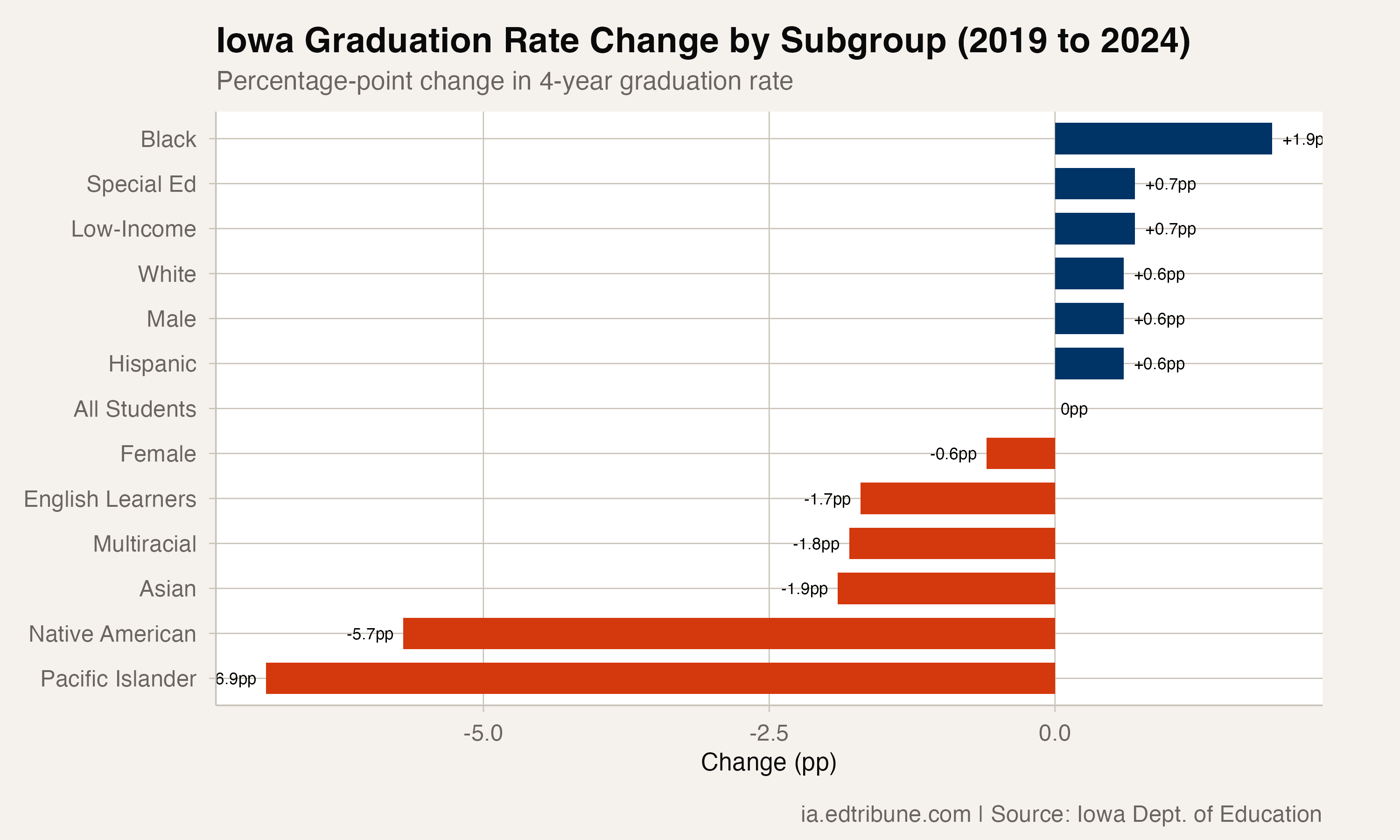
Six subgroups improved their graduation rates between 2019 and 2024. Six declined. The pattern is not random.
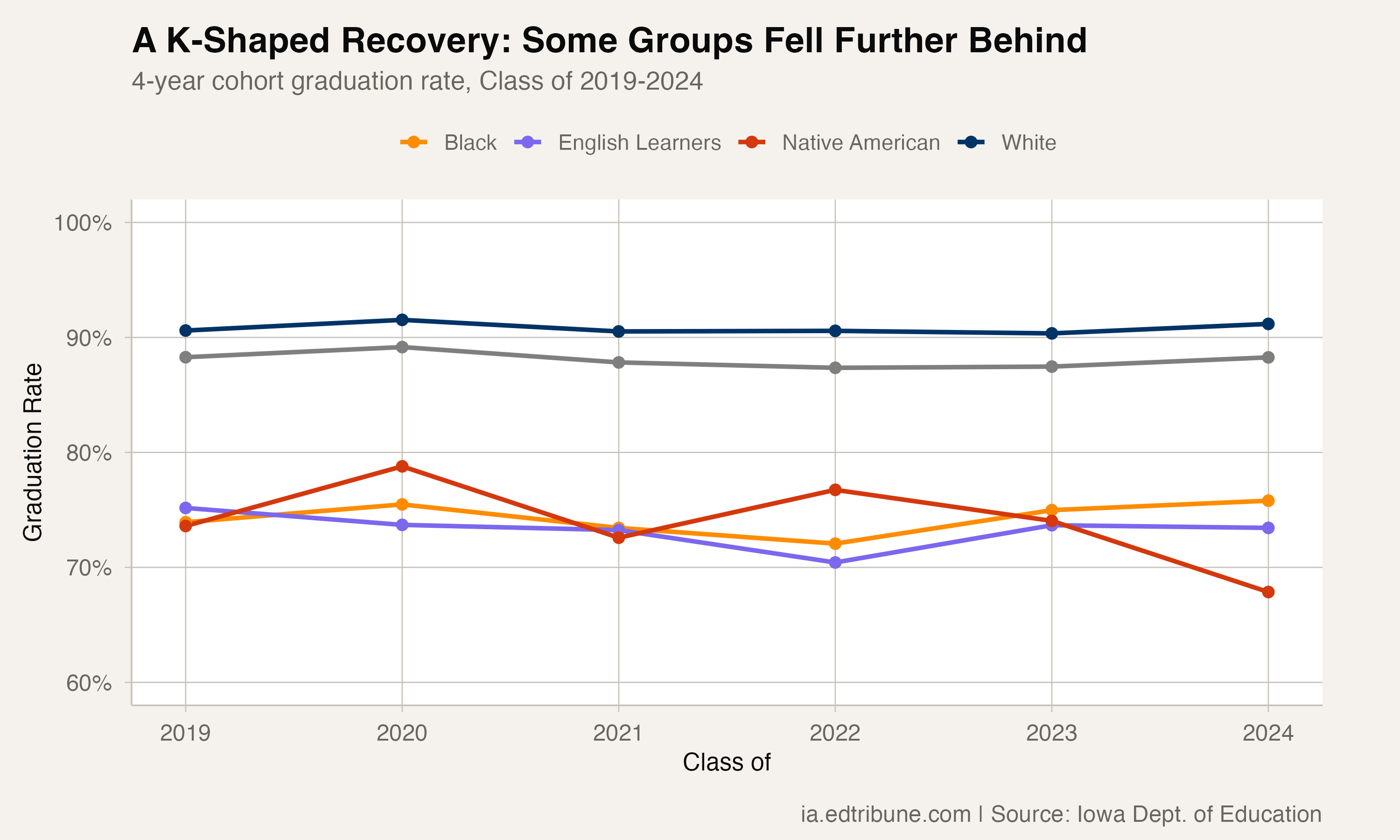
The groups that gained were the ones starting closest to the state average. White students edged up from 91% to 91%. Males gained a fraction of a point. Black students made the largest gain of any group, climbing from 74% to 76%. Economically disadvantaged students and special education students each gained less than a point.
The groups that fell were concentrated at the margins. Native American students declined 6 points, from 74% to 68%. Pacific Islander students dropped 7 points. Asian students, who started near the top at 90%, fell 2 points. English learners declined 2 points. Multiracial students lost 2 points.
The weight of the majority
Iowa's graduation numbers are dominated by white students, who made up 74% of the Class of 2024 cohort. When 28,507 white students graduate at 91%, the statewide average rises regardless of what happens to smaller groups.
Consider the math: the 6-point decline among Native American students affected 112 people. The 0.6-point gain among white students affected 28,507 people. In a statewide average, the larger group's modest improvement swamps the smaller group's steep decline.
This is not a criticism of how averages work. It is a caution about what they communicate. A superintendent, a legislator, or a parent reading "88.3%" might reasonably conclude that things are back to normal. For Native American students, English learners, and Pacific Islander students, the post-pandemic period has been worse than the pandemic itself.
The trough and the bounce
The pandemic's impact on graduation showed up with a one-year delay. Iowa's rate dropped from 89% (Class of 2020, who were seniors when schools closed) to 88% (Class of 2021, who lost their junior year). It continued declining to 87% for the Classes of 2022 and 2023 before recovering in 2024.
The trajectory varied by group. White students never dropped below 90%. Black students fell to 72% in 2022 -- losing all their pre-pandemic gains -- before climbing back. English learners dropped from 75% to 70% in 2022 and have not recovered. Native American students hit their dataset low of 68% in 2024, with no recovery in sight.
More graduates, same questions
Iowa graduated 1,818 more students in 2024 than in 2019, driven by a larger cohort. The graduating class has also grown more diverse: Hispanic students increased from 3,691 to 4,928 in the cohort, and Black students from 2,121 to 2,405. English learners grew from 1,619 to 2,413.
The growing diversity of Iowa's student body makes the persistent gaps more consequential. A graduation gap that affects 2% of the cohort is a concern. The same gap affecting a growing share of students is a compounding problem.
Iowa's 88% headline rate will probably hold. The white majority is large enough and stable enough to keep the average where it is. But 88% is doing double duty -- it is both a sign of broad success and a screen that hides the 68% for Native American students, the 69% for Pacific Islanders, the 73% for English learners. Those rates belong to a growing share of Iowa's student body, and they are moving in the wrong direction.
Detailed code that reproduces the analysis and figures in this article is available exclusively to EdTribune subscribers.
Discussion
Sign in to join the discussion.
Loading comments...