Correction: An earlier version described the latest rate as the best in the full record and included contextual claims the evidence did not support. The revised analysis uses stable district IDs and the complete available panel.
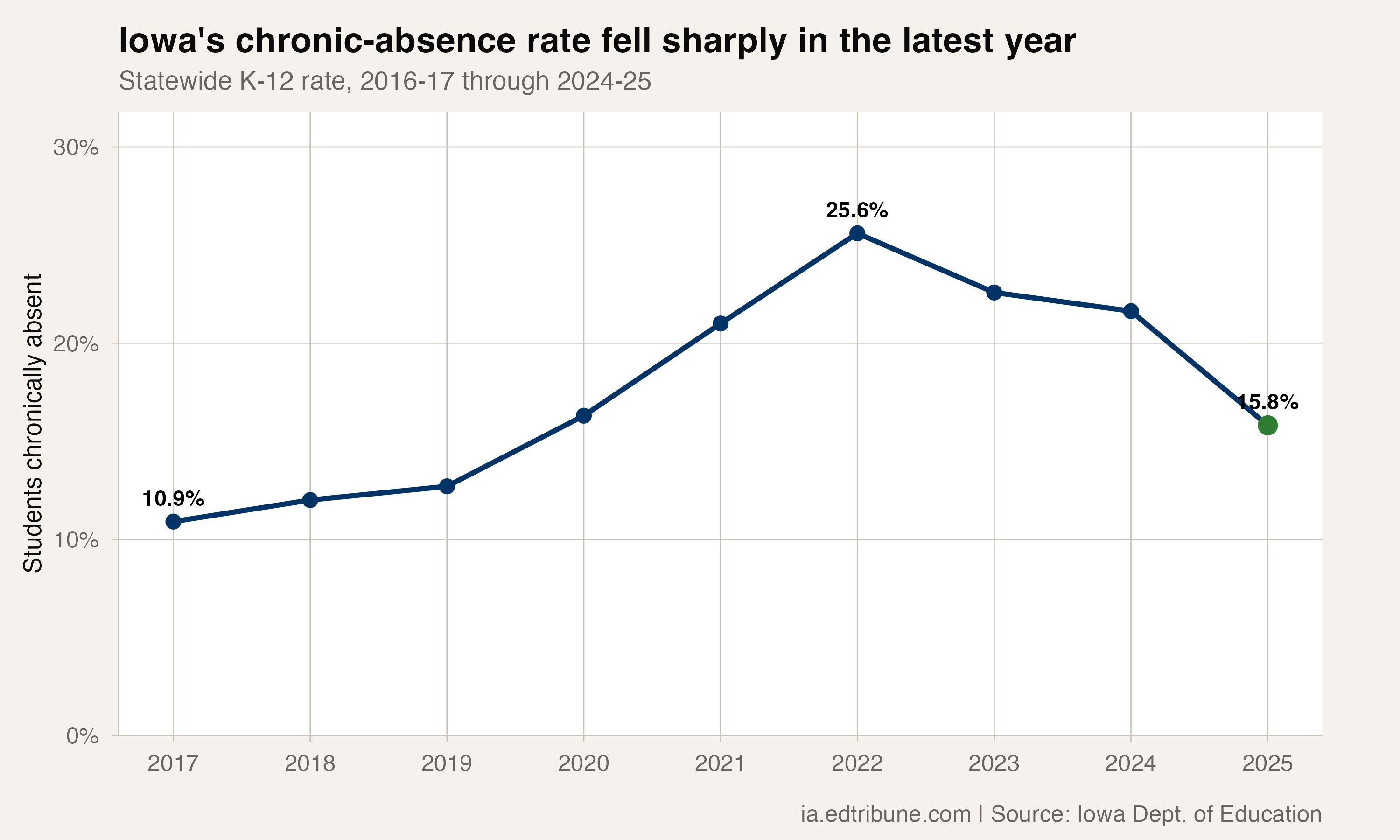
Iowa's statewide chronic-absence rate fell from 21.6% to 15.8% in 2024-25, an improvement of 5.82 percentage points. That was the largest annual improvement in the Iowa Department of Education data available from 2016-17 through 2024-25.
The timing invites a policy question. The school year was the first full one after Iowa's attendance law took effect. The Iowa Department of Education's attendance guidance describes a framework of district attendance policies, family notices, school engagement meetings, prevention plans and coordination with county attorneys.
The data can measure what changed during that year. It cannot establish that the law caused the change.
A statewide break from the recent pattern
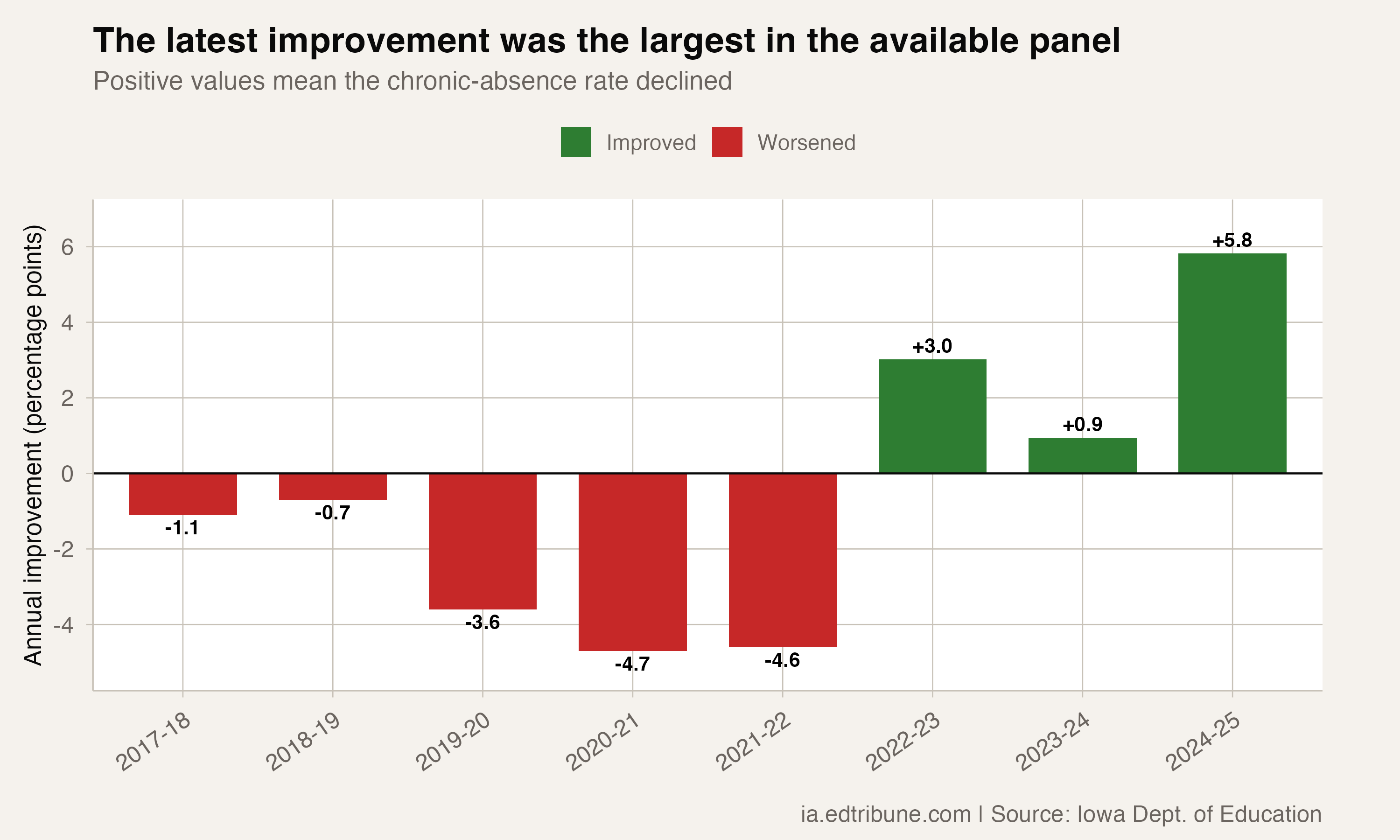
The 5.82-point improvement was nearly twice the previous record annual improvement of 3.02 points in 2022-23. The rate had improved again in 2023-24, but by 0.95 points. The latest movement was therefore larger than either of the two improvements that preceded it.
The full history matters. Iowa's rate peaked at 25.6% in 2021-22. The latest rate is 9.8 points below that peak, but it remains 4.9 points above the 10.9% rate at the start of the available record. Calling 2024-25 the best attendance year in the panel would be wrong. It was the strongest single-year improvement.
The district result was broad, not universal
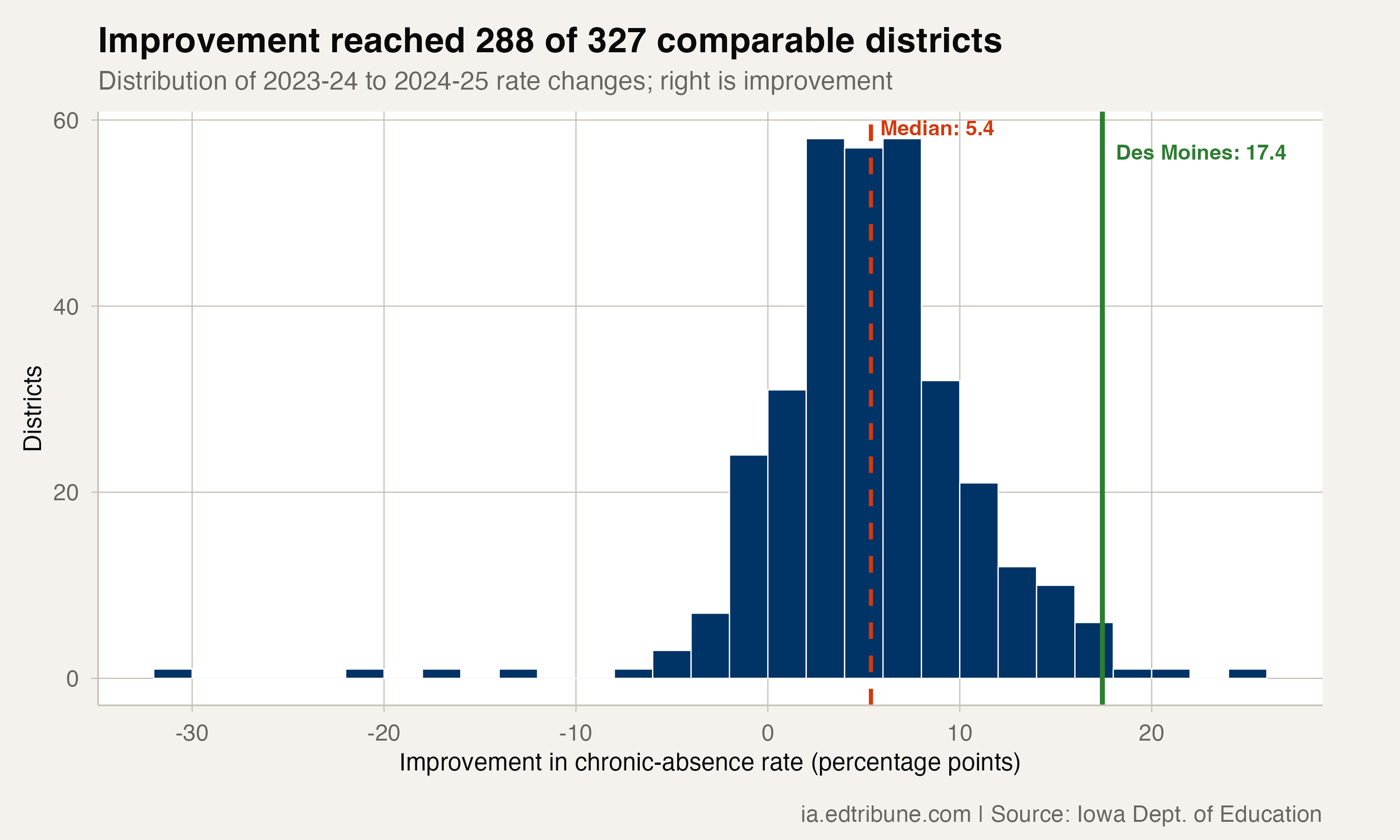
Among the 327 stable district IDs with published rates in both 2023-24 and 2024-25, 288 improved. The median district improvement was 5.4 points. Districts without both endpoints are excluded from those counts rather than treated as unchanged.
Des Moines↗ET moved from 38.7% to 21.2%, a 17.4-point improvement. That local change was much larger than the statewide movement, but it does not by itself identify a mechanism. The published files show the outcome, not which notices, meetings, supports or enforcement choices each district used.
What the timing can and cannot show
Suggestive context: the largest improvement in the available panel occurred during the first full school year after the law took effect, and the change extended across 288 comparable districts. A statewide policy is one plausible contributor to a statewide movement.
Competing explanation: improvement had already started before that school year. The earlier declines show that Iowa was not starting from a flat trend, so a simple before-and-after comparison cannot separate the law from an ongoing recovery.
Competing explanation: the department's attendance FAQ says later legislation modified the original framework and describes local choices in attendance coding and implementation. Those differences can affect both the intervention students receive and the rate districts report. The published data used here does not isolate either effect.
A stronger evaluation would compare Iowa with a credible counterfactual, test whether changes differed with implementation intensity and follow the pattern after the first full year. It would also need evidence on local practice. The state package's published absence rows contain statewide and district totals, not a demographic subgroup breakdown or district-level implementation measures.
The fairest report card is narrower than the original headline suggested: Iowa recorded an unusually large and broadly distributed improvement during the law's first full school year. The result is consistent with the law helping, but the available evidence does not distinguish that explanation from recovery already under way or differences in local reporting and practice.
Iowa publishes district-level chronic absenteeism data through the Iowa Department of Education. The IAEdTribune is an independent publication and is not affiliated with the Iowa Department of Education.
Detailed code that reproduces the analysis and figures in this article is available exclusively to EdTribune subscribers.
Discussion
Sign in to join the discussion.
Loading comments...