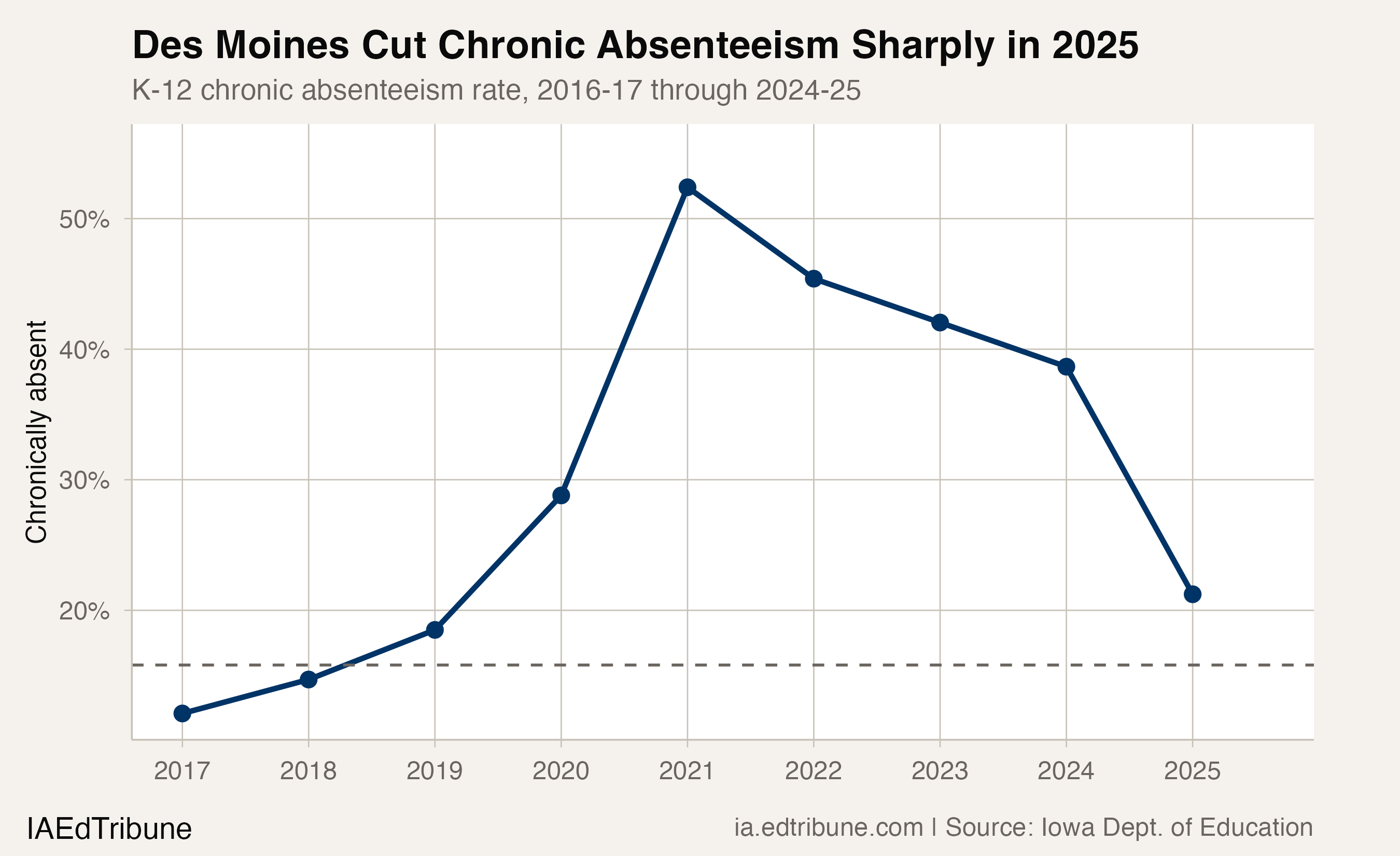
In the spring of 2021, more than half the students in Iowa's largest school district were chronically absent. Des Moines Independent↗ET recorded a 52.4% chronic absenteeism rate that year — one of only two major Iowa districts to ever cross the 50% threshold, alongside Davenport at 60.5%. One in two students missing 10% or more of the school year is not an attendance problem. It is a system that has stopped functioning.
Four years later, the district's rate is 21.2%. The 2024-25 drop of 17.4 percentage points — from 38.7% to 21.2% — is the single largest year-over-year improvement of any major Iowa district on record. The district removed 5,449 students from the chronically absent count, going from 11,755 to 6,306.
What certified mail tested
Des Moines was among the first districts to operationalize Senate File 2435, which took effect July 1, 2024.
The Iowa Department of Education says the law requires specific school actions based on non-exempt absence rates, including attendance policies, county-attorney collaboration, school engagement meetings, and work with truancy officers.
An Axios survey of Des Moines-area districts reported that schools had to send certified mail when students missed 10% or more of classes for the academic period.
The certified-mail approach forces a physical confrontation between families and attendance data. A letter that requires a signature at the door carries a different weight than an email that disappears into a spam folder or a robocall that goes to voicemail.
The mailings were only one piece of the district's broader response. DMPS had already launched its "Every Day Matters" campaign to raise awareness among families and community partners.
Axios later reported that the district paired the new state-law notifications with more home visits and individual supports such as winter clothing and food-pantry help.
The district-level result in the state data is clear even if the package does not expose school-level chronic-absence rows: the K-12 rate fell by 17.4 points in one year.
Still above where it started
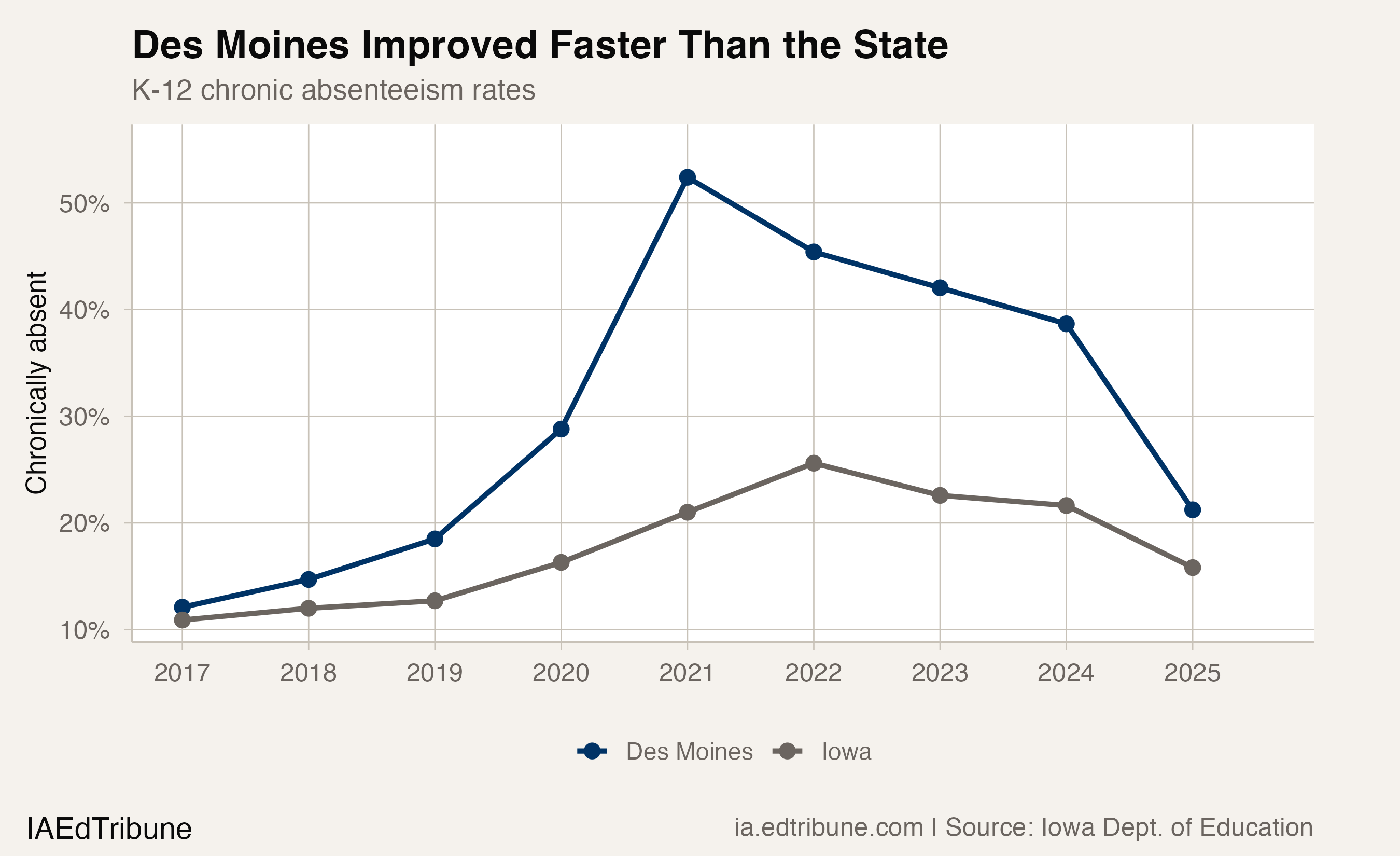
The 21.2% rate represents enormous progress from the COVID peak, but it is not a full recovery. Before the pandemic, Des Moines' chronic rate was 18.5% in 2018-19 — itself already above the statewide average of 12.7%. The current rate sits 2.7 points above that baseline.
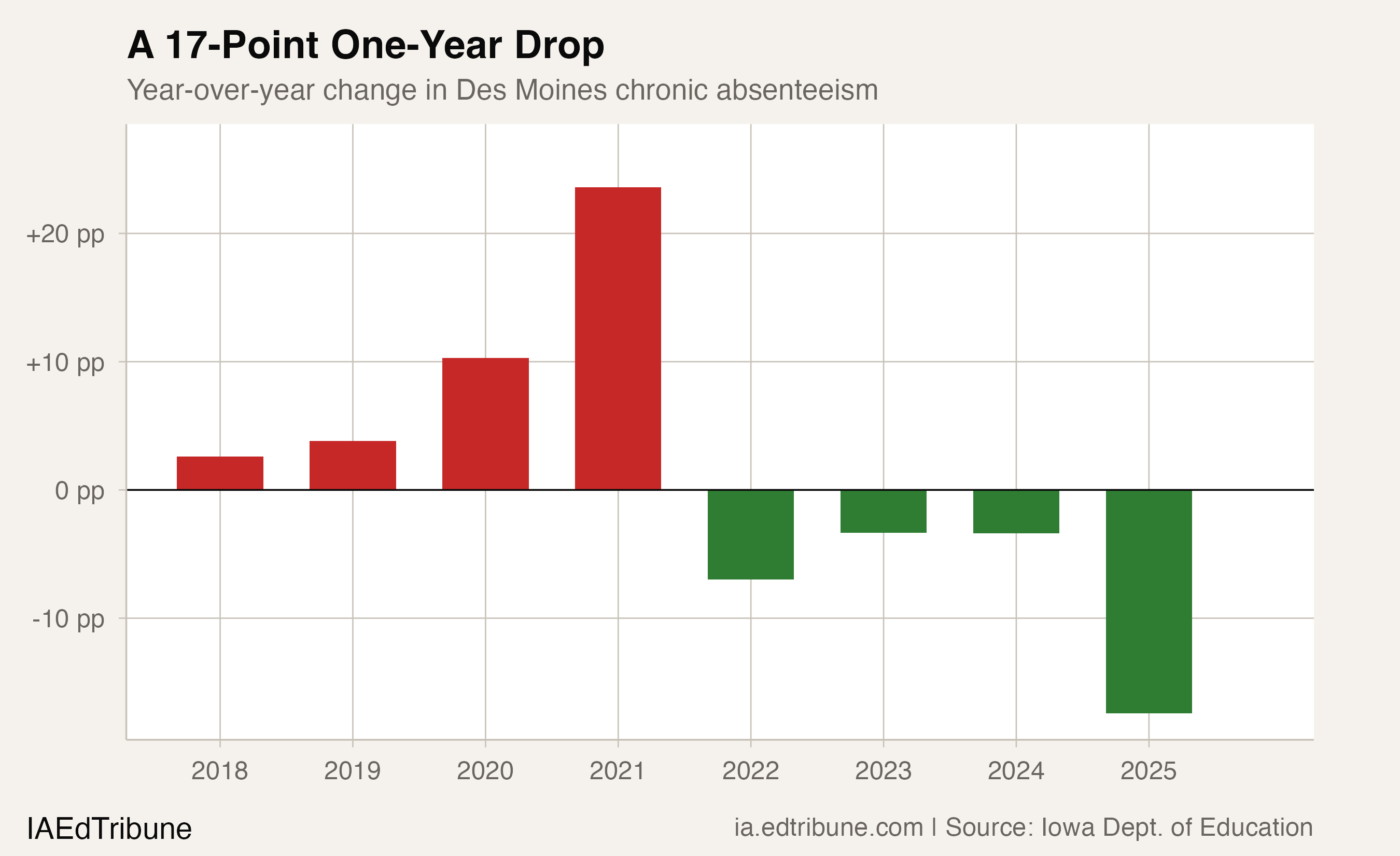
More concerning: the pre-COVID rate was already climbing. Des Moines went from 12.1% in 2016-17 to 18.5% in 2018-19, a 6.4-point increase over two years before COVID changed anything. The pandemic accelerated a trajectory that was already worsening.
The district is also shrinking. Des Moines enrolled 34,538 students in 2016-17 and 29,703 in 2024-25 — a loss of 4,835 students, or 14%. Some of the chronically absent students did not become newly present; they simply left.
What the district data cannot show
The state package does not expose building-level chronic absenteeism rows for Iowa, and it does not break the district's chronic absenteeism rate by race, income, disability, or English learner status. That means the 21.2% districtwide rate cannot show whether the improvement was evenly distributed across student groups or concentrated in particular schools. The article can verify the district-level turnaround, not the internal distribution of that turnaround.
First-year compliance effects tend to fade. Certified mail is a novel disruption in 2024-25; by 2026-27 it will be routine. Whether Des Moines' drop holds will depend on whether the improvement reflects changed habits or a one-time response to a new kind of letter.
Detailed code that reproduces the analysis and figures in this article is available exclusively to EdTribune subscribers.
Discussion
Sign in to join the discussion.
Loading comments...