Iowa's most recent published district absence file, covering 2024-25, shows sharply different trajectories across six communities connected to meatpacking. A federal review identified large plants in Storm Lake, Denison, Perry, Columbus Junction and Marshalltown (U.S. Government Accountability Office); Postville's plant remains one of the town's largest employers (Axios Des Moines). The comparison establishes different attendance outcomes, not a common cause.
Postville↗ET, in northeast Iowa, dropped from a 24.5% peak to 10.2%, fully recovering to below its pre-COVID rate of 13.9%. Columbus Junction↗ET, in the southeast, went from 38.7% to 22.4%, erasing most of its COVID spike. But Storm Lake↗ET, in the northwest, barely moved recently: 24.0% in 2023-24 and 23.9% in 2024-25. Iowa districts improved by a median of 5.4 percentage points over that year; Storm Lake improved by one-tenth of a point.
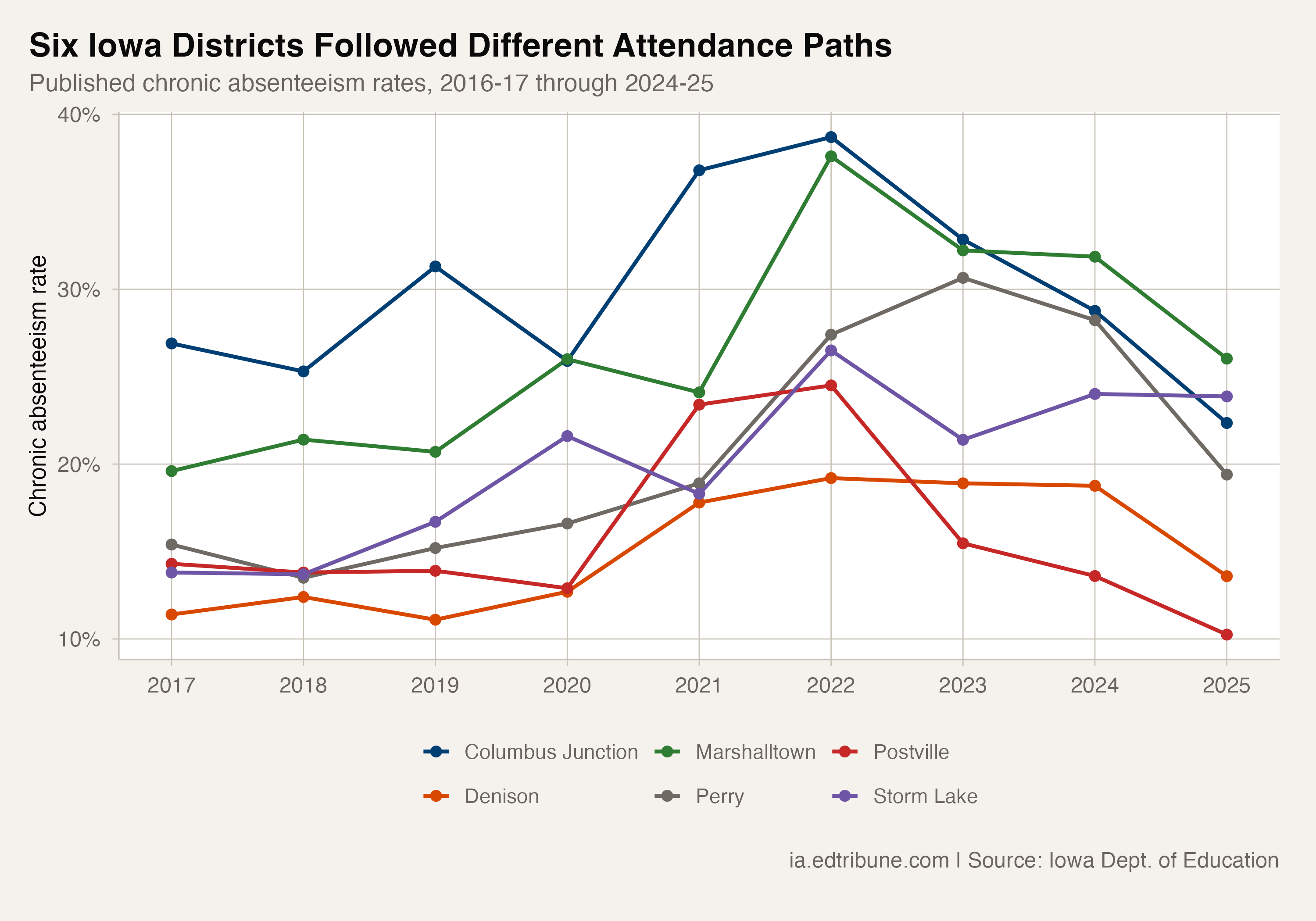
The same economy, different outcomes
The recovery outcomes diverge sharply:
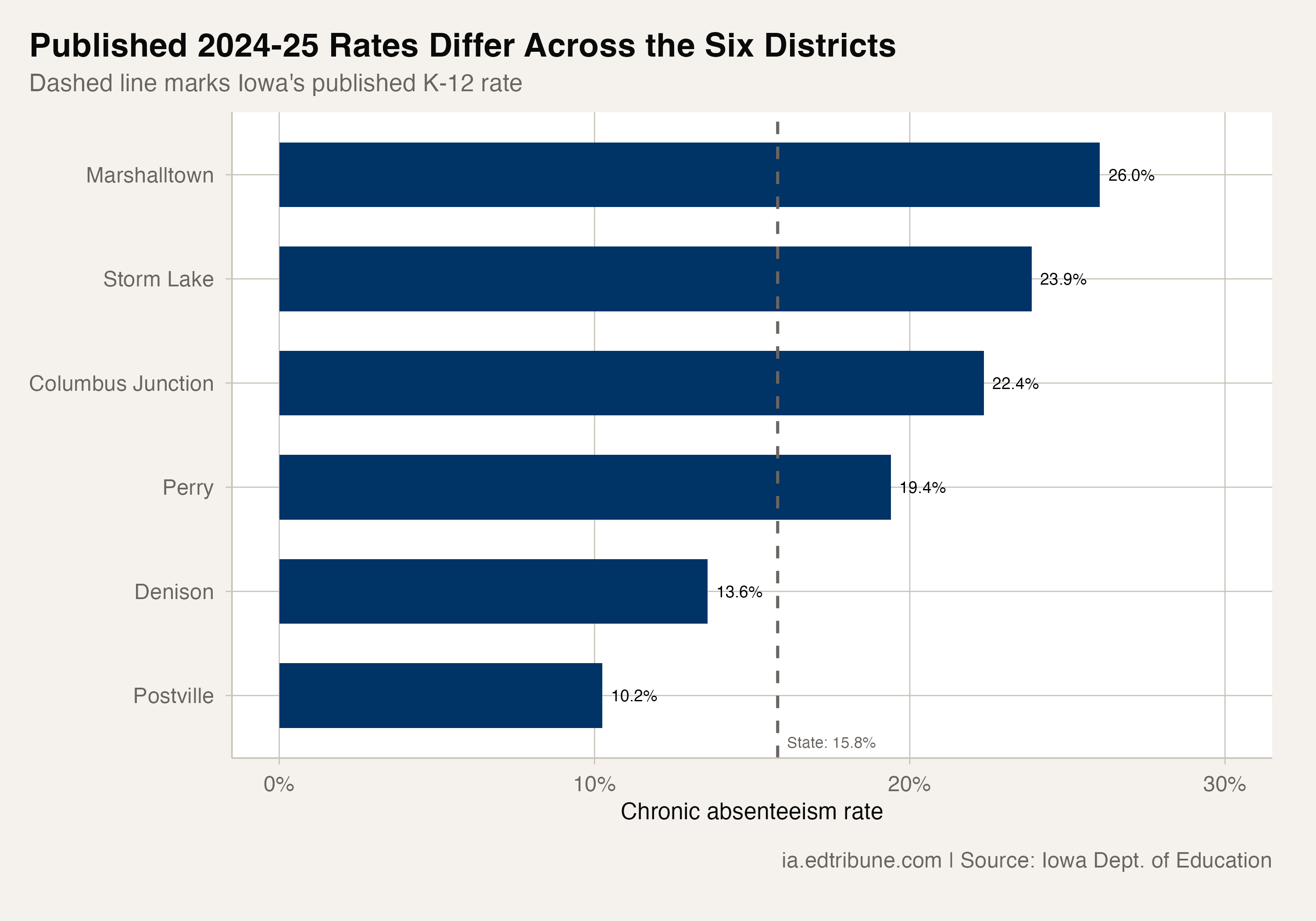
- Postville (732 students): 10.2%, below pre-COVID and below the state average
- Columbus Junction (698 students): 22.4%, down sharply from a 38.7% peak
- Denison↗ET (2,185 students): 13.6%, partially recovered from a 19.2% peak
- Perry↗ET (1,737 students): 19.4%, partial recovery from a 30.6% peak
- Marshalltown↗ET (5,086 students): 26.0%, improved but still 5.3 points above its 2018-19 rate
- Storm Lake (2,954 students): 23.9%, nearly unchanged from the prior year
Why Storm Lake is different
Storm Lake's published enrollment makes the scale visible. The district counted 2,954 students in the state's absence file, and it sits in Prairie Lakes AEA, where the aggregate district chronic absenteeism rate was 14.2% in 2024-25.
The district's chronic rate was 13.8% in 2016-17, reached 16.7% in 2018-19, spiked to 26.5% in 2021-22, then fell to 21.4% the next year. That matters because the story is not a simple flatline. Storm Lake did improve after the pandemic peak, then lost ground in 2023-24 and remained almost unchanged in 2024-25.
Superintendent Stacey Cole said the 2021-22 to 2022-23 improvement reflected concentrated work: an assistant principal dedicated roughly 20% of his time to attendance in partnership with the county attorney's office, mostly in elementary schools. That focus let the district "intervene deeply with our youngest students and families, where we believe long-term attendance habits can still be established," Cole said.
The later increase and plateau, Cole said, has to be read against Storm Lake's scale and complexity. In 2024-25, Storm Lake served 1,158 English learners, 41.2% of its enrollment. Postville's EL share was higher at 48.9%, but Storm Lake's count was more than three times as large.
"This is not an excuse," Cole said. "Our expectation is that every student attends school regularly, but it does affect the amount of outreach, relationship-building, and individualized support required to help families understand school attendance expectations and overcome barriers."
Size and recovery speed
In this six-district comparison, the two districts with the most complete recoveries, Postville and Columbus Junction, are also the smallest, each under 750 students. A smaller denominator makes each student's attendance record move the district rate more. That arithmetic is context, not proof that district size caused either recovery.
Postville Superintendent Brendan Knudtson added a caution about reading the district's recovery as a single clean intervention story. "Looking back at those years after the pandemic you would also see some significant drops in our enrollment," Knudtson said. "We had some very high years with transient students coming in and out rapidly."
Still, Knudtson pointed to concrete changes. He said attendance rules, clearer family communication and dedicated staff in each building helped Postville make attendance more explicit. "We have seen improvements with the little bit of teeth that has given us," he said.
The district did not claim a simple fix. Knudtson said Postville had no magic wand.
Attendance law changed the work
Iowa reports no demographic breakdowns for chronic absenteeism. Districts in the meatpacking belt cannot determine from the public data whether their elevated rates are driven by language barriers, shift-work scheduling, poverty, transportation, housing instability, open enrollment, or something else entirely. The distinction matters for choosing interventions such as multilingual communication, home visits, transportation help or case management, but the state file forces generic comparisons.
The work also changed under Iowa's newer attendance rules. The Iowa Department of Education says student engagement meetings are required when non-exempt absences exceed 15% of scheduled days or hours in a grading period, and the school, family and student are supposed to identify attendance barriers and interventions together (Iowa Department of Education).
Cole said Storm Lake supports the law's intent, but implementing it districtwide has increased workload. Students meeting attendance thresholds receive formal notification, staff conduct family meetings, complete home visits, convene intervention teams and document multiple support attempts before mediation through the county attorney's office.
"The challenge we have experienced is that this process is extremely time-intensive," Cole said.
Storm Lake is now emphasizing early intervention, family engagement, home visits, multilingual communication, community-agency partnerships and staff allocation that gets help to students before absenteeism becomes chronic. Cole also said the district has added a process for open-enrolled students who are not Storm Lake residents, with meetings to either support attendance or end open enrollment when the placement is not working.
That gives the article a sharper question than whether Storm Lake cares about attendance. It clearly does. The question is whether a district serving almost 3,000 students, including more than 1,100 English learners, can build an attendance system intensive enough to move beyond a 23.9% plateau.
Iowa publishes district-level chronic absenteeism data through the Iowa Department of Education. The IAEdTribune is an independent publication and is not affiliated with the Iowa Department of Education.
Have a tip or feedback? Contact us at theedtribune@gmail.com.
Detailed code that reproduces the analysis and figures in this article is available exclusively to EdTribune subscribers.
Discussion
Sign in to join the discussion.
Loading comments...