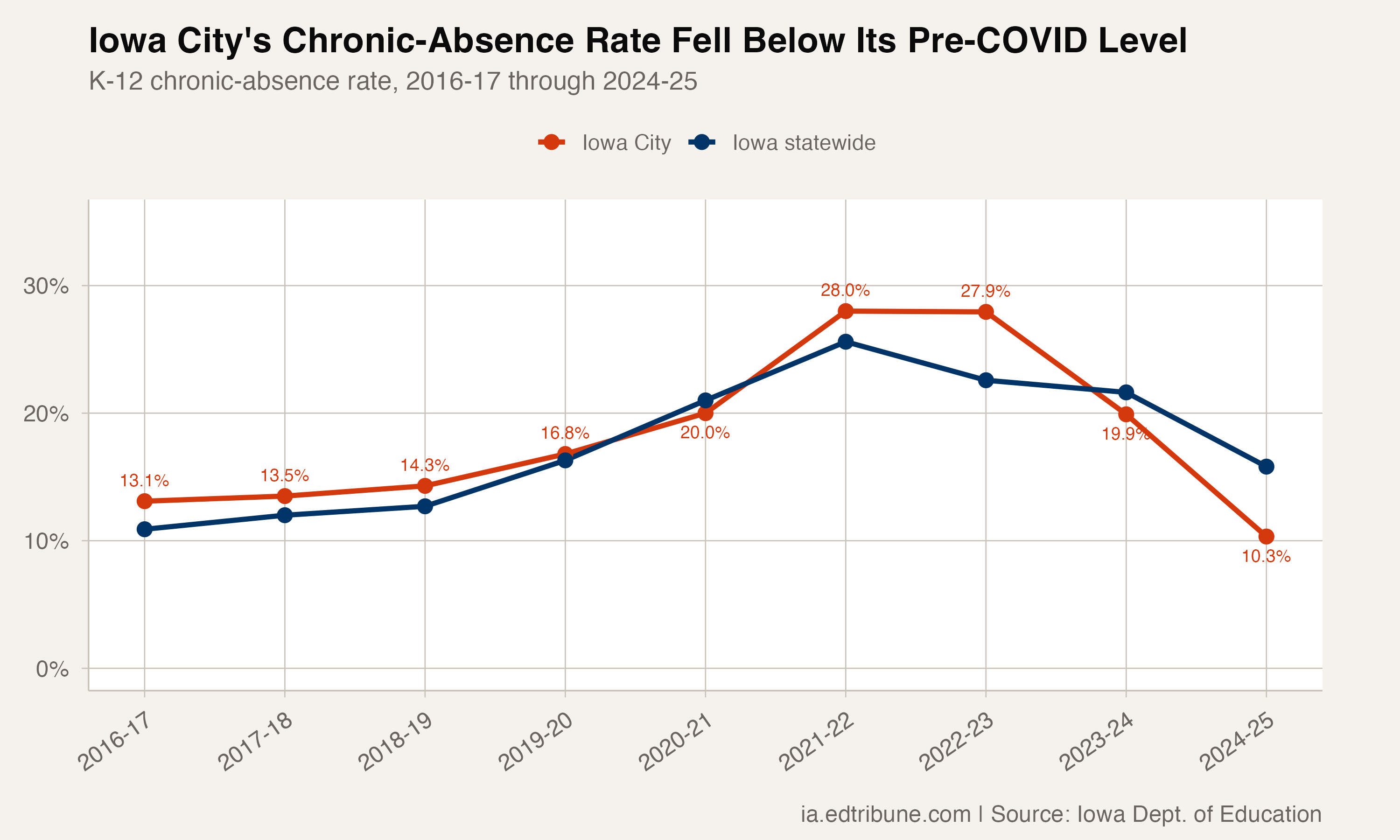
Iowa City Community School District↗ET's chronic-absence rate fell to 10.3% in 2024-25. That was below both its 28.0% peak in 2021-22 and its 14.3% pre-COVID rate in 2018-19.
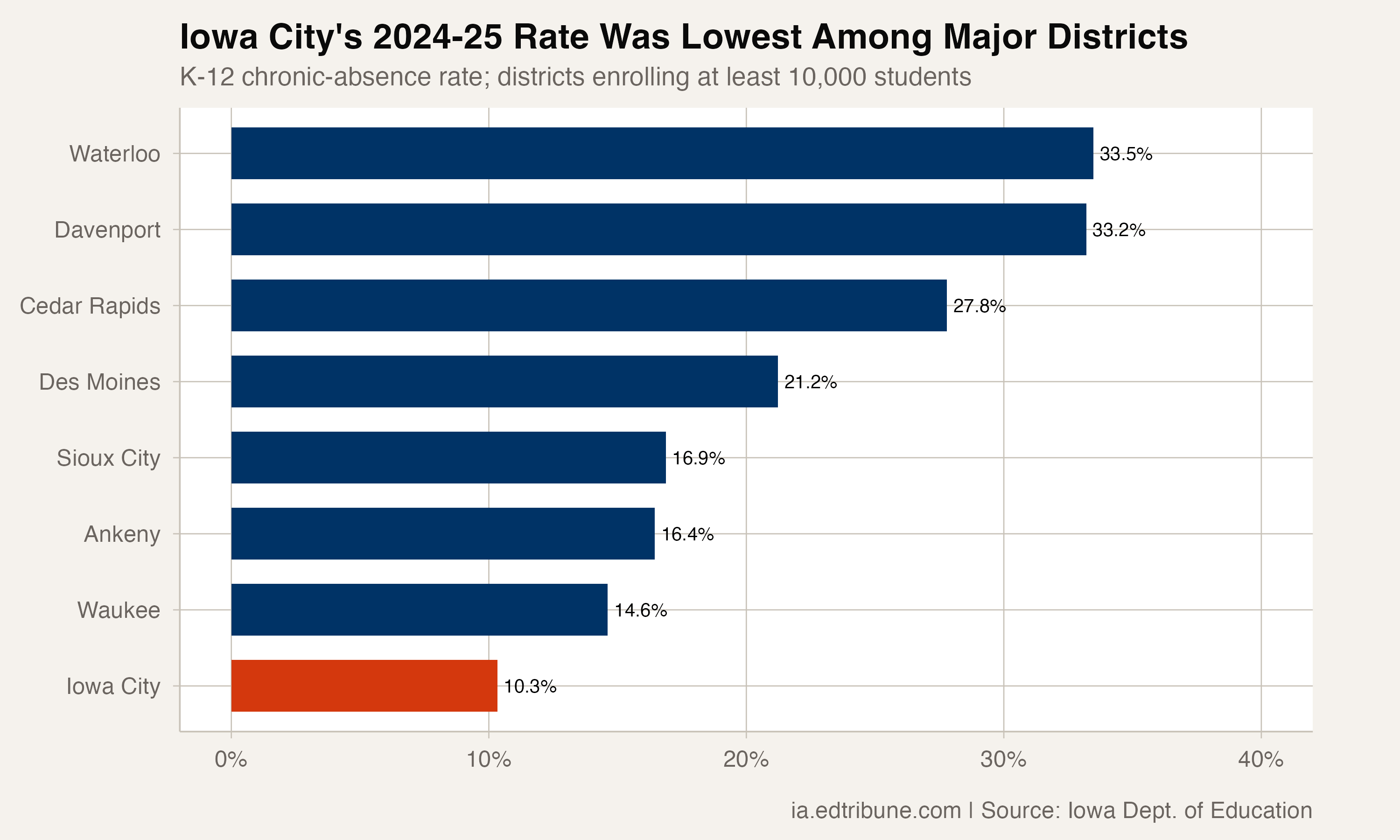
In an enrollment-based comparison with Iowa's larger districts, Iowa City had the lowest 2024-25 chronic-absence rate. It ranked third by enrollment in that group.
Two years of faster improvement
The largest improvement came in two consecutive school years. In 2023-24, Iowa City's rate fell from 27.9% to 19.9%, an 8.0-point improvement. In 2024-25, it fell another 9.6 points, to 10.3%.
Across those two years, the rate fell 17.6 points and the number of chronically absent students fell from 4,211 to 1,543. The second annual improvement was larger than the first, so the recovery accelerated across the two published transitions.
Iowa City moved below the state
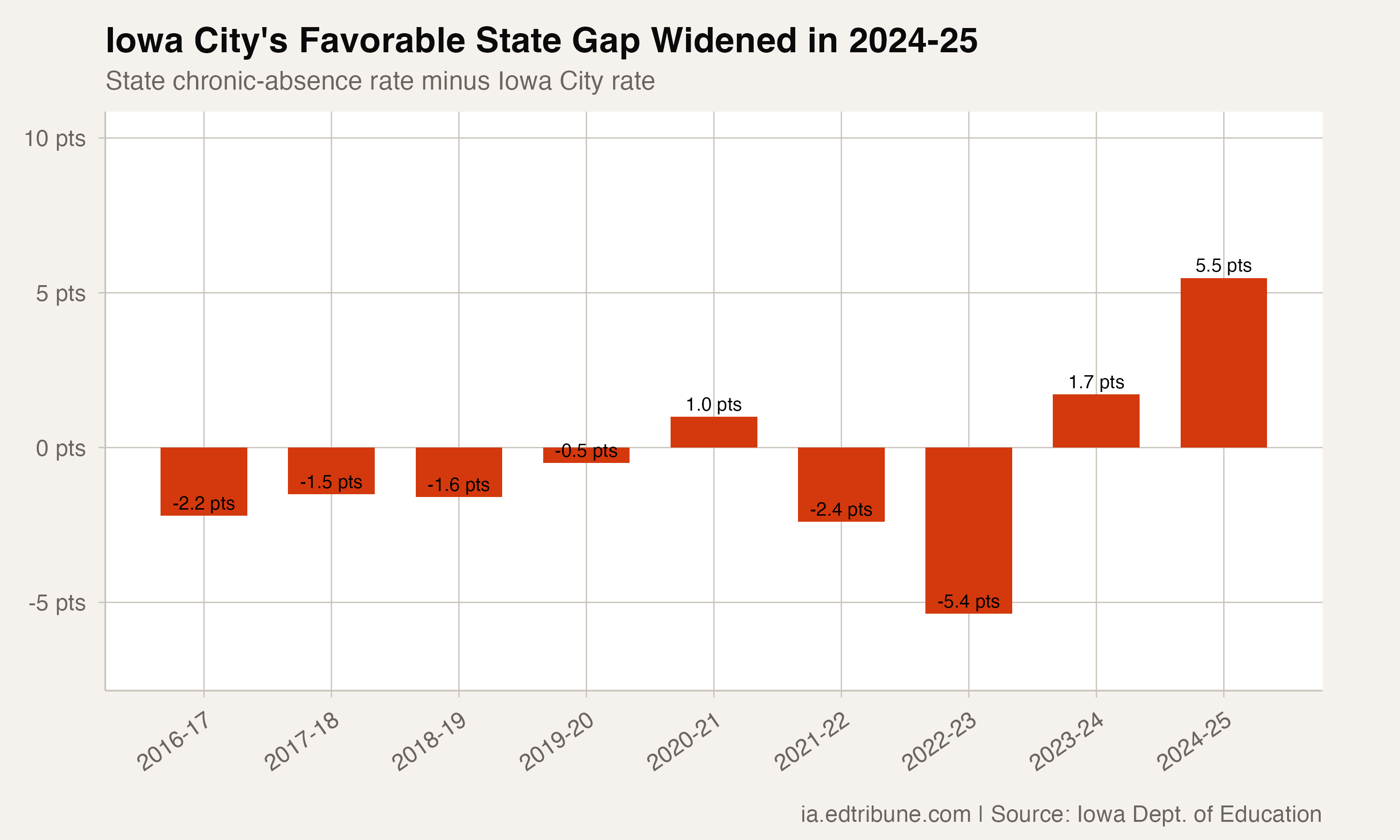
Iowa City's 2024-25 rate was 5.5 percentage points below the statewide rate of 15.8%. That was the widest Iowa City advantage in the nine-year 2016-17 through 2024-25 series.
Iowa City's enrollment changed from 14,603 in 2018-19 to 14,933 in 2024-25, a 2.3% increase. Over the same years, Des Moines Independent Community School District's enrollment fell 12.5%, from 33,944 to 29,703. Those enrollment totals provide context for the rate comparison, but the attendance data do not identify what caused Iowa City's improvement.
What changed inside the district
Kristin Pedersen, executive director of community relations for the district, answered written questions about the decline. Asked what accounts for it, Pedersen pointed to work inside individual buildings rather than to a single program.
"The biggest factor has been a consistent, building-level focus on attendance and understanding the individual barriers that may be keeping a student from school," Pedersen wrote, crediting principals, Student & Family Advocates, teachers, counselors and attendance staff who "have been very intentional about identifying attendance concerns early, building relationships with families, and working with them to find solutions."
Day to day, by Pedersen's account, that meant close monitoring and then direct contact with families. "Much of the work happens one student and one family at a time," Pedersen wrote. "Our schools monitor attendance closely so they can identify patterns early rather than waiting until they become significant concerns." No single fix applies across cases. "There isn't one solution that works for every student. Sometimes the barrier is transportation, sometimes it is health-related, sometimes there are family circumstances, and sometimes a student may simply need a stronger connection to school," Pedersen wrote.
Because the second year's improvement was the larger of the two, we asked whether any part of the drop was a matter of how absences are recorded and coded rather than students being in school more. Pedersen wrote that the district has "certainly worked to make sure our attendance practices and reporting are consistent with changes in state law and guidance, but we would not attribute this improvement simply to changes in coding or recordkeeping." New state attendance requirements "have also brought additional attention and structure to this work, but ICCSD's focus on improving attendance began before those requirements took effect," Pedersen wrote, and "the decline in chronic absenteeism reflects more students attending school more consistently."
Pedersen closed on the students. "Ultimately, though, the most important part of this story is that more of our students are in school," Pedersen wrote. "Our families and students deserve a lot of credit for that as well."
The Iowa Department of Education publishes the district-level chronic-absence data used here. The Iowa Department of Education does not provide an intervention field in the published data, so the district's account of what changed cannot be tested against these figures. What the published data establish is the size and the timing of the decline.
The IAEdTribune is an independent publication and is not affiliated with the Iowa Department of Education.
Have a tip or feedback? Contact us at theedtribune@gmail.com.
Detailed code that reproduces the analysis and figures in this article is available exclusively to EdTribune subscribers.
Discussion
Sign in to join the discussion.
Loading comments...